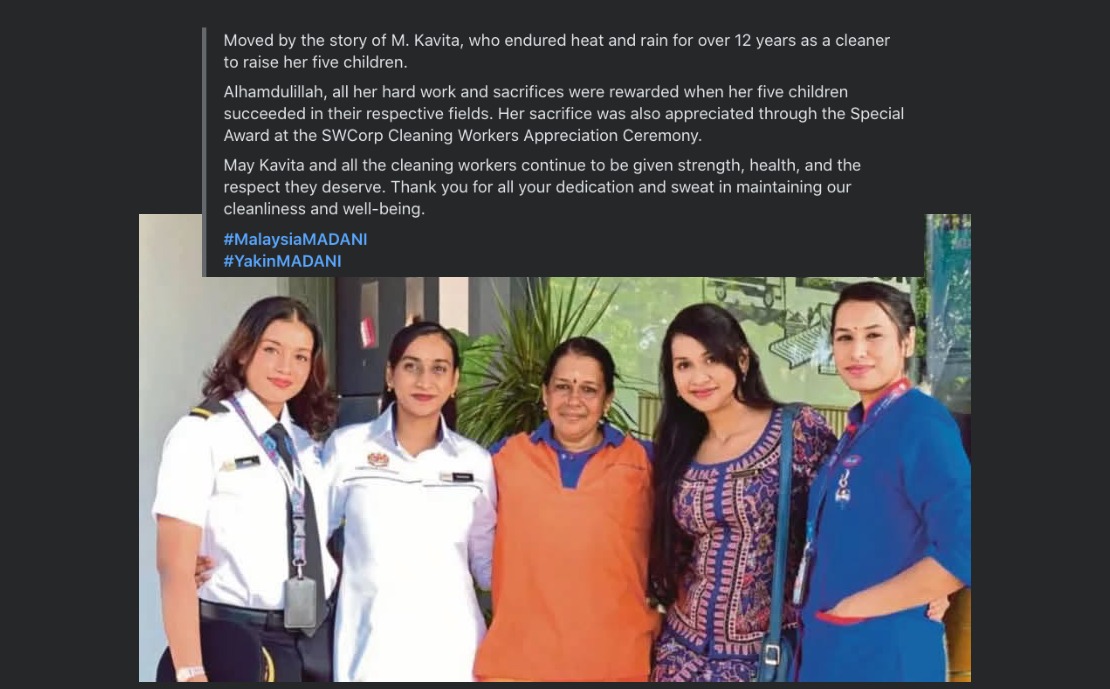
Prime Minister Datuk Seri Anwar Ibrahim has publicly lauded the extraordinary determination of street sweeper M. Kavita, whose two-decade commitment to her family whilst maintaining her duties in Malaysia's sanitation sector has emerged as an inspiring example of parental sacrifice and resilience. Speaking through a Facebook message, the Prime Minister reflected on how Kavita's unwavering work ethic—demonstrated through years of labour regardless of weather conditions—ultimately enabled all five of her children to achieve professional success across diverse career paths.
Kavita's story first captured national attention when her achievements received formal recognition at the SWCorp Cleaning Workers' Day Appreciation ceremony, where she was presented with a Special Award acknowledging her contributions to both the sanitation workforce and her family. An SWM Environment employee based in Seremban, Kavita represents a significant portion of Malaysia's essential services workforce whose labour underpins public health and urban cleanliness yet remains comparatively undervalued in public discourse.
The narrative took on additional emotional weight when social media amplified a heartwarming birthday celebration from the previous month. As Kavita went about her regular work duties, her four daughters orchestrated a surprise gathering to commemorate her 50th milestone. What transformed this modest family moment into a touching viral sensation was the deliberate symbolism embedded within the celebration—each daughter arrived wearing the professional uniforms of her respective career, presenting a visual representation of her accomplishments.
The uniforms displayed represented a cross-section of Malaysia's professional sectors: one daughter had pursued aviation as a pilot, another had established herself within the airline industry as cabin crew, whilst a third had chosen healthcare, working as a staff nurse. These career trajectories span technical, service, and medical industries, suggesting Kavita's influence extended beyond mere financial provision to encompassing broader guidance regarding educational aspiration and professional development. The emotional climax of the gathering came when Kavita's reaction to this coordinated display of her daughters' achievements proved so overwhelming that she wept with joy.
In his formal acknowledgment, Anwar emphasised the magnitude of Kavita's dual achievement—maintaining employment within the sanitation sector whilst simultaneously navigating the financial and emotional demands of single-handedly parenting five children to professional maturity. His message specifically highlighted that the tangible success of all five children vindicated the immense personal investment Kavita had made across more than twelve years. This public endorsement carries particular significance given Malaysia's ongoing discussions regarding social mobility, educational equity, and the circumstances that enable disadvantaged families to transcend economic constraints.
The Prime Minister's tribute extended beyond individual recognition to encompass broader validation of the sanitation workforce collectively. Anwar explicitly called for continued blessing upon both Kavita and all fellow street sweepers and cleaning workers, invoking themes of sustained strength, health preservation, and—significantly—the respect that this essential workforce fundamentally deserves within Malaysian society. This framing subtly addresses persistent societal attitudes that frequently marginalise workers in sanitation and manual labour despite their indispensable role in maintaining public infrastructure and community wellbeing.
Kavita's narrative also illuminates economic realities facing Malaysian households in lower-income brackets. Her sustained employment through extended weather conditions and the demanding physical requirements of street sweeping whilst simultaneously securing her children's educational advancement demonstrates the intersection of individual determination with systemic challenges. The successful outcomes achieved by her five children suggest that educational opportunity remains accessible to motivated families, yet Kavita's prominent media coverage also underscores how exceptional such achievement remains rather than representing the norm across comparable socioeconomic circumstances.
The timing of public recognition through both the SWCorp award and the Prime Minister's endorsement reflects evolving governmental acknowledgment of service sector workers' contributions. Malaysia's sanitation workforce—comprising both formal SWM Environment employees and contract workers—has gained increased visibility particularly following the pandemic period, when essential worker designation highlighted their critical role in maintaining public health infrastructure. Kavita's profile exemplifies this shifting perception, positioning sanitation work not as a dead-end occupation but as a legitimate career sustaining families and enabling broader life achievements.
For Malaysian readers, particularly those managing household economics in similar circumstances, Kavita's accomplishment offers both aspirational inspiration and practical documentation that educational advancement remains feasible despite constrained financial resources. Her children's professional diversity suggests that parental commitment can facilitate multiple pathways toward stability and advancement. Simultaneously, her story validates the essential nature of work frequently rendered invisible within discussions of national economic achievement—the foundational labour that maintains urban spaces and public health standards.
Anwar's public recognition represents a deliberate political and social messaging choice, positioning the government as acknowledging service sector contributions whilst promoting narratives of social mobility and opportunity. For the broader Southeast Asian context, particularly as regional nations grapple with economic mobility questions and service sector worker visibility, Kavita's profile demonstrates how individual resilience intersects with family structure and educational access to produce measurable outcomes. Her journey—from sustained sanitation work to witnessing her children's professional establishment—encapsulates the possibility of transgenerational advancement whilst simultaneously highlighting the extraordinary personal sacrifice such achievement typically requires from families operating within economic constraints.

