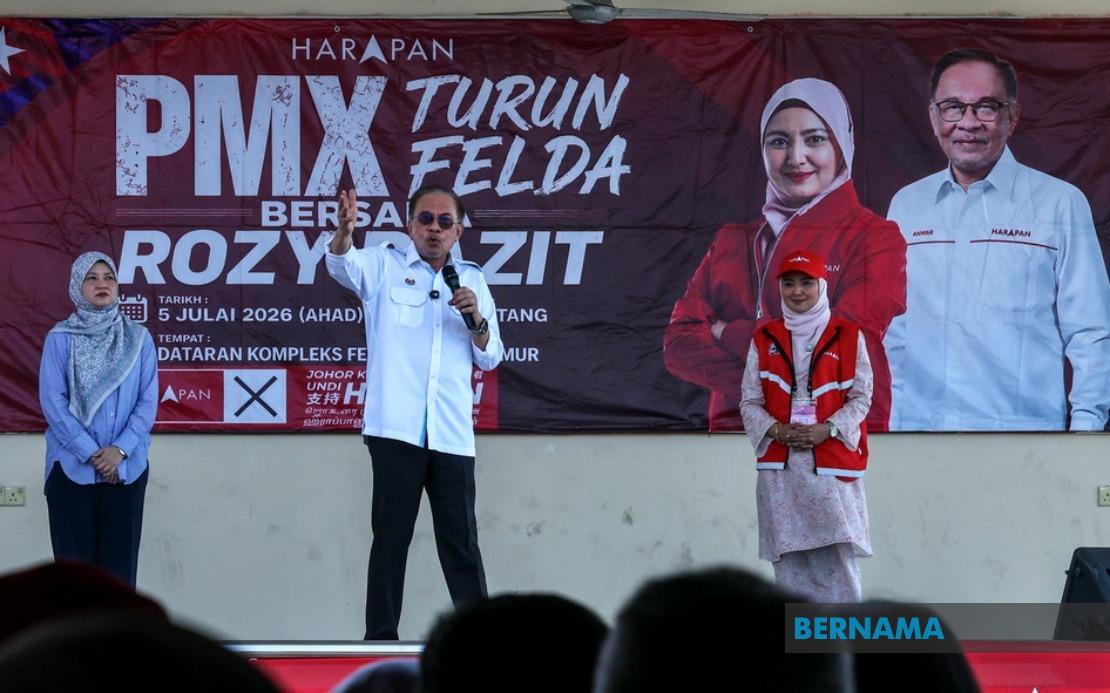
Prime Minister Datuk Seri Anwar Ibrahim has thrown his weight behind efforts to resolve a pressing housing crisis affecting the second generation of FELDA settlers, making a public pledge during a community engagement session in Segamat today. The issue, which has festered for decades without concrete resolution, represents one of the most persistent grievances within Malaysia's Federal Land Development Authority communities, where younger settlers struggle to secure housing sites promised by their parents' pioneering settlement agreements.
Addressing residents at Dataran Putra FELDA Palong Timur in the Buloh Kasap constituency, Anwar outlined his administration's policy position: establishing definitive protections and guarantees for housing allocations to ensure second-generation settlers receive the same foundational security their parents enjoyed when joining FELDA schemes. This framing signals a shift toward viewing the issue as a matter of intergenerational equity rather than a budgetary constraint, potentially opening pathways for accelerated implementation compared to previous administrations' halting progress.
The Prime Minister's statement carries particular significance given the political weight of FELDA communities across Malaysia's heartland. These settlements, concentrated heavily in states like Johor, Pahang, and Perak, represent crucial voting blocs that have historically determined electoral outcomes in rural constituencies. By publicly committing to resolution, Anwar is placing his personal credibility on the line while simultaneously signalling to coalition partners and party members that FELDA welfare remains a government priority despite competing fiscal demands.
However, Anwar's remarks also contained a candid acknowledgment of institutional constraints that have historically stymied progress on this file. Land administration and the provision of basic infrastructure—two foundational requirements for establishing new housing sites—fall under state government jurisdiction according to Malaysia's federal-state constitutional allocation. This reality means that even with clear political will at the federal level, implementation hinges on securing cooperation from state governments controlled by various political parties, some of whom may view FELDA development differently or prioritise competing projects.
The delegation accompanying Anwar at the Segamat event underscored the multi-agency approach required to untangle this longstanding problem. Selangor Menteri Besar Datuk Seri Amirudin Shari, who also serves as PKR vice-president, represented state-level coordination capacity. Education Minister Fadhlina Sidek's presence suggested consideration of broader community development elements beyond housing alone. Deputy National Unity Minister R. Yuneswaran, who represents Segamat as the local MP, provided direct parliamentary linkage to bring constituent concerns into legislative chambers.
For second-generation FELDA settlers, the promise carries both hope and echoes of previous unfulfilled assurances. Many younger members of these communities have deferred major life decisions—marriage, business investment, family expansion—while waiting for housing certainty that never materialised under previous administrations. The financial burden of purchasing land and constructing homes independently, without the subsidised pathways available to their parents, has effectively locked many out of property ownership despite deep family ties to FELDA schemes and communities.
The structural complexity underlying this issue reflects broader tensions in Malaysia's development model. First-generation FELDA settlers received heavily subsidised land and infrastructure as part of state-sponsored rural development initiatives designed to transform smallholding agriculture. However, no equivalent mechanism was embedded to support their descendants, who grew up expecting similar security but found themselves navigating increasingly expensive urban and semi-urban land markets without the same institutional support apparatus.
Anwar's specific statement that he wants "issues affecting the second generation...to be settled while I am Prime Minister" introduces a temporal dimension that observers will scrutinise closely. Rather than deferring action to successor administrations or committee studies, the Prime Minister has invited accountability against his own tenure, suggesting either genuine conviction or strategic political calculation that resolution is achievable within a reasonable timeframe. Implementation will likely become a metric by which his government's effectiveness on rural welfare issues is measured.
The cooperation requirement Anwar emphasised also hints at anticipated negotiations with state governments, particularly those controlled by opposition parties where FELDA constituencies exist. This cross-party coordination challenge mirrors similar infrastructure and development initiatives requiring federal-state alignment, demonstrating how Malaysia's constitutional structure can either facilitate or obstruct policy implementation depending on political alignment at different governance levels.
Malaysian policymakers recognise that FELDA communities represent a distinct demographic with particular vulnerabilities in an economy increasingly dominated by services and high-skill industries. The housing issue functions as a proxy for broader questions about whether state-sponsored rural development can sustainably support multi-generational settlement or whether new models must emerge to keep second and third-generation settlers engaged with their communities rather than forcing urban migration.
The implications extend beyond FELDA alone. Similar intergenerational equity gaps exist across Malaysia's landscape of state-sponsored rural schemes, indigenous settlements, and regionally disadvantaged communities. How the government navigates the FELDA housing challenge will establish precedents and resource-allocation patterns affecting multiple constituencies and programmes throughout rural Malaysia.

