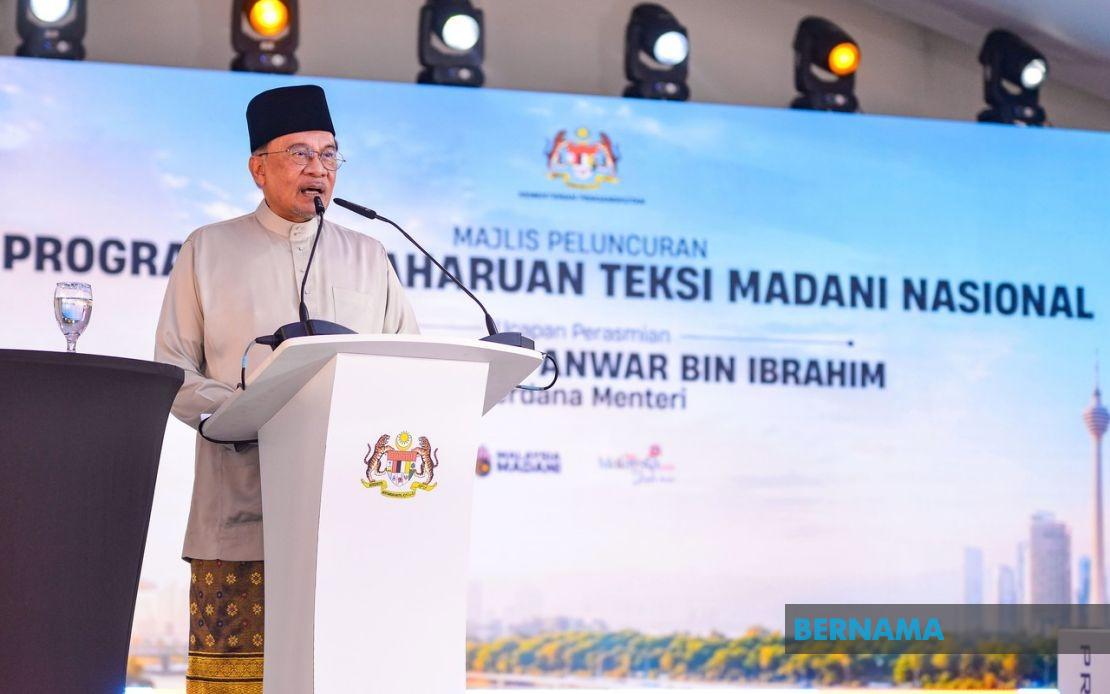
Prime Minister Datuk Seri Anwar Ibrahim has committed an additional RM10 million to accelerate the replacement of ageing taxis across Malaysia, signalling the government's determination to modernise the country's transportation sector. The supplementary allocation came on the heels of strong uptake for the initial RM10 million committed under the National MADANI Taxi Reform Programme in Budget 2026, suggesting widespread demand among taxi operators for vehicle upgrade assistance.
Anwar, who holds the dual portfolio of Prime Minister and Finance Minister, unveiled the funding boost at the formal launch of the National MADANI Taxi Reform Programme at Dataran Merdeka. His decision to fast-track additional resources reflects not merely a response to market interest, but a deeper policy conviction that revitalising Malaysia's taxi fleet carries significant implications for urban mobility, employment, and the broader service economy. The taxi industry, employing hundreds of thousands across the nation and serving millions of commuters daily, has long struggled with ageing vehicle fleets that undermine service quality and driver livelihoods.
Crucially, the government has engineered a partnership with automaker Proton and the Transport Ministry to establish a bespoke financing mechanism that would allow taxi operators to purchase the Proton S70 model on manageable terms. This development represents a strategic convergence of industrial policy and transport reform, potentially boosting domestic automotive sales while simultaneously providing drivers with affordable access to newer vehicles. The S70, positioned as a mid-range sedan, offers reasonable fuel efficiency and reliability—attributes particularly valued by taxi operators operating on thin margins.
The matching grant structure itself merits scrutiny, as such schemes typically require drivers to contribute a portion of replacement costs themselves, creating a shared investment model. This approach encourages genuine commitment from operators while stretching government resources across a larger cohort. For drivers operating in saturated urban markets or struggling with declining revenue from competition by ride-hailing platforms, even a RM10 million top-up remains modest relative to the scale of Malaysia's taxi ecosystem, yet it represents meaningful relief for those able to access the programme.
Transport Minister Anthony Loke's presence at the launch underscores interagency coordination on the initiative. The Transport Ministry holds regulatory authority over taxi operations, vehicle standards, and licensing—functions essential for ensuring any replacement scheme aligns with broader modernisation objectives. Such cooperation between the Finance and Transport portfolios signals institutional alignment that has occasionally been absent in Malaysia's policymaking apparatus, where departmental silos can impede holistic sectoral reform.
The participation of Minister in the Prime Minister's Department (Federal Territories) Hannah Yeoh and Chief Secretary to the Government Tan Sri Shamsul Azri Abu Bakar further elevates the programme's profile within the administrative hierarchy. Their attendance suggests the initiative enjoys high-level bureaucratic support and reflects acknowledgment that taxi reform touches multiple governance domains—from urban planning and congestion management to social protection of workers in the informal economy.
For Malaysian taxi drivers, particularly those operating independent vehicles or through smaller cooperatives, the timing of this announcement carries weight. Many have endured years of stagnant earnings amid rising operational costs and the disruptive entry of technology-enabled ride-sharing competitors. A vehicle replacement grant, especially when coupled with preferential financing terms, offers a pathway to reduce maintenance expenditures and improve vehicle reliability, thereby enhancing both safety and earning potential. However, the effectiveness of such schemes ultimately depends on implementation efficiency, equitable distribution mechanisms, and clarity around application procedures.
The decision also reflects broader government priorities articulated through the MADANI framework, which emphasises raising living standards for workers and strengthening domestic industries. By channelling funds toward taxi fleet renewal while simultaneously supporting Proton's sales volumes, the government pursues dual objectives: supporting a vulnerable occupational sector while nurturing local manufacturing capacity. This integrated approach distinguishes it from piecemeal assistance that might benefit drivers without generating concurrent economic stimulus.
Regionally, Malaysia's taxi modernisation efforts warrant attention from neighbouring Southeast Asian economies grappling with similar transportation challenges. Countries across ASEAN have wrestled with how to integrate informal taxi services with formal public transport networks while ensuring driver incomes remain viable in an era of digital disruption. Malaysia's combination of direct grants, targeted financing partnerships, and ministerial coordination offers a case study in active state engagement with transport sector restructuring.
Looking ahead, the success of this expanded allocation depends on several factors: the uptake rate among eligible drivers, the actual terms of Proton's financing scheme, and whether subsequent budgets maintain momentum. Should the RM20 million combined outlay prove insufficient relative to the scale of vehicles requiring replacement across Malaysia's estimated 60,000-plus taxi fleet, pressure will mount for further allocations. Conversely, if implementation bottlenecks emerge—such as cumbersome application processes or insufficient dealer participation—even generous funding may fail to achieve desired transformation.
The announcement also carries implications for Malaysia's sustainability objectives, as newer vehicles typically produce lower emissions and consume fuel more efficiently than the ageing fleet they replace. This environmental co-benefit, though not emphasised in official messaging, aligns with international climate commitments and domestic air quality improvement goals, particularly acute in urban centres like Kuala Lumpur and the Klang Valley.
Ultimately, Anwar's decision to nearly double the taxi reform allocation within months of the initial Budget 2026 announcement demonstrates governmental responsiveness to sectoral feedback and confidence in the programme's potential. Whether this commitment translates into tangible improvements in driver welfare and service quality will depend on disciplined execution and sustained political will in subsequent policy cycles.

