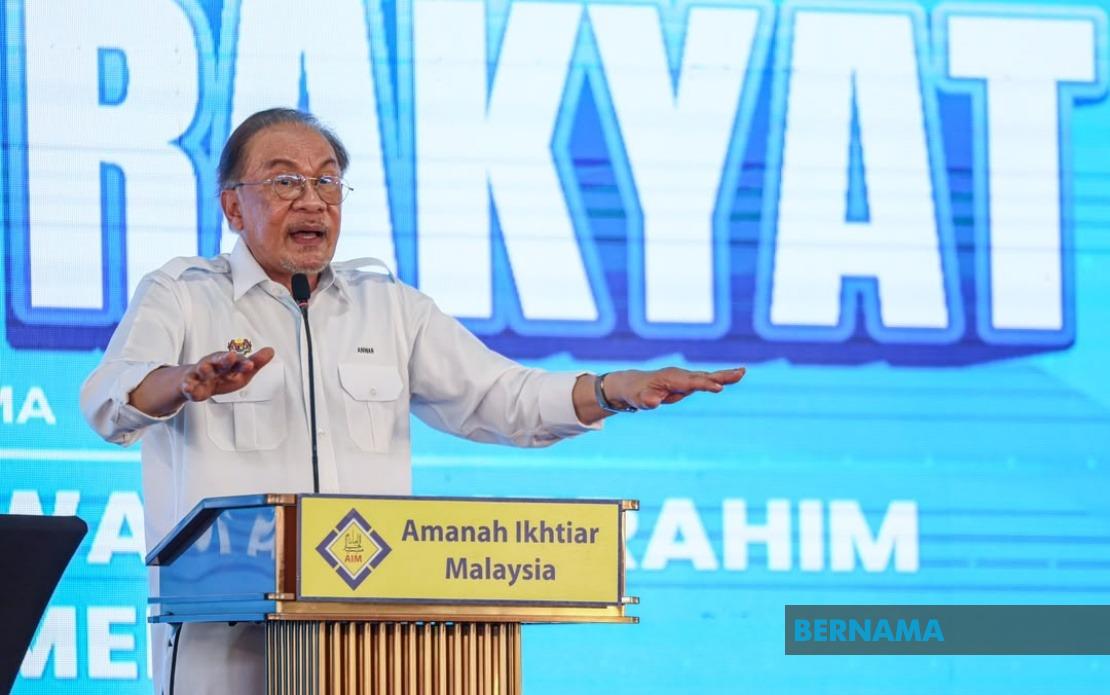
Prime Minister Datuk Seri Anwar Ibrahim has attributed growing political pressure against his administration to its uncompromising approach to fighting corruption and the misuse of public office. Speaking at a campaign event in Batu Pahat during the Johor state election campaign, the Pakatan Harapan chairman argued that rival political parties perceive his government's integrity agenda as a genuine threat to their political interests, which is motivating them to coordinate efforts to dislodge him from power.
Anwar's remarks represent a strategic framing of political opposition as essentially reactive to his anti-corruption record rather than principled disagreement over policy direction. By positioning himself as the target of a coordinated assault because of his commitment to clean governance, he seeks to recast the political contest as a battle between those committed to transparency and accountability versus those with vested interests in preserving corrupt networks. This narrative strategy is particularly potent in Malaysian politics, where public concern about governmental integrity and the use of state resources for personal enrichment remains consistently high among voters.
The Prime Minister emphasised that the MADANI Government refuses to tolerate leaders who divert public funds or exploit their positions for private advancement. His administration views this stance as fundamental to rebuilding public trust in government institutions, which has been severely damaged by high-profile corruption cases in previous years. Anwar stated flatly that his government's operational philosophy centres on preventing elected officials from acquiring land, securing lucrative projects, obtaining shareholdings, or accumulating wealth through their positions of power—a principle he said must be embedded in the political culture.
To substantiate his personal commitment to this principle, Anwar pointed to his own conduct during his tenure as Prime Minister. He disclosed that despite numerous visits to Johor in his official capacity, he has neither acquired land, secured projects, nor obtained shares in the state. This personal example serves as a counter-narrative to any allegations of financial impropriety and attempts to establish him as a credible exemplar of the anti-corruption message he is promoting to voters. The rhetorical move transforms abstract anti-corruption rhetoric into a concrete personal testimony that resonates particularly strongly in campaign settings.
Campaigning in Johor ahead of the state election scheduled for July 11, Anwar called on voters to grant Pakatan Harapan the opportunity to govern the state, framing this as essential for implementing transformative change across multiple policy domains. He identified public welfare improvements and clean governance as the twin pillars of his party's vision for Johor's future. Central to this pitch is the argument that a state government aligned with the federal administration can coordinate development initiatives and welfare programmes far more effectively than an administration operating at odds with Kuala Lumpur.
The Prime Minister acknowledged that Johor has received substantial development investment, with projects valued in the billions of ringgit, yet he contended that fundamental challenges affecting ordinary residents remain inadequately addressed. His diagnosis of persistent dysfunction despite substantial capital expenditure points to governance failures in translating investment into tangible improvements in living standards. He specifically highlighted the affordability crisis in housing, the deteriorating state of road infrastructure, and the inadequacy of facilities including mosques, surau, and places of worship. Additionally, he noted insufficient assistance programmes reaching vulnerable populations, suggesting these shortcomings reflect misaligned priorities or poor execution by the current state administration.
Anwar articulated a vision of inclusive development that explicitly rejects the concentration of wealth among a privileged minority. His assertion that Johor, as a comparatively wealthy state, should not tolerate a situation where only a small elite prospers while the majority struggles represents a social compact argument pitched to lower-income and middle-class voters. This framing appeals to distributive justice concerns and suggests that Pakatan Harapan would prioritise broader-based wealth distribution rather than maintaining patronage networks that enrich connected elites.
Addressing a persistent source of political tension in Malaysia's plural society, Anwar mounted a vigorous defence of Pakatan Harapan's partnership with the Democratic Action Party (DAP). He asserted that throughout his three-and-a-half-year tenure as Prime Minister, DAP representatives serving in his Cabinet have never opposed any government initiatives benefiting ethnic Malays or advancing Islamic interests. This claim directly challenges opposition narratives portraying DAP as a threat to Malay-Muslim concerns and seeks to establish that multiethnic coalition governance does not require compromising on issues central to the Malay-Muslim majority. The empirical claim that no Cabinet minister from DAP has voiced opposition to such programmes invites scrutiny but serves his immediate political objective of reassuring Malay-Muslim voters about the safety of supporting a coalition that includes DAP.
The campaign event itself generated considerable enthusiasm among Pakatan Harapan supporters, with substantial crowds gathering in the Senggarang state constituency despite intense heat. Anwar characterised the turnout as extraordinary and noted that voters waited in scorching conditions to attend his address, describing the energy as remarkable even by his extensive experience conducting public speeches. He leveraged this visible support to underscore the momentum behind his coalition's Johor campaign and called explicitly for voters in Senggarang, Rengit, and Penggaram constituencies to translate their enthusiasm into electoral support for Pakatan Harapan candidates.
The Johor state election represents a significant political contest, with 172 candidates competing across 56 state seats. The timing of this election carries implications beyond Johor itself, as success or failure could reshape the political momentum heading into any potential federal elections. Early voting was scheduled for July 7, with main polling day set for July 11. For Pakatan Harapan, this election presents an opportunity to extend its control beyond federal government into a major state administration, which would enhance its capacity to implement integrated governance across multiple policy domains and demonstrate to voters that multiethnic coalition governance can deliver concrete improvements in living standards and institutional integrity.

