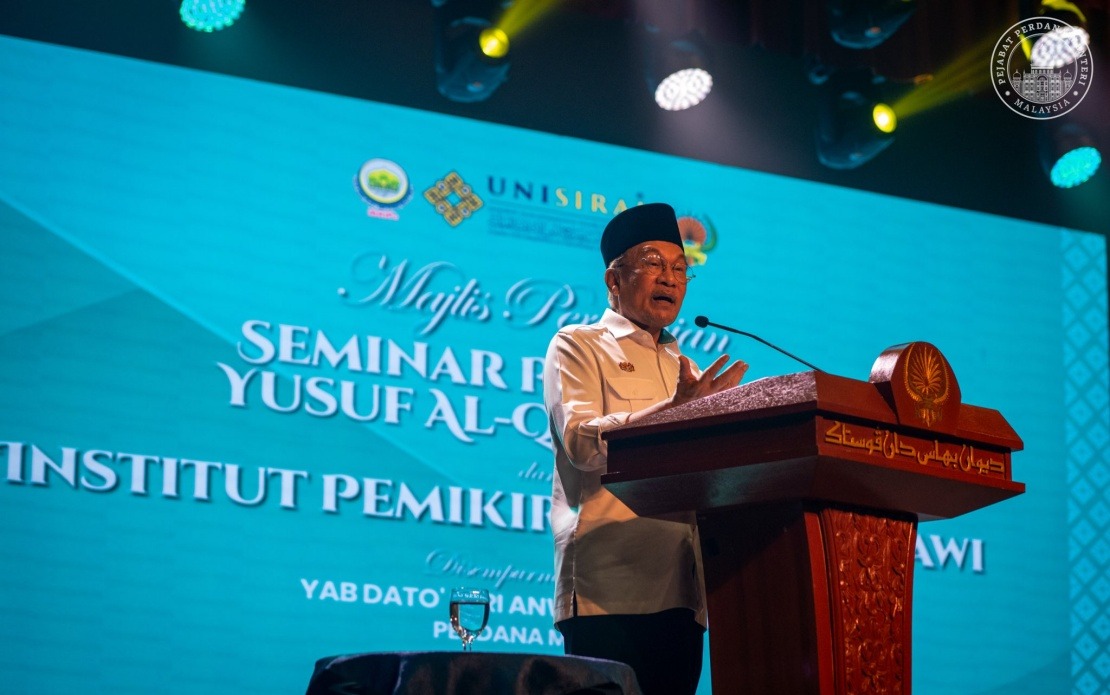
Prime Minister Datuk Seri Anwar Ibrahim has pledged RM2 million in MADANI Government funding towards the Al-Qaradawi Thought Institute, underscoring the administration's investment in advancing Islamic scholarship and research centred on the life and contributions of the renowned Islamic scholar Sheikh Dr Yusuf Al-Qaradawi. The announcement came during the inaugural Yusuf Al-Qaradawi Thought Seminar and formal opening of the institute at Wisma Dewan Bahasa dan Pustaka in Kuala Lumpur on July 21, signalling the government's commitment to preserving and promoting the intellectual heritage of one of modern Islam's most influential figures.
Anwar's personal connection to Al-Qaradawi runs deep, shaped by decades of intellectual exchange and shared ideological convictions. In remarks posted on social media, the Prime Minister articulated his profound debt to the scholar across multiple dimensions—whether stemming from foundational ideas, moral guidance, or the bonds of genuine friendship cultivated through years of meaningful engagement. This disclosure reflects more than ceremonial tribute; it demonstrates how Al-Qaradawi's philosophical framework has fundamentally shaped the trajectory of Malaysian Islamic leadership, particularly among those who came of age during Islam's resurgence in the latter twentieth century.
The genesis of their relationship traces back to Anwar's formative years as an active member of the Malaysian Islamic Youth Movement, known as ABIM, during a transformative period for Islamic activism in Malaysia. As a young firebrand within ABIM's leadership circles, Anwar encountered Al-Qaradawi's thought at a crucial juncture when Islamic movements across the Muslim world were grappling with fundamental questions about strategy, theology, and engagement with modernity. This intersection of youthful idealism and intellectual mentorship would leave an indelible mark on Anwar's evolving worldview and subsequent political philosophy.
Al-Qaradawi occupied a singular position within twentieth-century Islamic thought as a transformative force, a figure Anwar characterises as embodying the zeitgeist—the spirit and motive energy of an age. Beyond mere scholarship, Al-Qaradawi represented a particular approach to Islamic interpretation that synthesised respect for classical tradition with openness to contemporary realities. His career demonstrated that Islamic revival need not entail wholesale rejection of modern knowledge systems or defensive closure against intellectual pluralism. Instead, he modelled an approach to religious scholarship that embraced reformation, recognised the legitimacy of diverse viewpoints, and sought constructive engagement with the challenges posed by rapid social change.
The pivotal moment in their relationship crystallised during the early 1980s, when Islamic resurgence movements were experiencing explosive growth throughout Southeast Asia and the broader Muslim world. During this period of ideological ferment, Al-Qaradawi transmitted a formal treatise to ABIM's leadership that would prove transformative for the movement's trajectory. This document represented far more than routine scholarly correspondence; it constituted strategic guidance at a critical inflection point. Al-Qaradawi's central counsel urged ABIM to resist the gravitational pull toward doctrinal rigidity and instead embrace wasatiyyah—the principle of moderation and balance that privileges the middle path between theological extremism and excessive accommodation to secular frameworks.
Anwar reflects that this intervention arrived at precisely the moment when ABIM confronted mounting pressure from competing currents within global Islamic discourse. Fervent ideological enthusiasm, while energising grassroots participation, risked hardening into positions hostile to dialogue and intellectual exchange. Al-Qaradawi's emphasis on wasatiyyah offered a counterbalance, redirecting youthful passion toward purposeful reform grounded in principled flexibility rather than dogmatic confrontation. The guidance proved consequential for ABIM's evolution and, by extension, for Anwar's own intellectual and political development, steering him toward a vision of Islamic governance that remains receptive to competing perspectives while maintaining clear ethical principles.
The establishment of the Al-Qaradawi Thought Institute, now backed by substantial government resources, institutionalises this philosophical legacy within Malaysia's intellectual infrastructure. The institute's mandate encompasses research, documentation, and dissemination of scholarship relating to Al-Qaradawi's contributions across Islamic jurisprudence, ethics, social thought, and contemporary Islamic responses to globalisation. For Malaysian academic and religious circles, the institute promises to serve as a repository of knowledge and a platform for advancing discussion about how Islamic civilisation engages with modernity without sacrificing its spiritual and ethical foundations.
The government's financial commitment carries implications beyond academic preservation. By channelling RM2 million toward institutionalising Al-Qaradawi's thought, the MADANI administration signals its official alignment with a particular vision of Islamic governance—one that privileges moderation, intellectual pluralism, and pragmatic reform. This positioning reflects Anwar's broader political philosophy, which has consistently emphasised reconciliation between Islamic principles and democratic governance, between religious conviction and respect for minority rights, and between tradition and innovation.
For Southeast Asian observers, the institute's establishment and generous funding underscore Malaysia's role as an incubator of Islamic thought that bridges the classical and contemporary. Al-Qaradawi, though Egyptian-born, maintained extensive connections throughout Southeast Asia and influenced Islamic movements across the region. His emphasis on contextual interpretation of Islamic law, his engagement with questions of religious pluralism, and his insistence that moderation represents strength rather than weakness resonate throughout Muslim-majority nations grappling with integration of religious identity and modern governance.
The broader significance of this development extends to how Muslim societies approach the question of their relationship with Western-origin institutions and ideas. Al-Qaradawi rejected both wholesale Westernisation and defensive Islamic isolationism, instead advocating selective engagement where Muslim communities critically assessed external inputs against Islamic principles before determining adoption. This framework has influenced how Southeast Asian nations balance economic globalisation with cultural preservation, how they navigate religious diversity in pluralistic societies, and how they construct educational systems serving both religious and secular aspirations.
Anwar's articulation of personal indebtedness to Al-Qaradawi, coupled with the government's substantial financial commitment, effectively canonises the late scholar's influence within Malaysian state structures. The Prime Minister's invocation of the seminar and institute opening as occasions for reflection on Al-Qaradawi's legacy invites broader reconsideration of what Islamic modernity might encompass—not as compromise or dilution of religious conviction, but as sophisticated engagement with contemporary complexities through resources provided by Islamic intellectual tradition itself.

