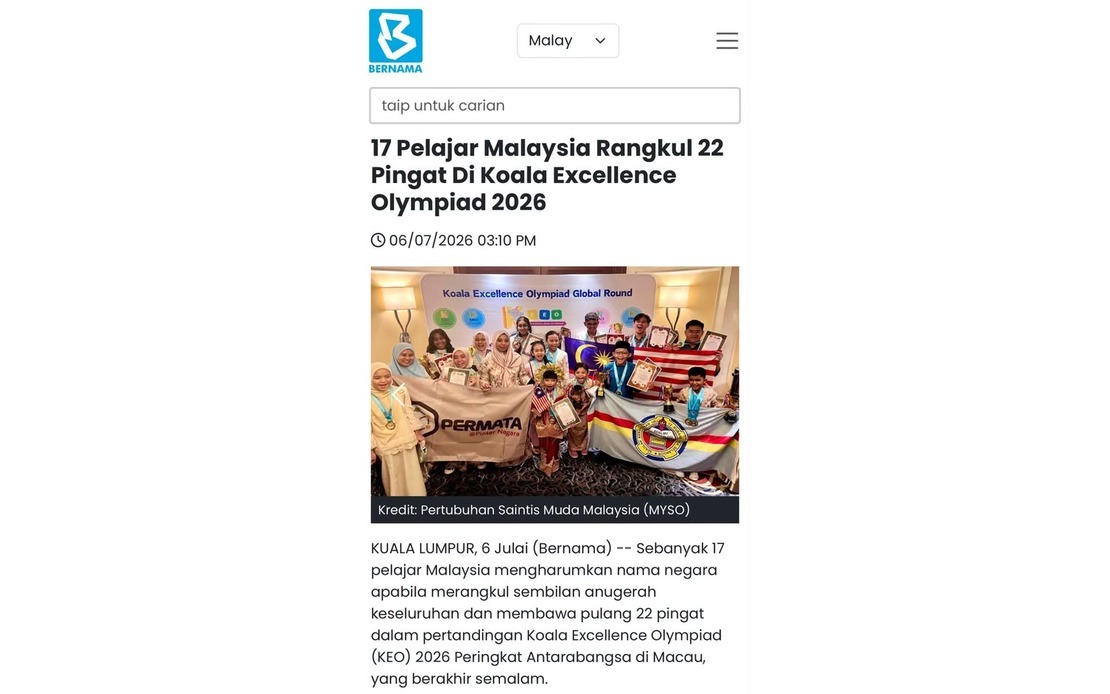
Prime Minister Datuk Seri Anwar Ibrahim has extended his congratulations to a delegation of 17 Malaysian students who demonstrated strong academic prowess at the 2016 Koala Excellence Olympiad (KEO) Global Finals held in Macau, with the competition concluding recently. The Malaysian contingent's performance yielded nine overall awards alongside 22 individual medals, marking a respectable achievement in a competitive international setting that drew young scholars from across the globe. Through a social media post, the Prime Minister urged the accomplished students to maintain their commitment to excellence and aspire toward even more substantial accomplishments in their academic journeys.
The medal haul comprised five gold, six silver, and 11 bronze medals, according to Aidah Misran, coordinator of the Malaysia Young Scientists Organisation (MYSO) and head of the Malaysian delegation that travelled to the Macau venue. This breakdown demonstrates consistent performance across the competition's various categories, reflecting the depth of talent within Malaysia's student community and the effectiveness of domestic preparation efforts. The diversity of medal distributions suggests that Malaysian participants competed credibly not only in their strongest disciplines but also achieved notable results across multiple fields of study.
The KEO platform represents a significant opportunity for emerging scholars to test their capabilities against international counterparts. Established by a collective of Australian educational experts and graduates, the competition encompasses four core subject areas: English, Mathematics, Science, and Arts Olympiads. This multi-disciplinary approach distinguishes KEO from single-subject competitions, requiring participants to demonstrate well-rounded academic abilities rather than excellence confined to narrow specialisations. For Malaysian students, such exposure provides valuable benchmarking against global standards and cultivates competitive spirit essential for future academic and professional pursuits.
The organisation of Malaysia's participation in KEO reflects collaborative efforts between multiple stakeholders committed to fostering youth excellence. MYSO, in partnership with KEO and the Miss Man International Group, coordinated the Malaysian team's selection, training, and representation at the global finals. This institutional support network underscores Malaysia's growing investment in developing intellectual capital among younger generations, an imperative for sustaining the nation's competitive advantage in an increasingly knowledge-intensive global economy.
Engagement in international academic competitions carries implications beyond immediate medal counts. Such platforms expose Malaysian students to diverse problem-solving methodologies, cultural perspectives on learning, and networks with peers from different educational systems worldwide. These intangible benefits often prove more valuable than tangible awards, particularly for students considering further studies or careers in globalised professional environments where cross-cultural competence and international exposure become increasingly prized assets.
The breadth of subjects covered in the KEO competition—spanning humanities, quantitative disciplines, and scientific inquiry—aligns with contemporary educational philosophy emphasising balanced intellectual development. Malaysian participation demonstrates commitment to nurturing competency across these domains rather than narrowly concentrating resources on any single field. This holistic approach benefits individual participants by building cognitive flexibility while contributing to a more versatile national talent pool capable of addressing complex societal challenges requiring multidisciplinary perspectives.
Governmental recognition of such achievements, as demonstrated through the Prime Minister's public acknowledgment, carries cultural significance beyond ceremonial courtesy. Official commendation signals to families, educational institutions, and broader society that excellence in academic competition receives state-level validation and encouragement. Such recognition mechanisms reinforce social values prioritising intellectual achievement and signal to other potential competitors that their participation and success will be acknowledged and celebrated at the highest levels of governance.
For Malaysia's education sector, international competition results provide quantifiable indicators of system performance relative to global benchmarks. Consistent success in platforms like KEO contributes to perceptions of educational quality both domestically and internationally, with implications for the nation's reputation as a destination for quality learning. Strong showings can enhance Malaysia's attractiveness to international students, educators, and educational institutions considering partnerships or expansion into the Malaysian market.
The timing and consistency of such achievements across multiple international competitions suggest that Malaysian educational institutions have developed effective systems for identifying, nurturing, and preparing talented students for global academic contests. Investment in coaching, curriculum enrichment, and exposure to competition formats evidently yields measurable returns reflected in medal tallies and overall awards. This institutional maturation represents cumulative progress in elevating Malaysian education standards and creating sustainable pipelines for identifying and developing exceptional young talent.

