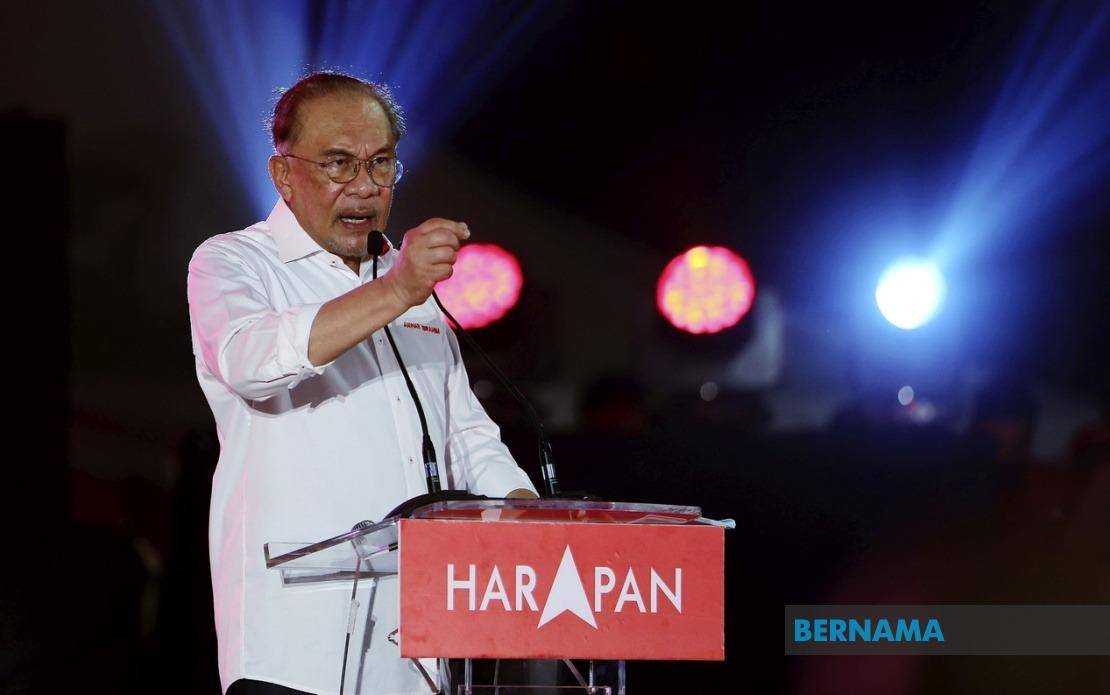
Prime Minister Anwar Ibrahim has drawn a clear line for political discourse in the upcoming Negeri Sembilan state election, cautioning all contesting parties to steer clear of inflammatory rhetoric surrounding the country's royal institutions and constitutional framework. Speaking at Kuala Pilah during Pakatan Harapan's candidate announcement ceremony, Anwar stressed that while democratic competition naturally involves robust political debate, such engagement must remain within the bounds of responsibility and respect for foundational national institutions.
Anwar's remarks carry particular weight as the election approaches, signalling that the federal government will not tolerate attempts to weaponise sensitive constitutional matters for electoral advantage. The message appears directed broadly, though implicitly cautioning opposition parties against strategies that exploit institutional sensitivities. In multiethnic Malaysia, where constitutional provisions governing royal prerogatives and Islam's special position remain historically sensitive, such warnings reflect the delicate balance required to maintain national cohesion during electoral contests.
The Prime Minister articulated a vision of political competition that distinguishes between legitimate policy disagreement and behaviour that threatens social unity. He explicitly rejected slander and divisive tactics whilst defending the democratic right to contest ideas. This framing positions Pakatan Harapan as a stabilising force committed to institutional preservation, a potentially valuable narrative in a state election where the ruling coalition seeks to consolidate its position. By preemptively establishing these parameters, Anwar attempts to occupy the moral high ground whilst potentially constraining opposition messaging strategies.
During the ceremony, Pakatan Harapan unveiled 36 candidates representing a blend of seasoned politicians and newcomers from its three component parties—PKR, DAP, and Amanah. This balanced slate reflects efforts to inject fresh energy whilst retaining experienced leadership, a common approach in state elections where maintaining incumbent performance proves crucial. The inclusion of senior figures such as Menteri Besar Aminuddin Harun contesting the Linggi seat and DAP secretary-general Anthony Loke running for Chennah underscores the coalition's commitment to the state's electoral prospects.
Anwar's confidence in Aminuddin's stewardship, described as cooperative and effective, publicly endorses the incumbent leadership ahead of the polls. Such validation from federal leadership strengthens Aminuddin's position and signals federal-state alignment, potentially advantageous in campaigning. The Menteri Besar's prominence in the candidate slate and Anwar's explicit praise construct a narrative of competent, integrated governance that voters can relate to existing state administration.
The coalition's messaging pivots toward development and integrity as central election themes. Anwar emphasised the need for clean leadership capable of advancing Negeri Sembilan's economic and social progress, arguments that resonate broadly across Malaysian voters concerned with governance quality. By linking electoral victory to sustained development, Pakatan Harapan frames the election not as a contest for power but as a mandate to continue improving state conditions.
The attendance of senior coalition figures—including DAP secretary-general Anthony Loke, Amanah president Mohamad Sabu, and communications director Fahmi Fadzil—demonstrates the coalition's unified commitment to the contest. This visible cohesion among traditionally distinct political entities signals stability within the ruling partnership, important in maintaining voter confidence in the government's ability to govern effectively at state level.
Anwar's specific invocation of preventing Negeri Sembilan from being "left behind" taps into regional development anxieties common across Malaysian states. The framing positions federal resources and attention as contingent on electoral alignment, a subtle but powerful argument that state-level cooperation with the federal government delivers tangible benefits. This approach has proven effective in Malaysian politics, where voters often consider the practical advantages of alignment between state and federal administrations.
The constitutional caution represents a strategic choice by federal leadership to constrain the terms of electoral debate. Rather than permit fundamental questions about institutional power to become campaign flashpoints, Anwar's intervention attempts to establish consensus on constitutional matters as off-limits for electoral advantage. This reflects broader sensitivities in Malaysian politics, where institutional questions carry implications extending beyond individual electoral contests.
For opposition parties, Anwar's remarks effectively raise the political cost of constitutional messaging strategies that might otherwise appeal to specific constituencies. By characterising such approaches as irresponsible and divisive, federal leadership attempts to delegitimise them within broader public discourse. Whether such framing succeeds depends partly on opposition responses and voter receptiveness to arguments about institutional responsibility versus electoral opportunity.
The election itself carries significance beyond Negeri Sembilan's borders, as state-level performance influences broader perceptions of Pakatan Harapan's governing competence. A strong showing would reinforce the coalition's mandate and consolidate recent electoral gains, whilst setbacks might embolden opposition voices questioning federal leadership legitimacy. The coalition's fielding of strong candidates and clear messaging around development thus reflects high stakes for maintaining electoral momentum.
Anwar's emphasis on generational responsibility—building a better future for the next generation—frames electoral politics in terms extending beyond immediate partisan advantage. This rhetorical move positions Pakatan Harapan as custodians of long-term national interests rather than opportunistic power-seekers, a distinction potentially resonant with voters concerned about governance stability. Whether voters reward such messaging remains contingent on perceptions of actual delivery and governance quality across both state and federal levels.
Ultimately, Anwar's intervention establishes boundaries for acceptable political discourse whilst simultaneously advancing the coalition's electoral narrative around clean governance and development. The balance between constraining opposition options and presenting compelling reasons for voter support will determine whether this approach yields electoral advantage. The Negeri Sembilan contest thus functions as both a local electoral test and a broader statement about the kinds of politics Malaysia's federal government intends to permit and encourage.

