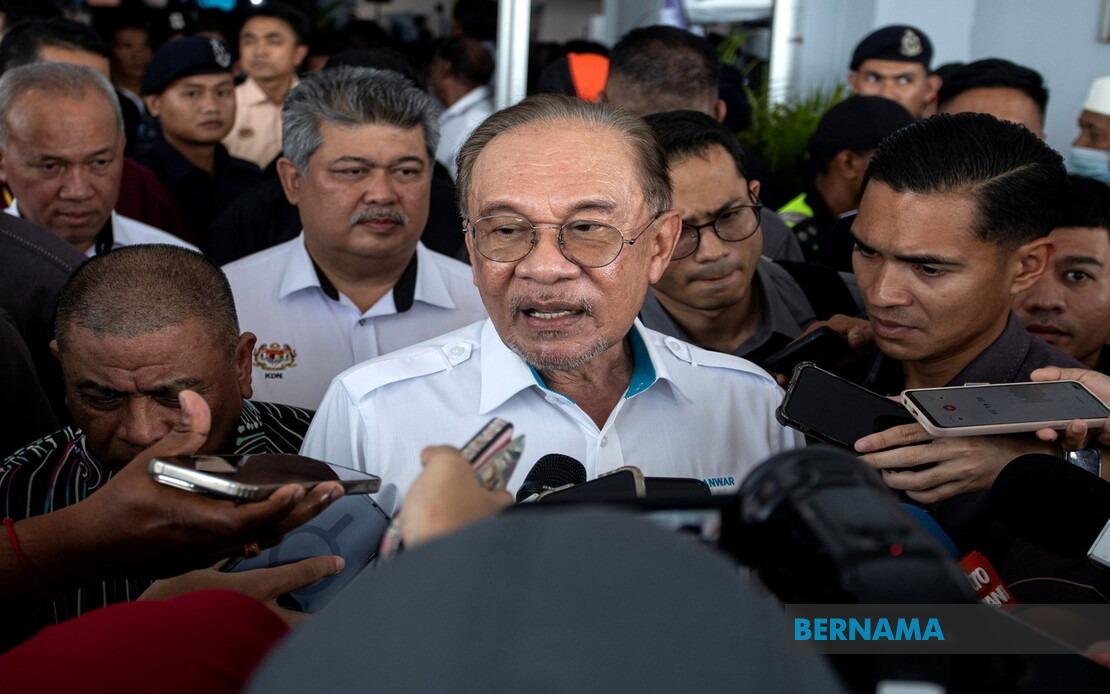
Prime Minister Datuk Seri Anwar Ibrahim has issued a stern reminder to government officials participating in ongoing state election campaigns to maintain strict discipline and refrain from criticising the Federal Government, cautioning that breaches of this conduct could cost them their positions. Speaking in Ipoh following a MADANI KITA community engagement event, Anwar underscored that attacking the federal administration during electioneering creates what he termed a "damaging political landscape" that undermines the coherence of Malaysia's governance structure.
The Prime Minister's directive reflects a fundamental tension within Malaysia's Unity Government coalition, where multiple parties operate simultaneously at federal and state levels despite sometimes competing against each other in state-level contests. This structural complexity has occasionally created friction when government ministers and senior officials, campaigning for their respective parties' state ambitions, have criticised policies or decisions made by the federal administration in which they hold ministerial portfolios. Anwar's intervention signals growing concern within the federal leadership that such contradictions risk eroding public confidence in the government's unified direction.
Central to Anwar's position is the principle that accepting government office carries corresponding obligations regarding public conduct and political messaging. Officials holding ministerial or agency leadership roles, he emphasised, remain bound by strict disciplinary standards that transcend their role as party campaigners. Those unwilling to accept these constraints have a clear alternative: resignation from their government posts before engaging in any campaign activity that might contradict federal administration positions. This framing presents the issue as one of basic accountability rather than partisan restriction, establishing clear boundaries for what constitutes acceptable political participation within the government apparatus.
The Prime Minister noted that this guidance had been communicated directly to his two deputies, Datuk Seri Dr Ahmad Zahid Hamidi and Datuk Seri Fadillah Yusof, ensuring that the message carries weight across the entire senior ministerial hierarchy. By involving both deputy prime ministers explicitly, Anwar has made clear that the discipline requirement applies uniformly regardless of party affiliation or seniority within the coalition structure. The involvement of these two figures, representing different coalition components, suggests the directive targets not specific parties but systemic behaviour patterns that have emerged as state election seasons approach.
Anwar distinguished sharply between acceptable and prohibited campaign activity. Coalition officials remain entirely free to campaign on substantive state-level issues—discussing local governance, state-specific policies, infrastructure needs, or service delivery challenges within their constituencies. What crosses the line, according to the Prime Minister, is leveraging the campaign platform to undermine or attack the Federal Government's record, policies, or direction. This differentiation attempts to preserve both the democratic principle that coalition parties can compete at state level while maintaining the unified federal administration's functional integrity.
The backdrop to this intervention involves the ongoing reality that Malaysia's federal coalition comprises parties that maintain distinct organisational structures and sometimes competing interests at state level. Perikatan Nasional, Pakatan Harapan, and Gabungan Parti Sarawak represent different political traditions and regional bases, yet jointly sustain the federal administration. During state election campaigns, internal coalition tensions occasionally surface publicly when ambitious candidates or eager officials overreach in their rhetorical attacks on rivals, sometimes inadvertently criticising federal government initiatives supported by their own coalition partners.
Anwar's emphasis on preserving "cordial relations at both the federal and state levels" reflects the delicate balancing act required to maintain the Unity Government's stability. The coalition represents Malaysia's most ideologically diverse governing arrangement in recent history, bringing together parties that previously opposed each other in fundamental ways. This arrangement, while electorally beneficial in securing sufficient parliamentary numbers, requires sustained discipline and restraint to prevent state-level competitions from metastasising into federal-level fractures. The Prime Minister's intervention indicates concern that without explicit reminders and consequences, normal campaign intensity could destabilise the fragile consensus binding the coalition.
For Malaysian voters and the broader public, Anwar's message carries implications for governance coherence. When government ministers campaign by attacking federal policies or decisions they helped formulate, it creates legitimate confusion about what the government actually stands for and whether its stated commitments reflect genuine consensus or merely convenient positioning. This credibility concern transcends partisan politics; it affects public trust in institutions and the government's capacity to implement announced programmes consistently. Anwar's intervention, framed as preserving effective service delivery capacity, ultimately addresses this systemic coherence challenge.
The practical enforcement mechanisms for this directive remain somewhat ambiguous, though the threat of ministerial removal provides significant incentive for compliance. Malaysian political culture has generally avoided removing ministers for campaign-trail rhetoric alone, but Anwar's explicit warning that resignation should precede any such behaviour establishes a higher standard. This approach shifts responsibility to individual officials to evaluate whether their campaign activity crosses the stipulated boundaries before proceeding, rather than relying on post-hoc disciplinary mechanisms. The consequence of breach is presented not as punishment but as logical conclusion of incompatible positions.
For coalition parties, particularly those smaller components dependent on maintaining cabinet representation, the directive creates real constraints on campaign messaging strategies. Opposition to specific state-level policies or decisions, when those policies originated from coalition partners, becomes precarious if such opposition implies federal government failure. This dynamic particularly affects parties holding state power in their traditional bases while seeking to expand federal influence, as they must balance local legitimacy with federal coalition loyalty. Anwar's intervention effectively raises the political cost of pursuing aggressive zero-sum campaign strategies within coalition contexts.
Looking forward, this episode illuminates an enduring challenge for any coalition government managing internal competition while maintaining public unity. The Unity Government's survival depends partly on accepting that coalition partners will compete at state level, but its effectiveness requires preventing such competition from poisoning federal relationships or contradicting the government's publicly stated direction. Anwar's intervention represents an attempt to codify these boundaries explicitly, though whether such reminders prove sufficient to prevent future tensions remains uncertain as state election cycles inevitably generate pressures toward more combative positioning.

