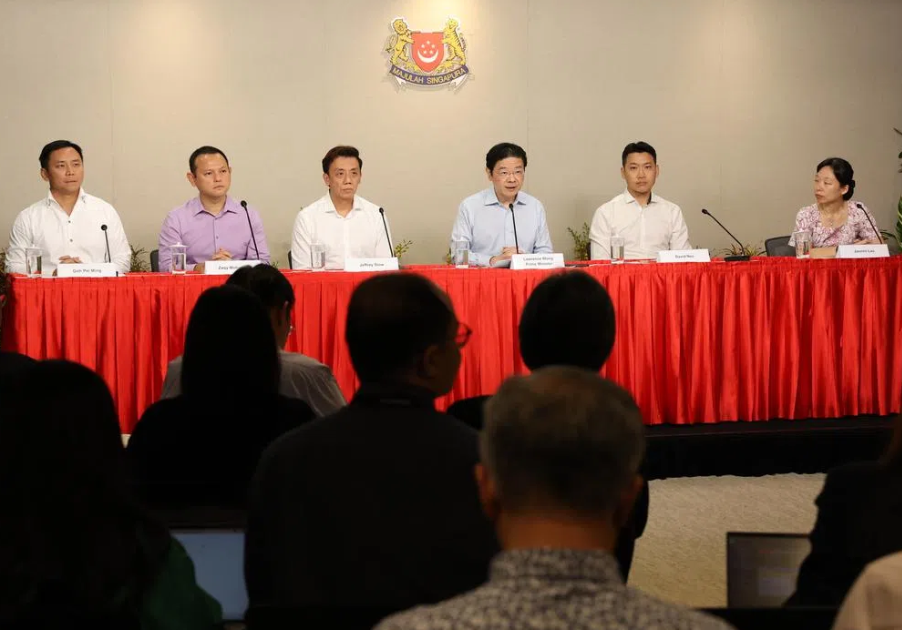
Prime Minister Lawrence Wong has announced a significant restructuring of Singapore's Cabinet on July 22, aimed at accelerating the advancement of a newer generation of political leaders while retaining the steadying influence of seasoned ministers. The reshuffle, which follows two high-profile political resignations within the past month, underscores the city-state's intentional approach to leadership renewal—a process that balances the need for continuity with the imperative to develop fresh talent capable of steering the nation through evolving challenges.
Two General Election 2025 newcomers are being elevated to full ministerial status as a result of the overhaul. Jeffrey Siow, who has served as Acting Transport Minister since May 2025, and David Neo, who has held the Acting Minister position for Culture, Community and Youth, will now assume these portfolios as full ministers. Their promotion represents a significant acceleration of their political careers, signalling that both have demonstrated the competence and leadership qualities required to manage major government portfolios independently. A third first-term parliamentarian, Sim Ann, steps into a coordinating role as Second Minister for Foreign Affairs and Home Affairs, expanding her responsibilities across two critical security and external relations domains.
Another newcomer, Jasmin Lau, assumes the mantle of acting minister for the Manpower Ministry, assuming responsibility during a period when labour market dynamics and workforce development remain central to Singapore's economic agenda. This move displaces Tan See Leng from his previous position, though he transitions horizontally rather than downward, taking on the portfolio of Minister for Trade and Industry (Energy and Industry)—a role that carries significant weight given Singapore's focus on economic transformation and energy security in an evolving regional landscape.
Two first-term backbench parliamentarians, Foo Cexiang and Shawn Loh, will ascend to the ministerial rank as ministers of state. Both bring backgrounds as former senior civil servants, suggesting that Singapore's political leadership continues to draw expertise from its professional bureaucracy. Their elevation reflects a deliberate strategy of rotating capable public servants into elected office, a practice that has historically strengthened the technocratic character of Singapore's governance.
The reshuffle was necessitated by unexpected political departures that disrupted the planned leadership calendar. Faishal Ibrahim, who held the position of Acting Minister-in-charge of Muslim Affairs and Senior Minister of State for Home Affairs, resigned on July 20 following what he characterised as a "lapse of judgment" in managing personal interactions. His departure removed a significant figure from the Home Affairs portfolio at a time when security and community relations remain priorities. Earlier, in June, Koh Poh Koon stepped down from his senior minister of state position, citing family considerations. Together, these departures created vacancies that required immediate attention and prompted a broader recalibration of ministerial assignments.
Prime Minister Wong stressed during his announcement at the National Press Centre that the Cabinet's composition undergoes annual review, though unexpected resignations necessitate more immediate adjustments. He emphasised that Singapore's governance requires a dual-track approach: experienced leaders capable of navigating near-term crises and obstacles, and a generation of emerging politicians prepared to chart the nation's medium and long-term trajectory. This philosophy reflects a conscious rejection of cliff-edge leadership transitions, instead favouring a gradual, overlapping approach where institutional knowledge transfers from veterans to their successors.
K. Shanmugam has been appointed Senior Minister, joining Lee Hsien Loong as the Cabinet's most seasoned members. Wong acknowledged that as Singapore undergoes its leadership transition, the counsel and mentorship of these experienced figures becomes increasingly valuable, particularly in guiding younger office-holders through their development. Shanmugam will continue his role as Coordinating Minister for National Security, one of three coordinating ministerial positions established to oversee distinct spheres of government activity alongside Chan Chun Sing and Ong Ye Kung.
Labour chief Ng Chee Meng returns to the Cabinet following his earlier absence, assuming the position of Minister in the Prime Minister's Office. His reinclusion signals that Singapore's political leadership values his experience and maintains flexibility in deploying senior figures to areas where their expertise can be most effectively deployed. Deputy Prime Minister Gan Kim Yong retains his position, and Wong indicated that the current senior leadership structure—without a second deputy prime minister—remains appropriate for present circumstances, though he signalled this arrangement remains subject to future review as the leadership transition unfolds.
Wong addressed his continued stewardship of the Finance portfolio, which he has held since 2021, describing his search for a successor as "a work in progress." He acknowledged that political figures mature at different rates, with some ready for elevated responsibilities earlier than others. His remarks suggest a pragmatic, performance-based approach to promotion rather than a timeline-driven one, reflecting his belief that individuals should be assigned to positions where they can optimally contribute to national objectives. This philosophy underpins the entire reshuffle, representing Wong's assessment that each reassigned minister is ready for their new responsibilities.
The changes take effect progressively beginning July 27, with some adjustments occurring at later dates to ensure smooth transitions and continuity of government operations. This staged implementation allows ministries to manage handovers systematically and minimises disruption to ongoing policy initiatives and administrative functions. For regional observers, Singapore's reshuffle demonstrates the intricate calculus involved in managing political transitions within a system where continuity and institutional stability are paramount. The elevation of multiple first-term politicians suggests confidence in the quality of recent parliamentary cohorts, a potentially significant factor as Singapore's political leadership faces demographic challenges similar to those affecting many developed Asian economies.
Singapore's approach to leadership renewal offers implicit lessons for other regional governments managing generational transitions. The deliberate cultivation of younger talent within a framework that preserves institutional continuity through experienced mentors contrasts with more abrupt transitions elsewhere. For Malaysia and other Southeast Asian nations, Singapore's methodical approach to building what Wong terms a "strong pipeline" of political talent—encompassing not only ministers but younger parliamentarians and capable backbenchers—reflects recognition that sustainable governance requires continuous investment in leadership development across multiple levels. The reshuffle ultimately represents not a departure from Singapore's leadership model, but rather its continuation and evolution, prioritising both institutional stability and generational renewal as complementary rather than competing imperatives.

