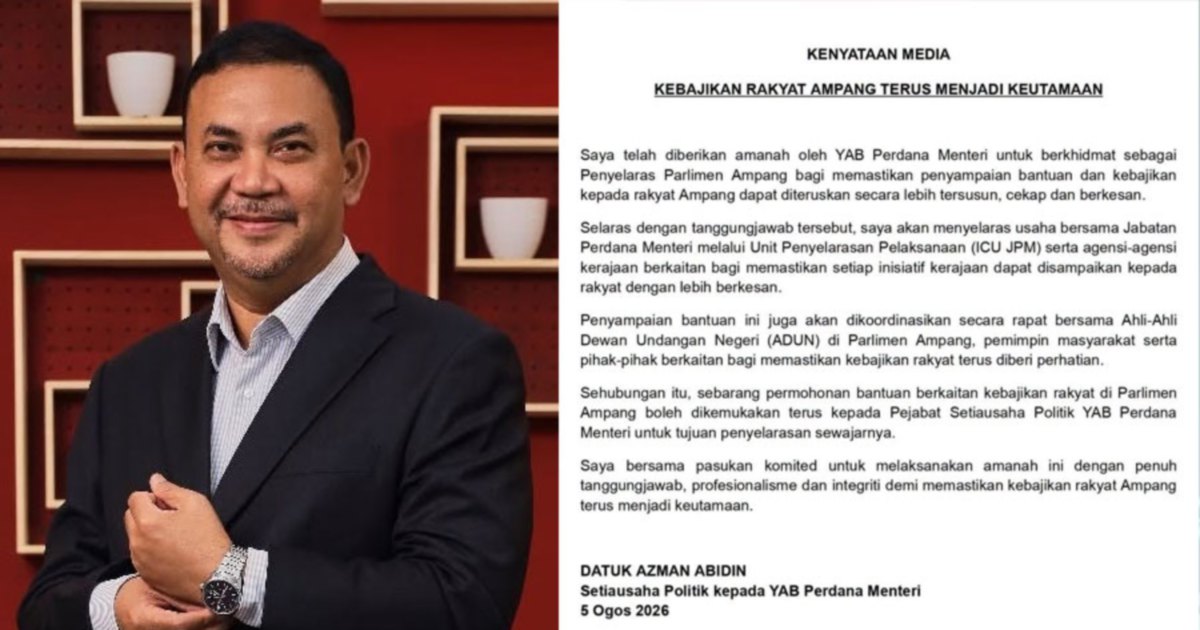
Prime Minister Datuk Seri Anwar Ibrahim's office has moved swiftly to install a political secretary into the role of parliamentary coordinator for Ampang, marking a significant intervention in the constituency's administration following the suspension of PKR lawmaker Rodziah Ismail's access to the MyKhas system, which administers federal funding allocations to parliamentary constituencies.
The appointment underscores deepening divisions within the ruling coalition, where questions about financial accountability and party discipline have emerged as central preoccupations. The MyKhas system, introduced to streamline the distribution of development funds to elected representatives, has become a focal point for ensuring compliance among legislators. The decision to restrict Rodziah Ismail's access signals that breach of party protocols or governance standards carries concrete financial consequences, effectively placing a lawmaker's constituency resources under external oversight.
Ampang, located in Selangor and historically one of Malaysia's significant urban constituencies, now finds itself in an unusual administrative arrangement. The deployment of a Prime Minister's political aide into a coordinating position traditionally held as an extension of the elected representative's mandate introduces a parallel structure of authority. This layering of administrative oversight reflects broader patterns within Malaysia's governing apparatus, where federal resources are increasingly being directed through mechanisms that ensure alignment with central political objectives rather than relying solely on elected representatives' discretion.
Rodziah Ismail's suspension from the allocation system raises questions about the underlying circumstances that prompted this action. Elected representatives face mounting expectations to demonstrate loyalty and compliance with party directives, particularly within the PKR framework where internal cohesion has been periodically tested. The removal of funding access represents a severe constraint on a legislator's ability to deliver constituency services and undertake development projects, effectively diminishing their political capital within their own area.
For Malaysian constituencies like Ampang, such administrative manoeuvres have direct implications for development spending and service delivery. When access to allocation systems is restricted, constituents may experience delays in small-scale projects, community facilities, or welfare initiatives typically funded through parliamentary allocations. The appointment of a Prime Minister's aide to coordinate these resources ensures continuity of service delivery while reinforcing central authority's control over resource distribution across constituencies.
This development also illuminates the mechanics of party discipline within Malaysia's coalition government. Unlike situations where a legislator might be formally expelled from parliament or stripped of party membership, the targeted restriction of funding access provides a more subtle mechanism for enforcing compliance. It allows the party leadership to maintain the legislator's nominal position while functionally constraining their ability to operate independently within their constituency, creating pressure for realignment without resorting to more dramatic political ruptures.
The appointment carries particular significance given Malaysia's complex electoral geography, where constituencies with diverse voter bases like Ampang require sustained engagement and development investment. By positioning an aide from the Prime Minister's office as coordinator, the administration ensures that major resource allocation decisions remain subject to federal-level scrutiny and approval. This centralization reflects both confidence in the coordinating mechanism and acknowledgment that constituency development spending carries political weight extending beyond individual legislator preferences.
Within the PKR context, such measures establish precedent for how party discipline operates when elected representatives deviate from expectations. The mechanism avoids the messiness of party disputes that might otherwise dominate media narratives, instead projecting an image of orderly, structured governance where deviations from prescribed conduct trigger proportionate administrative responses. For other PKR lawmakers observing these developments, the message regarding accountability is unambiguous.
The situation also speaks to broader questions about Malaysian electoral representation and the balance between legislative autonomy and executive oversight. While all constituencies depend on ministerial goodwill for development funding allocation, the formalization of parallel coordinating structures suggests an evolution in how this leverage is exercised. Rather than informal influence, appointment of specific coordinators creates permanent positions of oversight within constituencies, potentially reshaping how elected representatives interact with their constituents and federal authorities.
For Ampang residents and businesses seeking constituency support, understanding this new administrative arrangement becomes essential. Development projects and allocation requests now pass through multiple approval layers, potentially affecting processing timelines and outcomes. The dual-structure arrangement, while ensuring continued resource flow, introduces complexity into the traditionally direct relationship between elected representatives and their constituents seeking services.
Looking forward, this appointment pattern may indicate how the government intends to manage cases where elected representatives face suspension or restrictions on their authorities. Creating coordinating positions filled by loyalists provides flexibility in responding to internal party challenges without resorting to formal disciplinary mechanisms that generate political friction. For Malaysian politics, it represents a refinement in governance technique that merits close observation, particularly as similar arrangements potentially emerge in other constituencies facing comparable circumstances.

