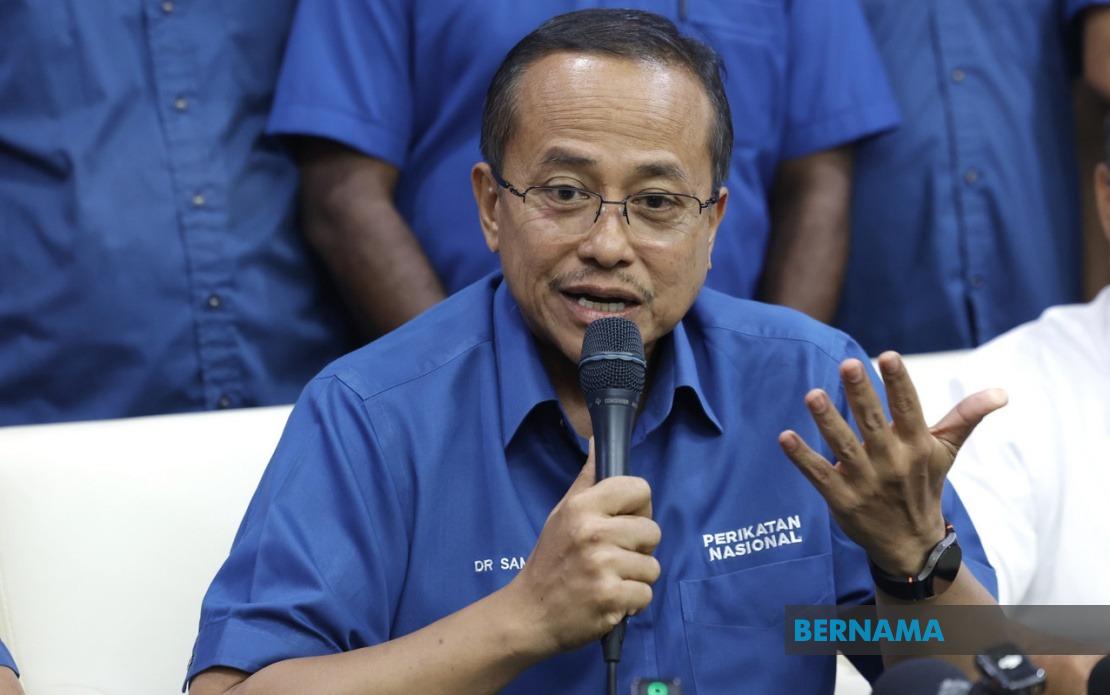
Perikatan Nasional has formally approved its campaign framework for the upcoming 16th Negeri Sembilan state election, moving the opposition coalition closer to active electioneering after months of internal negotiation. The coalition's apex body, convening in a special session in Seremban on July 16, endorsed arrangements governing how seats would be distributed among its constituent parties and confirmed that all participating candidates would campaign using the unified Perikatan Nasional logo rather than individual party symbols.
The breakthrough came after PN chairman Datuk Seri Dr Ahmad Samsuri Mokhtar signalled that the Supreme Council had settled longstanding questions about electoral strategy. His pronouncement essentially locked in the participation of PAS, Gerakan, Wawasan, and MIPP under a single organisational banner—a format meant to project unity and prevent voter confusion across the state's 36 contested seats. For regional analysts tracking Malaysia's fractious opposition landscape, the development underscores how coalition discipline, when enforced from the top, can temporarily override individual party interests.
Dr Ahmad Samsuri's statement carried particular weight because it addressed a lingering governance question: whether preliminary seat-sharing discussions had proceeded legitimately under his authority as coalition chairman. By explicitly confirming that all preliminary engagements occurred with his knowledge and approval before escalation to the full Supreme Council, he sought to establish that the process followed proper constitutional procedure. This clarification matters in a political climate where questions of legitimacy and procedural propriety frequently become weapons in internal party disputes.
The framing of PN's campaign objectives—emphasising the coalition's dedication to public welfare, state development, and social harmony in a plural society—reflects a deliberate messaging strategy aimed at voters weary of divisive rhetoric. By anchoring the campaign in developmental competence and inclusive governance rather than identity politics, PN appears to be testing whether it can broaden its appeal beyond its traditional base. For Negeri Sembilan specifically, where demographic diversity and economic interdependence have historically required coalition-building across communal lines, this language carries particular resonance.
However, the approval announcement occurred against a backdrop of significant rupture within the broader opposition movement. Bersatu, once the dominant force within the original PN iteration and currently the largest member by parliamentary representation, has declined to participate in the Negeri Sembilan arrangement. Party president Tan Sri Muhyiddin Yassin pointedly stated that Bersatu had not been meaningfully consulted on seat allocations and that discussions regarding potential cooperation with Barisan Nasional proceeded without his knowledge. This claim directly contradicted Dr Ahmad Samsuri's assertion that all negotiations occurred transparently within coalition structures.
Bersatu's exit decision—to contest independently under its own party symbol—reflects deeper tensions simmering within opposition politics. The party, which has oscillated between alignment with different coalitions and oscillated between government and opposition benches, appears to have calculated that independent candidacy offers better electoral prospects or political flexibility than remaining in a coalition where it holds limited strategic leverage. For observers tracking Malaysian coalition dynamics, Bersatu's withdrawal illustrates how opposition alliances remain brittle when major parties feel sidelined in decision-making or fear submerged identity in unified branding.
The practical consequence of Bersatu's departure is a significantly weakened PN presence in Negeri Sembilan. Without Bersatu's cadre and grassroots machinery, the remaining four components must contend with a narrower electoral footprint and reduced volunteer capacity. This structural disadvantage compounds what was already a challenging contest against Barisan Nasional, which retains substantial incumbency advantages and administrative resources in the state. For Malaysian voters in Negeri Sembilan, the split opposition landscape may effectively mean that the 16th state election becomes a two-player contest between BN and fragmented opposition forces rather than a three-way competition.
The timing of these announcements, coinciding with what appears to be imminent writs of election for Negeri Sembilan, suggests that both PN and Bersatu have reached decision thresholds on their respective strategies. Campaign preparations cannot indefinitely remain in limbo; at some point, coalition leaders must commit to specific formats and candidate slates. PN's approval and Bersatu's non-participation represent crystallised choices after what Muhyiddin's comments suggest was contested internal negotiation.
For Malaysia's broader political trajectory, the Negeri Sembilan contest now becomes a test case for several competing hypotheses. First, whether unified opposition branding under PN can improve electoral performance in circumstances where a major component has defected. Second, whether Bersatu's independent candidacy strategy generates sufficient voter confusion or splits the anti-BN vote in ways that benefit the ruling coalition. Third, whether PN's development-focused messaging can penetrate beyond traditional supporters in a state where governance performance and economic management remain salient voter concerns.
The event also highlights how Malaysian opposition politics remains characterised by coalition fragility and personality-driven leadership tensions. Muhyiddin's grievance about exclusion from PN decision-making, whether substantively justified or not, reflects the reality that opposition alliances often paper over genuine organisational rivalries rather than resolving them. PN's construction appears more stable than some past opposition formations, yet the Bersatu episode demonstrates that durability remains contingent on all major components feeling adequately empowered within shared structures.
Moving forward, the approved seat allocations and unified logo strategy represent PN's best organisational effort for the Negeri Sembilan contest, though the Bersatu split has materially altered the competitive equation. Dr Ahmad Samsuri's careful emphasis on procedural legitimacy suggests that PN leadership recognises the fragility of its construct and anticipates potential future accusations of unfair seat distribution or inadequate consultation. Whether these careful protocols prove sufficient to maintain coalition cohesion through a state election campaign remains an open question, particularly if electoral performance disappoints members who invested campaign resources expecting proportionally greater returns.

