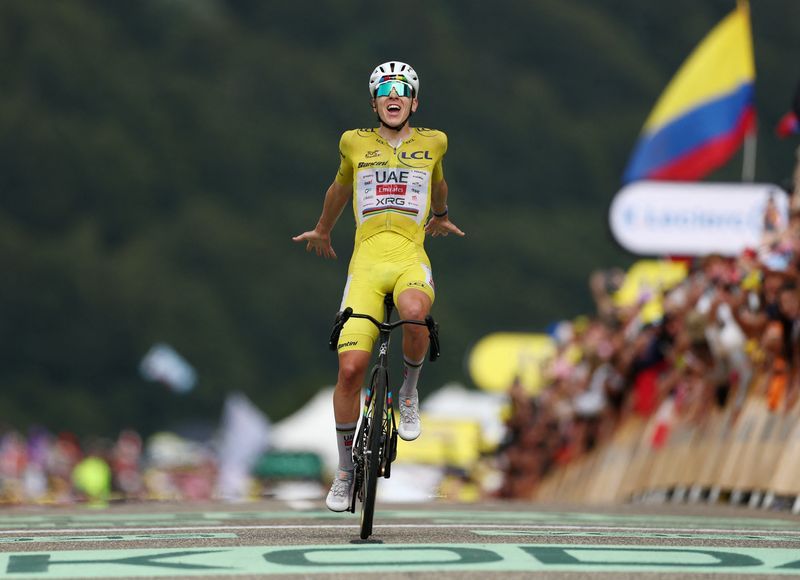
Tadej Pogacar has tightened his grip on the 2024 Tour de France, capturing his fourth stage victory of the race on Saturday with a commanding solo performance that underscores his dominance in this year's competition. The four-time champion launched his decisive attack along the steepest gradients of the Col du Haag during stage 14, extending his overall advantage to four minutes and 30 seconds ahead of Jonas Vingegaard, who crossed the line fourth. This continued assault on Vingegaard's deficit has shifted the psychological momentum decisively in Pogacar's favour as the race approaches its final mountain stages.
The 155.3-kilometre stage from Mulhouse to Le Markstein Fellering presented a formidable test of climbing prowess, with three category-one summits strewn across a route designed to whittle down the contenders. Adverse weather conditions—particularly heavy rain during the descent from Col du Page—added another layer of difficulty, forcing riders to navigate treacherous, slippery surfaces while maintaining concentration over extended periods. These challenging conditions typically favour experienced, confident racers capable of managing risk, a characteristic that Pogacar demonstrated throughout the stage.
French climber Valentin Paret-Peintre of Soudal Quick-Step and Ecuador's Richard Carapaz built the primary breakaway, establishing a commanding advantage over the chasing peloton at Grand Ballon, the day's opening major climb, where supportive home crowds lined the mountainside. Their lead stretched to nearly two minutes, suggesting a potential victory for one of the escapees. However, the peloton's co-ordinated chase, orchestrated largely by Pogacar's UAE Team Emirates-XRG unit, systematically reeled in the leaders as the race progressed through successive climbs.
The dynamics shifted at Ballon d'Alsace, where Paret-Peintre and Carapaz again crested first, though by this point the gap had shrunk to just three minutes. EF Education–EasyPost's Ben Healy and Carapaz briefly lost their way on the ascent but regrouped, demonstrating the navigation challenges presented by the mountainous terrain. By the time the leaders began their assault on the penultimate climb at Col du Haag, Pogacar's teammates had narrowed the advantage to merely 80 seconds, positioning their leader perfectly for a decisive intervention.
Carapaz attempted an aggressive move early during the 11.2-kilometre Col du Haag climb, with Norwegian Tobias Johannessen offering brief support. Yet their efforts unraveled as the general classification contenders closed in around 2.5 kilometres from the summit. The decisive moment came as gradients steepened toward the final two kilometres, reaching punishing 16-percent inclines that separate true climbing specialists from the field. Pogacar's counterattack at this critical juncture proved irresistible, establishing a 30-second buffer at the summit before he accelerated through the final descent to the finish line.
Pogacar's UAE Team Emirates-XRG teammate Isaac del Toro, the stage-two victor, secured second place with a 38-second margin over third-placed Paul Seixas, the local favourite, while del Toro also moved into fourth position in the general classification rankings, displacing Ayuso. This team victory—with del Toro's strong performance complementing Pogacar's dominance—demonstrates the collective strength that Pogacar's outfit has assembled. The Spanish team's ability to control the race, set tempo, and position their leader for maximum effect suggests they have refined their tactical approach throughout the race.
Reflecting on his performance immediately after the stage, Pogacar expressed satisfaction with his team's preparation and execution. He noted that his squad had identified stage 14 as an advantageous opportunity from the race's outset, underlining the importance of meticulous planning in Grand Tour racing. The Slovenian champion acknowledged the scenic beauty of the Vosges mountains, suggesting that even amid intense competition, he maintains appreciation for cycling's pageantry and setting.
Looking ahead to Sunday's stage 15, a mountainous 157-kilometre route from Champagnole to Plateau de Solaison, Pogacar acknowledged that further challenges await. He indicated his readiness to respond to whatever tactics Vingegaard and other contenders might employ, suggesting that the race's outcome remains contingent on how circumstances unfold in the coming days. Nevertheless, his commanding lead and demonstrated superiority on the mountains position him strongly for his third consecutive Tour victory.
For Malaysian and Southeast Asian cycling enthusiasts, Pogacar's dominance offers a masterclass in professional cycling at its highest level. His perfectly timed attacks, team co-ordination, and mountain-climbing prowess represent the standards to which aspiring cyclists in the region should aspire. The contrast between attacking prowess and overall race management—balancing aggression with prudent energy conservation—exemplifies lessons applicable across competitive pursuits. As the race continues through mountainous terrain toward its conclusion, Pogacar's performance trajectory suggests that his third consecutive Tour de France title remains his to lose.

