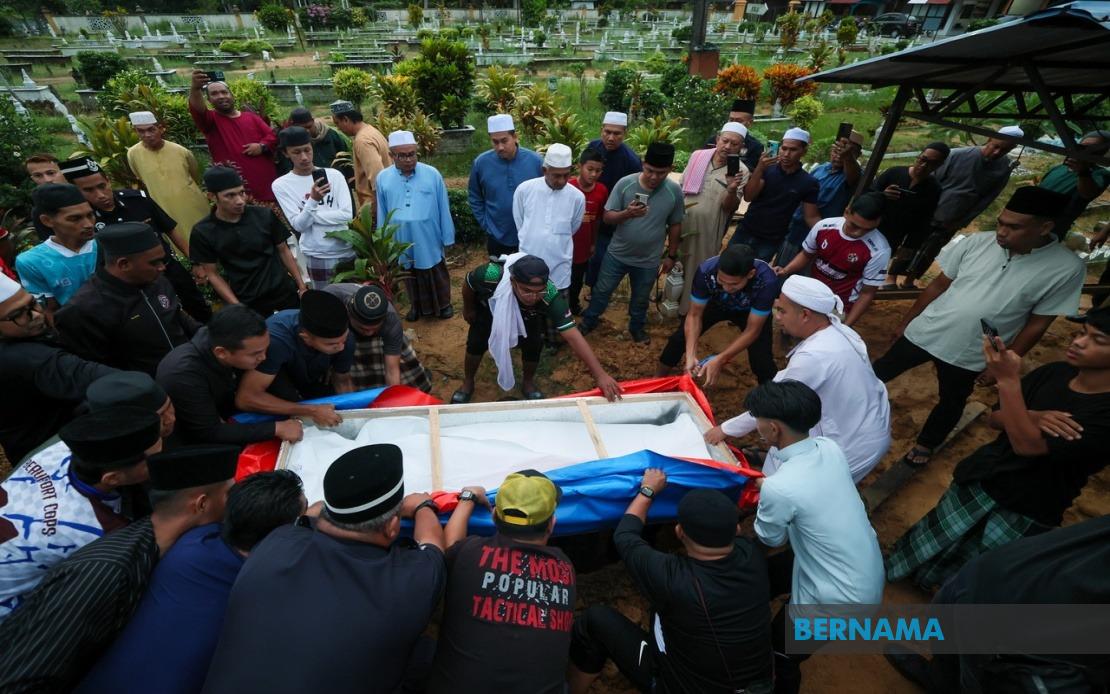
Corporal Mohamad Nur Hafiz Rahim, a 29-year-old police officer who died in an electric shock incident in Beaufort, Sabah, was committed to the ground at Kampung Pangkal Kuang Muslim Cemetery in Ketereh, Kelantan, this morning. The funeral proceedings commenced with prayers held at his family residence in Kampung Hutan Pasir before the burial ceremony took place. The tragic incident, which claimed the lives of three uniformed personnel stationed at Weston Police Station, has sparked national concern over workplace safety protocols within the force.
The remains of the officer arrived at his family home at 4.45 am on the day of burial, having been transported from Sabah following the incident that occurred at 5.50 pm the previous day. His family expressed deep gratitude to the Royal Malaysia Police for coordinating the logistical arrangements necessary to return his body home swiftly. The gesture underscored the institutional support extended to fallen officers and their grieving families during moments of profound loss. Such coordination between police hierarchy and bereaved families demonstrates the chain of responsibility that extends beyond the operational sphere into the realm of human dignity and compassionate care.
Nurlella Rahim, the deceased's eldest sister aged 34, emerged as a spokesperson for the family during the cemetery proceedings. She painted a portrait of close familial bonds that transcended geographical distance, revealing a household maintained through modern digital communication channels. The siblings had cultivated a routine of nearly daily video calls, leveraging platforms such as WhatsApp to sustain their connection despite being scattered across Malaysia—with Nurlella residing in Ipoh, Perak, while her brother served in Sabah. This contemporary family dynamic reflects the reality of many Malaysians whose careers necessitate interstate relocation, forcing them to depend on technology to preserve emotional ties.
The rhythm of these digital interactions provided telling glimpses into Mohamad Nur Hafiz's final days. His mother's last video conversation with him occurred on Thursday afternoon, during which he appeared fatigued and unusually subdued, though he managed to maintain composure and smile despite his apparent weariness. He explained his need to withdraw from the call due to impending work obligations, a poignant detail given that the incident would claim his life within days. Even during brief work intervals, he maintained the family habit of initiating video calls, demonstrating a commitment to familial connection despite his professional demands.
Nurlella's recollection of her own final interaction with her brother occurred on Sunday, when he took his wife, Fatimah Shahira, and their young child to the beach—a moment of leisure that would prove to be their last shared experience. These intimate details serve to humanize the tragedy beyond the headline statistics, revealing not simply a police fatality but the rupture of a family's ordinary life and the sudden termination of planned futures. The family's openness in sharing such moments suggests both a need to process grief and an inclination to memorialize the deceased through narrative, ensuring his presence persists through recounted stories.
The fatal incident unfolded at Weston Police Station in Beaufort when three personnel became electrocuted while attempting to relocate a 29-foot-long metal pole designed for harvesting coconuts. The pole's proximity to the school—Sekolah Kebangsaan Weston—adds an additional layer of concern regarding the hazardous materials and equipment maintained in close proximity to educational facilities and densely populated areas. The incident simultaneously claimed the lives of Corporal Chiu Teck Siong, a 40-year-old originally from Sarawak, and Constable Muhammad Raimi Ismarubee, aged 26 from Terengganu, expanding the tragedy's impact across multiple state constituencies and affecting families throughout the peninsula.
The scale of this catastrophe prompted immediate intervention from the nation's highest political authority. Prime Minister Datuk Seri Anwar Ibrahim issued directives for a comprehensive, transparent, and expedited investigation into the circumstances surrounding the electrocution. The Prime Minister's emphasis on transparency signals recognition that public confidence in institutions depends upon credible investigations that examine not only what transpired but why existing safety protocols failed. His articulation that the inquiry would serve to identify systemic improvements and prevent recurrence acknowledges that institutional learning must emerge from tragedy to justify the sacrifices made.
The deployment of a high-voltage pole for coconut harvesting outside a police station raises substantive questions about workplace safety assessments, equipment maintenance standards, and emergency protocols within police facilities. These establishments typically operate under distinct regulatory frameworks compared to commercial enterprises, yet personnel working within them warrant equivalent protections from electrical hazards. The incident suggests a gap between the occupational safety standards mandated for private sector workers and those actually enforced in government facilities, a disparity that demands examination.
For Malaysian readers and regional observers, this tragedy underscores the vulnerability of frontline personnel to workplace hazards that might appear routine or secondary to primary duties. Police officers dedicate their professional lives to maintaining public order and security; their right to return home safely depends upon working environments engineered with equivalent rigor. The incident also resonates across Southeast Asia, where similar workplace safety lapses have claimed lives in various sectors, highlighting the need for consistent application of occupational standards regardless of institutional affiliation or geographic location.
The investigation into this incident carries implications extending beyond the immediate families affected. It will establish precedents for how workplace fatalities within uniformed services are examined, what accountability mechanisms apply, and whether systemic reforms will be implemented. The Royal Malaysia Police must demonstrate that institutional learning translates into concrete changes in equipment protocols, electrical safety audits, and training procedures. Only through demonstrable commitment to prevention can the force honor the sacrifice of these three fallen officers and reassure the families of the remaining personnel that their welfare represents an institutional priority worthy of equal standing with operational objectives.

