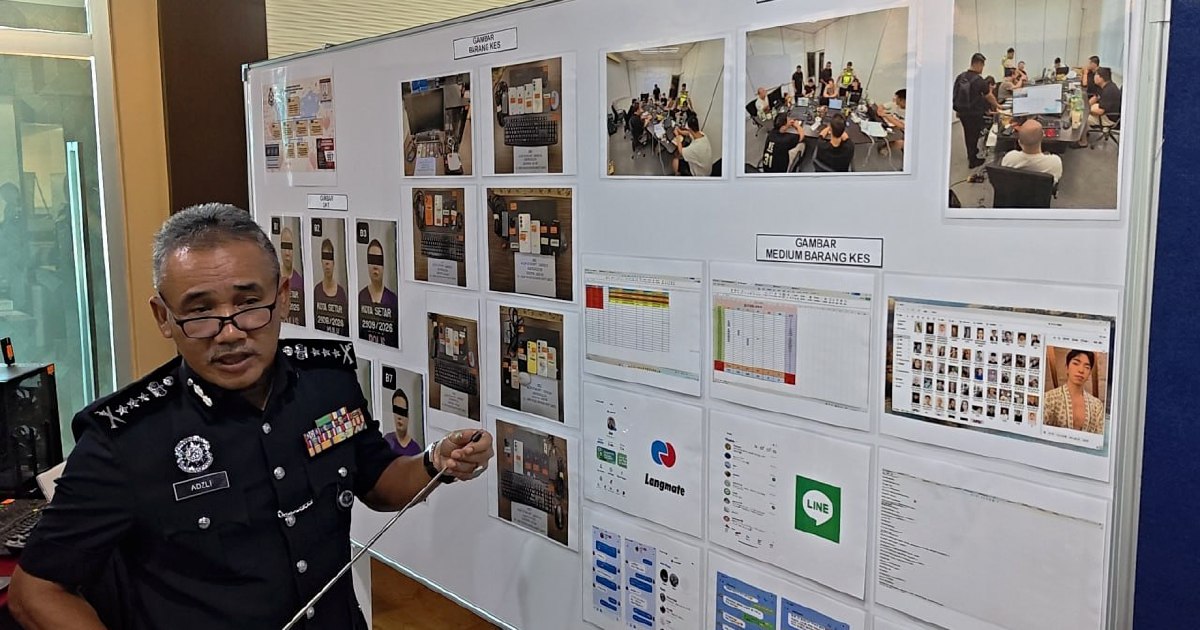
Law enforcement in Kedah has successfully dismantled a coordinated network of online romance fraudsters that had been systematically victimizing Japanese nationals through digital deception. The breakthrough came following a decisive enforcement operation at a commercial premises located within the Kristal Light Industrial Park in Alor Star last Sunday, resulting in the apprehension of seven individuals of Chinese nationality who are alleged to have orchestrated the scheme.
The targeting of Japanese victims by international scam syndicates reflects a growing trend in Southeast Asia where organized criminal groups exploit cross-border vulnerabilities and cultural differences to carry out large-scale financial fraud. Romance scams, sometimes referred to as catfishing operations or confidence schemes, represent one of the most lucrative categories of online fraud globally, with victims often losing substantial sums of money after developing emotional attachments to fictitious personas created by the perpetrators. The fact that this particular syndicate had developed specialized capabilities to target Japanese nationals suggests a degree of sophistication in how criminal networks segment their victim pools by nationality, language ability, and perceived wealth.
Alor Star's Kristal Light Industrial Park, while primarily serving as a hub for manufacturing and light industrial enterprises, has increasingly become a location of interest for law enforcement agencies investigating cybercrime operations. The choice of such a venue by the alleged scammers likely reflected the need for reliable internet connectivity, relatively inconspicuous commercial space, and geographical proximity to other operational bases. The park's positioning in Malaysia's northern corridor, combined with the nation's role as a regional technology hub, may have made it an attractive base for criminal operations with transnational reach.
The mechanics of love scams typically involve the creation of false online profiles featuring attractive photographs and fabricated personal histories. These profiles are then deployed across dating applications, social media platforms, and specialized matching websites where potential victims are likely to be found. Over weeks or months, the fraudsters cultivate increasingly intimate relationships with their targets, building trust through consistent communication and emotional investment. Once sufficient rapport has been established, the criminals introduce a pretext requiring financial assistance—claims of medical emergencies, business failures, travel disruptions, or investment opportunities that promise returns.
Japanese victims have historically represented a high-value target demographic for such operations due to factors including relatively high disposable incomes, cultural tendencies toward politeness and trust-building in relationships, and a preference for formal courtship that can be exploited by patient long-term scammers. The language barrier, while posing operational challenges for the perpetrators, may paradoxically have made Japanese victims feel more comfortable disclosing personal and financial information to English-speaking individuals presenting themselves as international suitors. The anonymity afforded by online platforms compounds these vulnerabilities, as victims have limited means to verify the authenticity of their purported romantic interests.
The police investigation leading to this operation likely involved cooperation between Malaysian authorities and their Japanese counterparts, reflecting the increasingly international nature of cybercrime investigations. Cross-border collaboration in fraud cases has become essential as perpetrators operate from multiple jurisdictions while targeting victims scattered across continents. The identification of the Kristal Light Industrial Park location suggests either intelligence gathering from victim complaints or coordination with telecommunications and financial service providers who detected suspicious transaction patterns.
The arrest of seven individuals raises questions about the broader organizational structure of the syndicate. Romance scam operations typically employ hierarchical arrangements with specialized roles including profile creators, conversation managers, money-laundering coordinators, and financial operatives. The number of arrests might suggest either a small specialized cell conducting limited operations or the capture of a particular shift or division within a larger enterprise. Whether the apprehended individuals represent the leadership tier or frontline operatives will significantly affect the investigation's ultimate impact on the organization's capabilities.
For Malaysian readers and residents, this case underscores the vulnerability of online spaces to sophisticated criminal enterprises operating within or transiting through the country. The prominence of Malaysia in regional cybercrime—whether as a base, transit point, or operational center—has prompted increased scrutiny from both domestic law enforcement and international partners. The presence of such syndicates highlights the importance of digital literacy and awareness campaigns about romance scam methodologies, which remain effective despite widespread publicity.
The financial implications of these schemes extend beyond individual victims to affect international relations and confidence in online platforms. When Malaysian-based operations target foreign nationals, the consequences can include diplomatic attention and pressure on domestic authorities to intensify enforcement efforts. Dating application operators and social media platforms face criticism for inadequate verification systems, though enforcement also reveals the resourcefulness of criminals in circumventing such safeguards through stolen identities and sophisticated technical maneuvering.
Moving forward, authorities will likely focus on tracing the proceeds from this operation, identifying additional victims who may not yet have filed complaints, and determining connections to other regional cybercrime networks. The seizure of devices, documentation, and financial records from the Alor Star premises will provide investigative material for weeks or months of follow-up work. Cooperation with Japanese authorities may extend to victim restitution efforts, though recovery of funds transferred through cryptocurrency and informal money-transfer systems remains extraordinarily challenging in practice.

