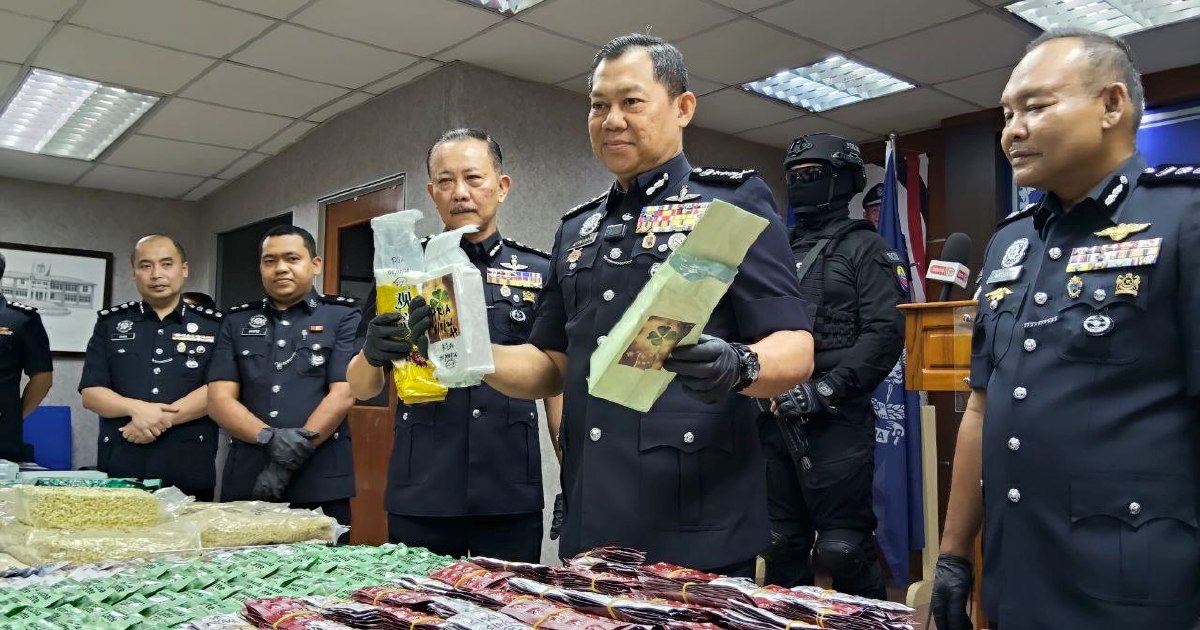
A major blow against organized drug trafficking in Johor has been delivered following a police operation that uncovered a substantial illicit narcotics cache in the Masai area. Authorities seized 96.76 kilograms of various controlled substances with an estimated street value of RM8.49 million from a residential unit located along Persiaran Senibong. The apartment, situated in this strategically important location near the Malaysia-Singapore border, had been commandeered by traffickers as a storage and distribution hub for their criminal enterprise.
The operation represents a significant escalation in law enforcement efforts targeting the drug trade in Johor, a state that has witnessed intensified trafficking activity due to its proximity to major maritime routes and its geographical position as a transshipment point for narcotics destined for broader Southeast Asia. The dismantling of this particular syndicate indicates that organized criminal networks are increasingly utilizing residential properties in urban and semi-urban areas rather than more conventional storage facilities, a tactical shift that has complicated detection efforts for local authorities.
Police made two arrests in connection with the operation, apprehending individuals suspected of orchestrating the distribution network. The scale of the seizure suggests this was not a small-scale operation but rather a significant component of a larger trafficking organization serving multiple distribution channels across the region. The investigation into the syndicate's operations, supplier connections, and customer base is ongoing, with authorities indicating that further arrests may be forthcoming as they unravel the broader network.
The value attached to the seized drugs reflects the substantial profit margins that make narcotics trafficking an attractive criminal enterprise despite the severe legal penalties involved. In Malaysia, trafficking charges for quantities of this magnitude carry potential sentences of considerable length, yet the lucrative returns continue to incentivize criminal groups to undertake these high-risk operations. The RM8.49 million valuation also underscores the purchasing power these organizations wield and their capacity to acquire and transport significant drug quantities without detection.
Masai's emergence as a focal point for this particular operation is noteworthy given the district's characteristics as a rapidly developing area with considerable population density and proximity to the port facilities in Johor Baru. The choice of residential accommodation as a storage facility rather than more isolated or industrial locations suggests that traffickers are adapting their methods to blend into civilian areas and exploit the difficulty authorities face in distinguishing suspicious activity within densely populated residential zones.
The apartment's rental arrangement as described indicates a deliberate attempt to compartmentalize the operation and distance ownership from active management, a tactic commonly employed by larger trafficking syndicates seeking to complicate law enforcement's ability to establish chain of custody for prosecution purposes. Property owners may be unwitting participants in such schemes, or they may have received substantial payments while turning a blind eye to the nature of their tenant's activities.
From a regional perspective, this seizure demonstrates the ongoing struggle by Southeast Asian law enforcement agencies in combating the flow of narcotics through the region. Despite coordinated efforts between Malaysia, Singapore, Indonesia, and Thailand, trafficking organizations continue to find pathways and methods to move vast quantities of drugs through established networks. The sophistication evident in this operation—including the use of false tenancy arrangements and strategically located storage facilities—indicates that traffickers are operating with considerable operational awareness and resources.
The seizure comes at a time when authorities across Malaysia have intensified focus on the drug menace following public concerns about rising addiction rates and drug-related social problems in communities nationwide. The Johor police's success in identifying and shutting down this operation will likely boost confidence in law enforcement's capacity to disrupt major trafficking networks, though the sheer quantity recovered also serves as a sobering reminder of the scale at which organized criminals continue to operate.
Investigators will likely focus on establishing the provenance of the seized drugs, identifying the supplier networks that fed this distribution hub, and determining the extent of customer connections throughout Malaysia and Singapore. The forensic examination of the apartment and associated documentation may yield crucial evidence linking individuals and organizations to the broader trafficking ecosystem operating throughout the Klang Valley, Johor, and beyond.
For Malaysian residents, particularly those in Johor and surrounding states, such operations underscore both the persistent drug threat affecting communities and the ongoing efforts by law enforcement to counter it. The visibility of major seizures like this can sometimes create a false sense of security if the public assumes that removing one distribution hub significantly impacts drug availability, yet the reality is that trafficking networks typically operate with redundancy built into their structures.

