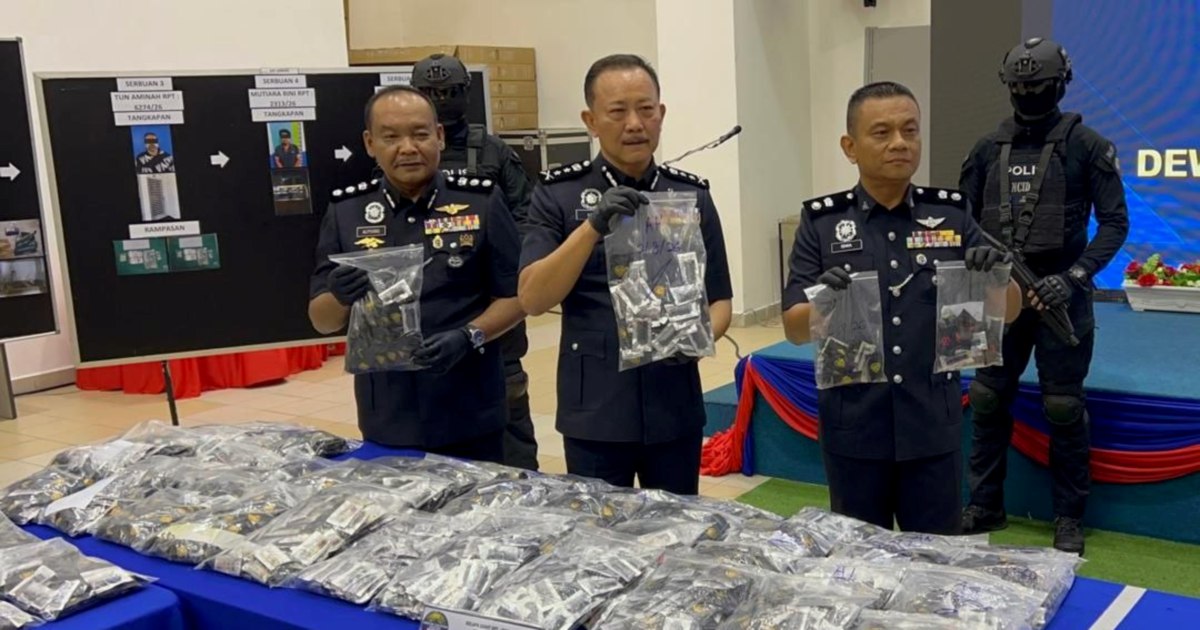
Authorities in Johor have successfully dismantled what police describe as an organised criminal network engaged in the manufacture and sale of narcotics-infused vape cartridges, with the operation resulting in the arrest of seven individuals and the seizure of products valued at RM10.68 million. The coordinated takedown occurred across five separate locations throughout the state on Sunday, representing a significant blow against drug trafficking in the region.
The scale of this operation underscores a troubling trend in Southeast Asia and Malaysia specifically: the exploitation of vaping technology as a delivery mechanism for illicit substances. Unlike traditional drug distribution methods that rely on conspicuous physical transactions, drug-infused vaping products appeal to a broader demographic and are considerably easier to conceal and transport. The relatively inconspicuous nature of vape devices means users can consume these substances in public spaces without immediately arousing suspicion, making them attractive to both traffickers seeking to expand their market reach and consumers attempting to mask their drug use.
The coordinated nature of the police response, involving simultaneous raids across multiple Johor locations, reveals the sophistication with which authorities have begun tracking these operations. Such tactical coordination requires extensive intelligence gathering and surveillance work, suggesting that law enforcement agencies have invested considerable resources in identifying the network's infrastructure, supply chains, and key personnel. The Sunday operation appears to have been designed to prevent suspects from using advance warning to destroy evidence or relocate inventory, a practical lesson learned from years of combating organised crime in the state.
The RM10.68 million valuation of seized materials represents either wholesale inventory destined for distribution networks or retail-level stock positioned throughout the state. This figure provides insight into the profitability that attracts criminal syndicates to vape-based drug distribution. The potential profit margins—typically several hundred percent when accounting for production costs and wholesale acquisition prices—make such operations financially attractive even when accounting for legal risks and enforcement pressures.
Johor's emergence as a focal point for drug trafficking operations reflects the state's geographic position as Malaysia's primary gateway between the Klang Valley and Singapore, combined with its extensive port infrastructure and proximity to cross-border trafficking routes. The state's population density and relatively permissive enforcement environments in certain jurisdictions create conditions conducive to clandestine manufacturing and distribution operations. Additionally, Johor's established logistics and transport networks, developed primarily for licit commerce, can be readily repurposed for illicit goods movement.
The seven arrests represent individuals positioned at various levels within the supply chain, though police have not yet publicly detailed specific roles and responsibilities. Typical operations of this nature involve manufacturers handling chemical synthesis and cartridge assembly, distributors managing regional inventory and wholesale networks, and street-level retailers conducting transactions with end users. Understanding the hierarchy and relationships within the syndicate will be crucial for prosecutors attempting to establish conspiracy charges and for preventing surviving network members from reorganising operations.
Vape-based drug distribution presents particular regulatory challenges because the underlying vaping technology itself remains legal in Malaysia, though subject to restrictions through tobacco control frameworks. This legal ambiguity creates enforcement complications, as authorities must prove active drug contamination rather than merely detecting vaping paraphernalia. Customs officials at ports and police conducting interdiction operations therefore require specialised training and testing capabilities to identify narcotics-infused products among legitimate commercial shipments.
The timing of this operation coincides with broader Southeast Asian efforts to address synthetic drug trafficking, particularly methamphetamine and its derivatives, which can be dissolved into vape liquids with relative ease. The region has experienced surging methamphetamine consumption, particularly among younger demographics, making younger users the obvious target market for drug-infused vaping products. Malaysian schools and social welfare agencies have reported increased substance abuse cases involving vaping devices, suggesting that prior to this enforcement action, the syndicate may have successfully infiltrated educational institutions and youth gathering spaces.
Investigators will now focus on tracing the sourcing of precursor chemicals, identifying wholesale buyers across Malaysia and potentially neighbouring countries, and establishing international connections that may extend beyond Southeast Asian borders. Many synthetic drug manufacturing syndicates operate transnational networks, with production facilities in one jurisdiction, distribution hubs in transit countries, and retail markets across the region. The seven arrests represent visible nodes within a potentially larger ecosystem.
The successful operation provides momentum for Johor's drug enforcement apparatus and demonstrates capabilities that regional authorities are increasingly developing. However, the underlying demand factors—youth recreational drug use, the widespread availability of production chemicals, and the profitability of narcotics trafficking—remain largely unaddressed. Sustained enforcement alone cannot eliminate such operations without complementary public health, education, and demand-reduction interventions. The seized products and arrested individuals represent symptoms of deeper structural issues within Malaysia's drug market rather than fundamental solutions to underlying problems.
Moving forward, this operation should catalyse enhanced coordination between state and federal law enforcement agencies, closer collaboration with international partners in source countries and transit routes, and strengthened community reporting mechanisms that enable citizens to contribute intelligence regarding suspicious vaping product sales. Educational campaigns explaining the risks of narcotics-infused vaping products may also prove valuable in dissuading potential users, particularly among younger demographics vulnerable to marketing by illegal vendors exploiting perceptions of reduced harm associated with vaping technologies.

