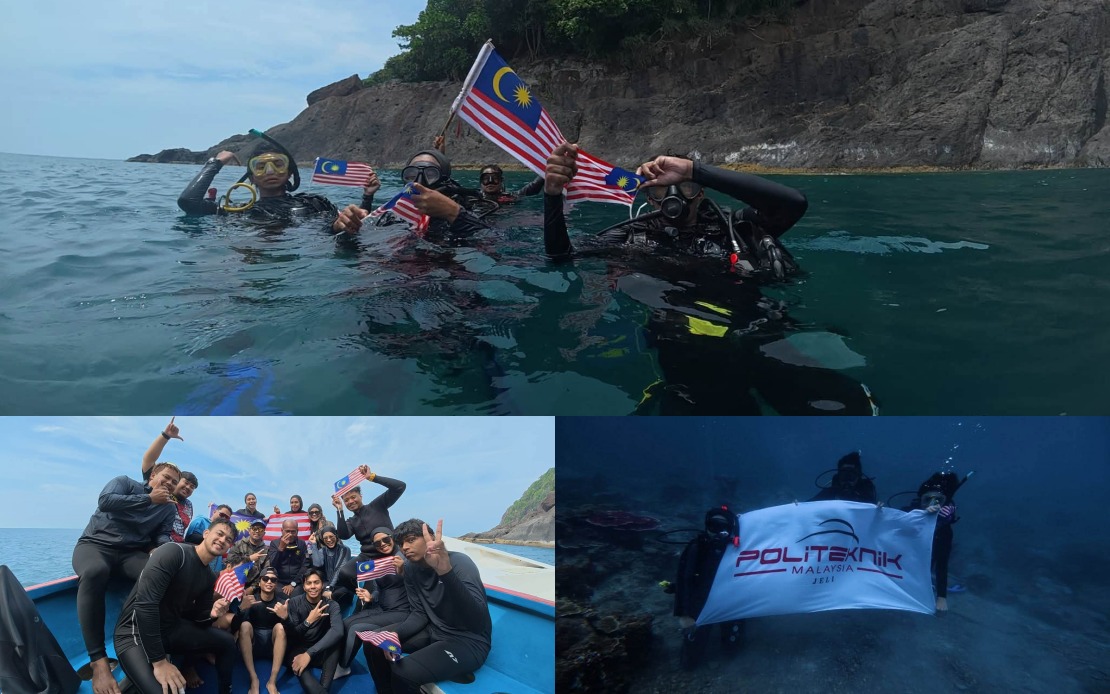
Politeknik Jeli Kelantan marked Malaysia's 69th National Day in August with an unconventional patriotic gesture, deploying the Jalur Gemilang 18 metres beneath the waters off Pulau Tenggol in Terengganu. The underwater flag display formed part of a broader scuba diving training and certification programme that ran from August 27 to 30, coordinated through the institution's Aquaculture Technology Unit within the Department of Agrotechnology and Bio-Industry. What began as a symbolic National Day observance evolved into a meaningful exercise that merged institutional pride with hands-on professional development in a sector increasingly vital to Malaysia's maritime economy.
The initiative emerged from Politeknik Jeli's commitment to providing students with experiential learning opportunities that extend beyond traditional classroom settings. Mohd Adam Nashriq Bani Yamin, an aquaculture lecturer at the institution, explained that the decision to plant the flag underwater represented far more than patriotic theatrics. Instead, it functioned as a teaching moment that grounded academic concepts in real-world application, allowing students to understand how technical competencies intersect with practical marine work environments. The programme deliberately wove together skill-building with national observance, recognizing that patriotism in a technical context means preparing citizens capable of contributing to Malaysia's development in strategic sectors.
The training component centred on water safety protocols and scuba diving certification, domains increasingly important for professionals working in marine aquaculture and biotechnology sectors. Two institutional lecturers and two fifth-semester Diploma in Aquaculture Technology students participated in the full certification process. Rather than outsourcing this training to an external provider, the college partnered with Dive Buddy Malaysia, leveraging the expertise of instructor Dr Nabila Talib to deliver both PADI Divemaster and PADI Open Water Diver certification courses. This arrangement ensured that participants received internationally recognized credentials while remaining anchored to an educational institution's pedagogical framework and institutional context.
Acquaculture represents a sector of strategic importance for Malaysia and Southeast Asia more broadly. As wild fisheries face mounting pressure from overharvesting and climate-related disruptions, farmed aquaculture systems offer potential pathways toward food security and rural economic development. However, modern aquaculture operations, particularly those involving offshore or deepwater environments, demand that workers possess not only biological and technical knowledge but also practical diving skills and emergency response competencies. Students graduating from Politeknik Jeli's programmes will increasingly encounter work situations requiring comfort and confidence in marine environments, making the integration of diving certification into standard curricula a logical evolution.
The underwater flag display itself carried symbolic weight beyond the immediate training context. Alongside the Jalur Gemilang, the institution also submerged its own institutional flag, creating a visual representation of how individual institutions contribute to broader national objectives. For students preparing to enter the workforce, witnessing their institution's colours displayed at depth alongside the national flag reinforced messages about institutional pride and professional identity. This layered symbolism acknowledged that competent technical workers serve national interests by advancing sectors like aquaculture that support economic growth and food production.
Water safety training formed a crucial component of the overall programme, addressing a genuine occupational hazard in marine industries. Workers in offshore aquaculture farms or those conducting underwater marine research face risks ranging from decompression sickness to equipment failure to environmental hazards. By incorporating comprehensive safety instruction into the diving certification process, Politeknik Jeli equipped students with knowledge and protocols that could prevent injuries or deaths during their professional careers. This proactive approach to occupational health reflects international best practices and positions the institution's graduates as safety-conscious professionals capable of protecting themselves and colleagues in challenging work environments.
The skills acquired through the diving certification programme extend well beyond the immediate context of flag deployment. Aquaculture technology graduates may apply these capabilities across marine research initiatives, offshore fish farm management, underwater ecosystem monitoring, and marine conservation projects. As Malaysia develops its blue economy ambitions and Southeast Asia expands its aquaculture production to meet growing protein demands, workers possessing both technical aquaculture knowledge and diving certifications become increasingly valuable. The programme thus functions as workforce preparation, equipping graduates with credentials that enhance their employability and professional trajectory across multiple career pathways within marine industries.
Politeknik Jeli's approach reflects broader trends within Malaysian technical and vocational education institutions toward integrating practical competencies with academic learning. Rather than treating National Day observance as a administrative requirement involving flag raisings and speeches, the college transformed the occasion into a genuine pedagogical opportunity. Students gained internationally recognized certifications, enhanced their professional portfolios, and experienced their institution's patriotic commitment expressed through meaningful action rather than ceremonial gesture. This integration of patriotism with professional development suggests an educational philosophy that sees national pride not as separate from economic contribution but fundamentally intertwined with it.
The involvement of Dr Nabila Talib as lead instructor also underscores the significance of specialized expertise in technical training. Professional diving instruction requires extensive personal experience, rigorous certification, and ongoing professional development. By engaging a qualified external instructor while maintaining institutional oversight, Politeknik Jeli balanced the need for specialized expertise with institutional accountability. This collaborative approach between educational institutions and private sector training providers represents a model increasingly common across technical education in Malaysia, where limited resources and specialized equipment requirements often necessitate partnerships and outsourcing arrangements.
Looking forward, the success of this initiative may encourage other Malaysian polytechnics and technical institutions to integrate similar experiential learning opportunities into their programmes. As Malaysia positions itself as a knowledge-based economy with growing emphasis on maritime sectors and blue economy development, educational institutions play crucial roles in producing graduates equipped with both theoretical understanding and practical capabilities. The Politeknik Jeli example demonstrates that National Day observance, institutional pride, and professional workforce development need not exist in separate domains but can converge around meaningful, practical initiatives that serve students, institutions, and national interests simultaneously.

