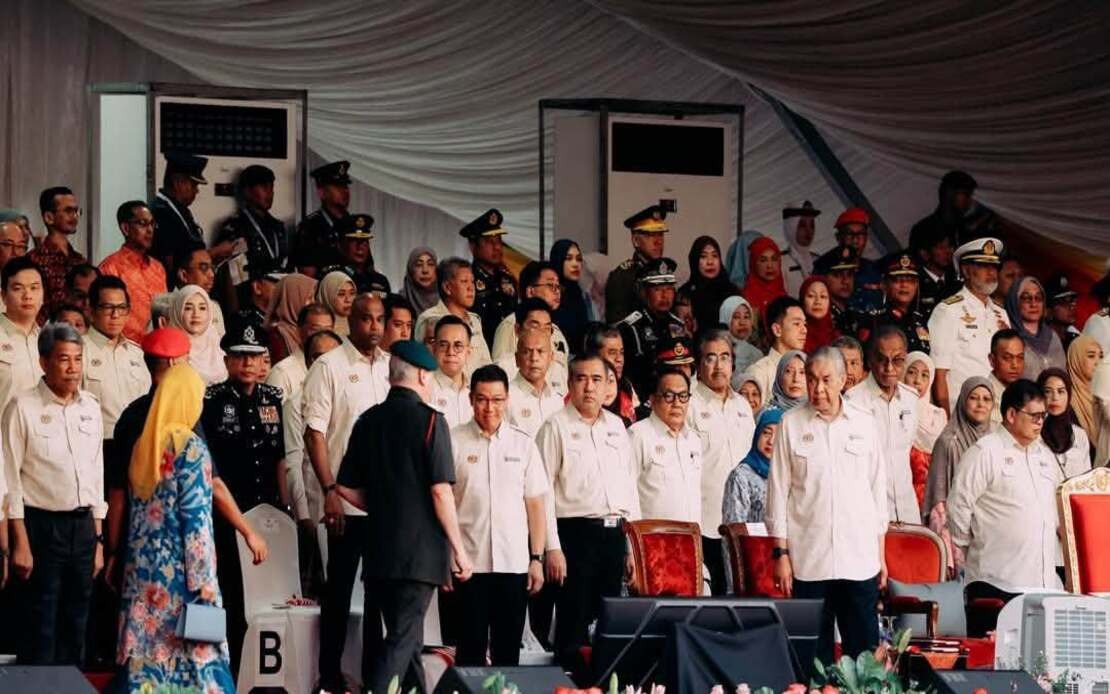
Malaysia's stability depends fundamentally on the political maturity of its leadership, according to Domestic Trade and Cost of Living Minister Datuk Armizan Mohd Ali, who has called for a measured and responsible approach to managing the country's evolving political landscape in the wake of the 15th General Election. Speaking on National Day, Armizan underscored that the shift away from single-party dominance represents both an opportunity and a challenge that requires deliberate commitment from political actors at all levels to prioritise nation-building over factional advantage.
The minister's remarks reflect growing recognition within government circles that the Unity Government's survival hinges on the ability of coalition partners to compartmentalise their competitive instincts while maintaining collaborative discipline in the corridors of power. This balancing act differs markedly from Malaysia's previous political experiences, where coalition arrangements were either absent or dominated by a single overwhelming partner. Armizan's framing suggests awareness that the current arrangement represents genuinely uncharted territory, demanding heightened sophistication in how political leaders navigate internal party activism whilst projecting governmental cohesion.
Armizan specifically highlighted the apparent disconnect between party-level rhetoric and cabinet-level conduct, observing that whilst party activists have engaged in vigorous public sparring over recent months, the cabinet ministers themselves have maintained professional and constructive engagement during official meetings. This distinction carries particular significance for understanding how the Unity Government functions: the coalition appears to have developed an implicit understanding that internal party competition need not—and indeed must not—translate into governmental dysfunction. This arrangement creates psychological and institutional separation between the political marketplace and state apparatus, allowing both to operate within different behavioural norms.
The minister drew pointed lessons from Malaysia's recent turbulent political history, specifically referencing the 2018-2022 period when three prime ministers and three different cabinet configurations emerged within a single parliamentary term. That period of instability created measurable economic costs, undermined policy continuity, and eroded public confidence in institutions. Armizan's invocation of this cautionary period serves as an implicit argument for accepting the current coalition model as preferable to the chaos and uncertainty that characterised the preceding years. By framing the question as a choice between flawed consensus and destabilising uncertainty, he positions the Unity Government as the more rational alternative despite its inherent tensions.
Central to Armizan's thesis is the concept of reciprocity between political rights and governmental responsibility. He argues that whilst individuals and parties retain legitimate claims to political agency and competitive positioning, these must be exercised within a framework of acknowledged duty to national development and public welfare. This formulation attempts to resolve what would otherwise constitute irreconcilable tensions: how can coalition partners simultaneously compete for political advantage whilst maintaining the unified governance necessary for state function? His answer frames these as complementary rather than contradictory, provided they operate at different temporal and spatial scales—competition in the public and party spheres, responsibility in governance spaces.
The minister's emphasis on consensus-building reflects the practical reality that Malaysia's complex political geography—spanning multiple ethnic communities, regional interests, and ideological perspectives—cannot be effectively governed through hierarchical imposition alone. The Unity Government emerged not from programmatic agreement on a unified vision but from recognition that fragmentation would be more costly than accommodation. This makes consensus-building less a noble ideal and more a functional necessity. Armizan's characterisation of political maturity as the ability to navigate this reality suggests that maintaining the coalition requires leaders who understand these structural constraints and can manage the expectations of their own constituencies accordingly.
For Southeast Asian observers, Malaysia's experience with coalition governance carries instructive lessons. The region has seen repeated cycles of political instability, constitutional crises, and institutional breakdown. If the Unity Government successfully demonstrates that diverse political forces can coexist within a shared governmental framework over an extended period, it would establish a regional model with significant implications. Conversely, if internal tensions rupture the coalition, the consequences would likely reverberate across the region's broader conversation about democratic sustainability and institutional resilience in plural societies.
The timing of Armizan's remarks during National Day celebrations was deliberately symbolic, linking political maturity to national cohesion and collective identity. His argument that every citizen—regardless of political affiliation or role—shares responsibility for nation-building seeks to elevate the conversation beyond partisan advantage. By invoking National Day traditions of unity and collective appreciation for independence, he attempts to frame support for governmental stability as consistent with deeper patriotic commitments. This rhetorical move suggests recognition that purely instrumental arguments for coalition maintenance may prove insufficient during moments of factional tension, necessitating appeal to broader national narratives.
Armizan's framing also implicitly acknowledges the generational dimension of Malaysia's political challenge. A public that has grown accustomed to political pluralism and coalition competition may resist attempts to restore previous patterns of single-party dominance, but equally may lose patience if the Unity Government proves unable to deliver effective governance. The narrow margins by which this government commands parliamentary support means that any significant erosion of public confidence could threaten its survival. This context gives additional weight to Armizan's emphasis on demonstrable delivery, suggesting that political maturity in practice means translating governmental stability into tangible improvements in economic management, cost of living pressures, and public service delivery.
Moving forward, the sustainability of Malaysia's Unity Government appears contingent on the capacity of its coalition partners to maintain what might be termed "strategic ambiguity"—competing politically where competition is appropriate whilst coordinating thoroughly where governance is at stake. This requires continuous calibration and implicit agreement on red lines and acceptable boundaries. Armizan's public articulation of these principles appears designed partly as reminder to coalition partners themselves about the terms of their arrangement, and partly as reassurance to the Malaysian public that political leaders understand the stakes involved in maintaining governmental stability.

