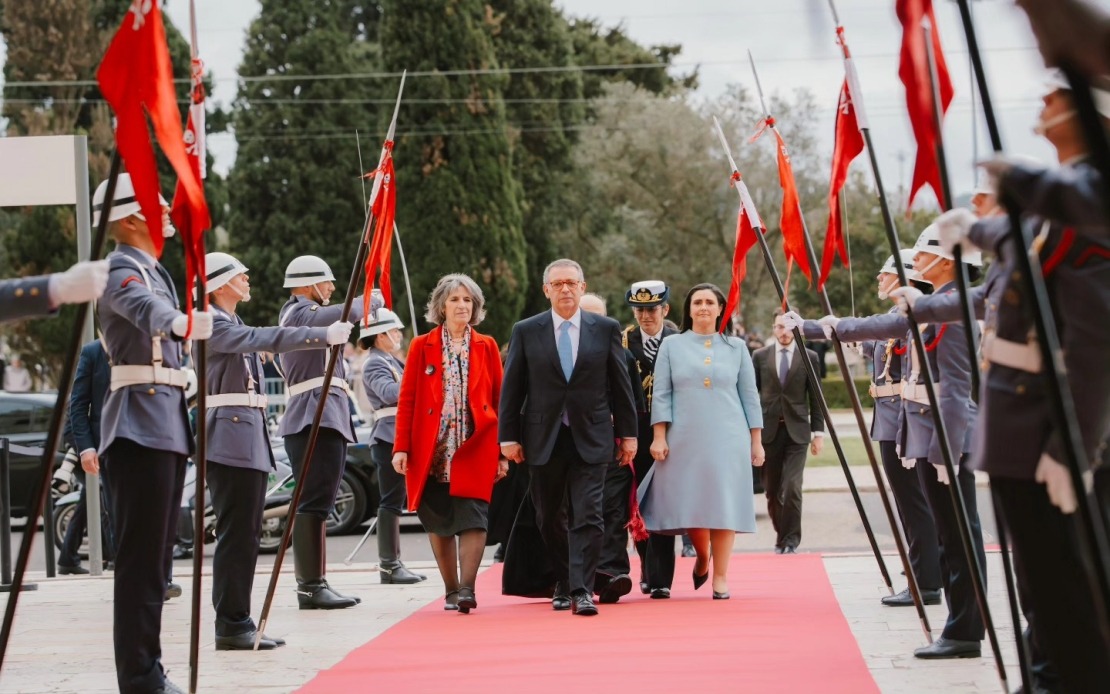
Portugal has formally prohibited face coverings in public spaces following President Antonio Jose Seguro's approval of legislation that originated from the right-wing Chega party. The presidential signature came on Tuesday, with officials at Belem Palace, the seat of Portugal's presidency in Lisbon, framing the decision as addressing matters of considerable social and cultural importance to the Portuguese nation. The enactment reflects growing momentum across Europe toward such restrictions, positioning Portugal alongside an expanding roster of EU member states grappling with similar policy questions.
Seguro's decision to endorse the measure followed substantive parliamentary amendments that addressed his initial reservations. These modifications proved persuasive enough to bring the president's support, demonstrating how legislative compromise can bridge executive concerns. The president's office articulated a multifaceted rationale encompassing social cohesion, the prevention of discriminatory practices, and maintenance of public order. Additionally, Seguro referenced established jurisprudence from the European Court of Human Rights, suggesting the legislation aligns with continental legal precedents governing facial concealment in shared spaces.
The presidential statement underscored philosophical foundations rooted in Portuguese civic traditions. Officials emphasised that an uncovered face functions as an essential element of social confidence, reflecting deeply embedded characteristics of Portuguese community life. The argument centres on the notion that daily social interaction fundamentally depends upon reciprocal visual recognition and the capacity for authentic human connection between individuals navigating shared environments. This framing positions the ban not merely as a security measure but as foundational to the nation's conception of communal existence.
A particularly significant dimension of the government's justification addresses gender equality. Portuguese officials emphasised that mandating facial concealment exclusively for women creates an inherent contradiction with principles of equal dignity and parity between genders that supposedly characterise European democratic societies. This gendered analysis suggests that permitting women alone to obscure their entire faces perpetuates asymmetrical social relationships incompatible with contemporary European standards governing the rights and freedoms of all citizens regardless of sex.
Simultaneously, the presidential statement attempted to reconcile the prohibition with individual liberty frameworks. Authorities acknowledged that citizens within a free society possess legitimate interests in expressing personal identity and religious conviction. However, this freedom operates within collective boundaries established through commonly accepted rules that generate shared civic experience. Officials indicated that the European Court of Human Rights has recognised this conceptual framework, suggesting international human rights jurisprudence accommodates restrictions on face coverings when properly framed.
However, the legislation has encountered sharp opposition from human rights organisations operating within Portugal. Amnesty International Portugal has denounced the ban as discriminatory, arguing that it effectively violates the autonomous choices of Muslim women who voluntarily adopt facial covering practices rooted in their religious and cultural commitments. The organisation contends that the restriction fails to distinguish between coerced concealment and consensual religious practice, thereby threatening fundamental freedoms for religious minorities within Portuguese society.
Portugal's adoption of this prohibition places it within a broader European movement toward similar restrictions. France, Belgium, Austria, Denmark, and the Netherlands have each implemented full or partial bans on public face coverings, creating a continent-wide pattern that reflects persistent tensions between security imperatives, cultural integration objectives, and minority religious rights. These nations span different political traditions and constitutional frameworks, yet have collectively converged on restricting facial concealment, suggesting profound anxiety across European societies regarding identity recognition and public belonging.
For Southeast Asian readers, Portugal's actions warrant attention as a case study in how wealthy democracies balance competing rights claims. Malaysia's own multi-religious and multicultural fabric creates distinct contexts where religious expression and public order interact differently than in homogeneous European societies. The Portuguese approach—emphasising visual recognition and gender equality—reflects European philosophical commitments that may not transfer seamlessly to Asian contexts with different historical relationships between religious practice and state authority.
The political dynamics underlying Portuguese policy also merit examination. That a law originated by a right-wing party yet received presidential approval suggests how face-covering restrictions have transcended traditional left-right political categories in Europe, becoming consensus issues among establishment and populist forces alike. This convergence indicates deeper anxieties about identity, belonging, and social integration that animate contemporary European politics beyond conventional partisan divisions.
Moreover, the invocation of European Court of Human Rights precedent reveals how international human rights institutions increasingly accommodate restrictions on religious dress practices, potentially narrowing the scope of religious freedom protections that minority communities previously understood as inviolable. This jurisprudential shift carries implications for religious minorities throughout Europe and potentially influences global human rights discourse more broadly, including debates within Southeast Asia regarding balancing security concerns with religious freedom.
As implementation proceeds, Portugal faces practical questions regarding enforcement mechanisms, definition of prohibited coverings, and exemptions for genuine security or medical purposes. These technical dimensions often determine whether restrictions function equitably or disproportionately burden vulnerable populations. The distinction between face veils worn for religious reasons and those worn for personal preference, security concerns, or medical needs will substantially affect the law's real-world impact on Muslim communities and other affected groups throughout Portuguese society.

