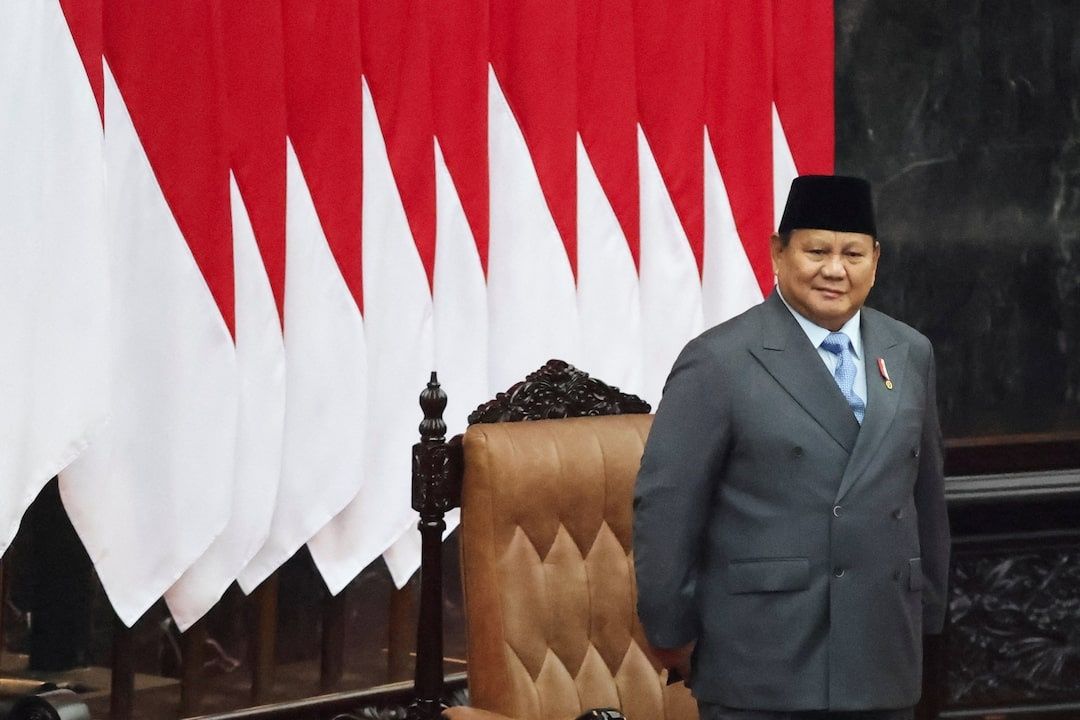
Indonesian President Prabowo Subianto faces a pivotal moment as he unveils the 2027 budget on Friday, addressing mounting concerns about his administration's economic track record and ambitious policy agenda. The former military commander, who entered office in October 2024 riding high on promises to combat corruption and accelerate growth to 8 percent annually, now confronts sharply eroded public confidence and deepening market uncertainty that could shape the trajectory of Southeast Asia's largest economy.
When Prabowo swept to victory just months ago, his mandate seemed clear and his popularity formidable. Beyond pledging to eliminate endemic corruption, he championed flagship programmes including free meals for millions of schoolchildren and committed to lifting economic growth from its current 5 percent pace. Yet the intervening months have proved far more challenging than anticipated, exposing the gap between campaign rhetoric and governing reality. The administration has grappled with a depreciating rupiah, a stock market that has disappointed investors, and persistent questions about fiscal discipline and institutional independence at the central bank.
The most visible casualty of these pressures has been the free meals initiative itself. Once celebrated as a centrepiece of Prabowo's social agenda, the programme has experienced significant budget reductions alongside allegations suggesting operational shortcomings. The setback has reverberated beyond mere policy mechanics—it signals to ordinary Indonesians that even the president's highest-priority commitments face real constraints, undermining confidence in his broader reform agenda.
The collapse in Prabowo's approval rating has been stark. Recent polling shows his support has hemorrhaged by 30 percentage points in just eight months, falling to 51 percent. This steep decline reflects both tangible economic frustrations and deeper public dissatisfaction with law enforcement performance, suggesting that security and anti-corruption platforms that once dominated his messaging have lost salience amid immediate household concerns. For a leader who built his election strategy on decisive action and nationalist appeals, this erosion poses genuine political risk.
International investors, meanwhile, have grown increasingly cautious. The budget presentation carries outsized symbolic weight because it represents what economists describe as a critical credibility checkpoint. As Irman Faiz of Bank Danamon observed, the market has absorbed policy surprises repeatedly over consecutive years and has become less tolerant of uncertainty. Indonesia's fiscal deficit, currently tracking around 2.8 percent of gross domestic product in 2025, is approaching the constitutional ceiling of 3 percent, leaving little room for expenditure surprises or revenue disappointments.
The deepest source of investor anxiety stems from Prabowo's May announcement regarding commodity export centralisation. In that address to parliament, he unveiled plans to consolidate all critical natural resource exports through a new state-owned enterprise called Danantara Sumberdaya Indonesia. The move alarmed global markets because it raised questions about trade liberalisation commitment and raised the spectre of state-directed resource nationalism that could disrupt international supply chains.
Since the original announcement, government officials have attempted to walk back the most aggressive interpretation, suggesting Danantara Sumberdaya Indonesia would function primarily as a supervisory body rather than a direct operator controlling exports. Yet ambiguity persists. Yose Rizal Damuri, executive director of the Center for Strategic and International Studies, emphasised that investors remain uncertain about the entity's precise mandate and operational scope. For commodity traders, particularly those engaged in palm oil markets already sensitive to environmental and political risks, this lack of clarity presents a material concern affecting investment and hedging decisions.
Friday's dual-address format—with an Independence Day speech in the morning followed by the afternoon budget presentation—offers Prabowo an opportunity to reset expectations and articulate a coherent policy narrative. The morning address will allow him to frame his vision in nationalist and patriotic terms, potentially appealing to domestic sentiment, while the budget itself will need to address hard fiscal realities and investor requirements.
Arya Fernandes, head of politics and social change at CSIS, identified the core challenge confronting the president: simultaneously addressing economic anxieties while defending the credibility of his priority programmes. The task appears formidable given current conditions. Prabowo must convince both domestic audiences and international investors that his administration possesses both the capacity and commitment to manage fiscal risks responsibly while pursuing transformative structural reforms.
The implications extend beyond Indonesia itself. Developments in Southeast Asia's largest economy influence regional investment flows, currency valuations, and commodity prices affecting neighbouring economies including Malaysia, Thailand, and the Philippines. If Prabowo's budget presentation succeeds in clarifying policy directions and reassuring markets about fiscal discipline, it could restore investor confidence across the region. Conversely, further ambiguity or disappointment could deepen capital outflows and currency volatility affecting the broader Association of Southeast Asian Nations community.
For Malaysian observers particularly, Indonesia's trajectory matters substantially. Trade relationships, currency movements, and regional financial stability are all interconnected. The rupiah's performance influences competitiveness of Indonesian exports relative to Malaysian goods, while commodity price movements affect both economies. A successful budget presentation that stabilises investor sentiment could create more positive regional conditions; persistent uncertainty could amplify volatility affecting cross-border commerce and investment flows throughout Southeast Asia.

