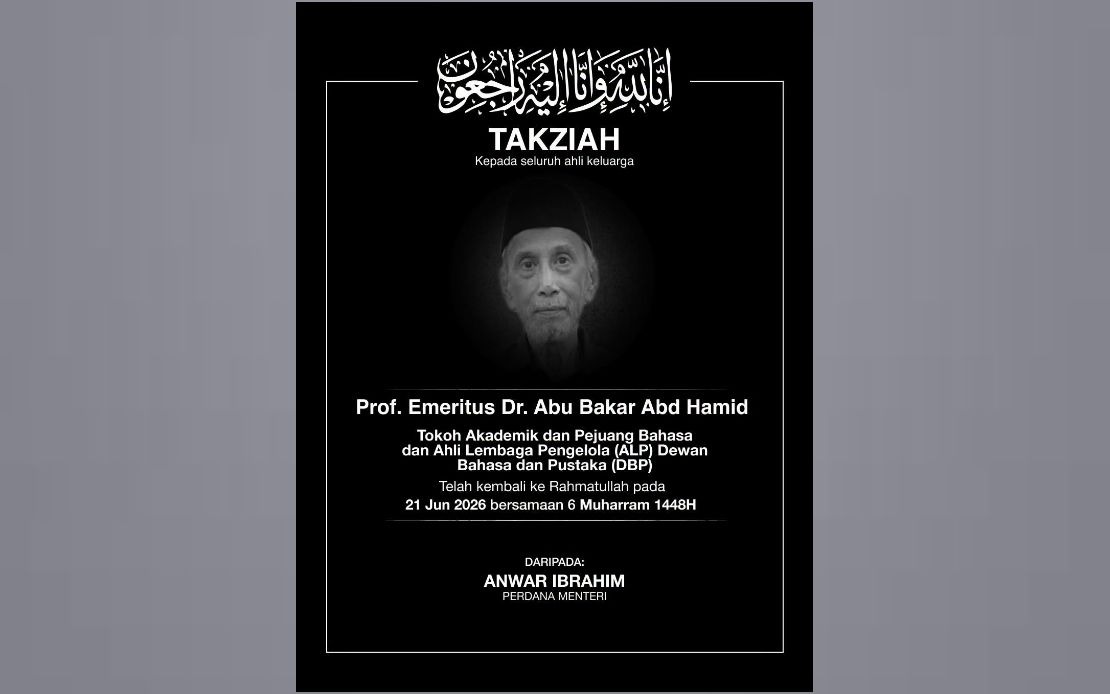
Prime Minister Datuk Seri Anwar Ibrahim has issued a statement of deep condolence following the death of Professor Emeritus Datuk Abu Bakar Abd Hamid, a cornerstone figure in Malaysian academic and literary circles who passed away on June 21 at his Petaling Jaya residence. The Prime Minister's tribute, shared through a Facebook post on June 24, reflected both his personal connection to the deceased scholar and the broader significance of Abu Bakar's contributions to Malaysia's intellectual heritage.
Anwar's remarks carried particular weight given his own academic background and his long-standing relationship with Abu Bakar. The Prime Minister recalled his time as a student under Abu Bakar's tutelage, describing the relationship as one that transcended the typical classroom dynamic. Anwar emphasised that Abu Bakar commanded respect and affection not merely as an educator dispensing knowledge, but as an intellectual beacon whose unwavering dedication to scholarship and learning left an indelible mark on generations of Malaysian students and scholars. This personal dimension underscores the profound influence Abu Bakar wielded within university circles and beyond.
The late academic's career trajectory encapsulates several pivotal moments in Malaysia's institutional development. Abu Bakar served as deputy vice-chancellor of Universiti Malaya beginning in 1987, a position that placed him at the helm of the nation's oldest university during a critical period of academic expansion and consolidation. His tenure coincided with Malaysia's broader push to strengthen higher education infrastructure, and his leadership contributed significantly to UM's development as a research-focused institution. Beyond his administrative responsibilities, Abu Bakar remained deeply engaged in scholarly pursuits centred on Malay literature, cementing his reputation as a leading voice in the humanities within the Malaysian academic establishment.
Abu Bakar's fingerprints are evident on the institutional scaffolding that defines modern Malaysian higher education. His involvement as joint secretary of the committee responsible for establishing Universiti Kebangsaan Malaysia in 1968 placed him among the architects of what would become the national university. UKM's founding represented a watershed moment in Malaysia's educational history, reflecting a strategic commitment to building indigenous research capacity and fostering Malay-medium scholarship. Abu Bakar's instrumental role in this process underscores his standing not merely as a scholar but as a nation-builder who helped shape the contours of post-independence Malaysia.
Beyond the university sector, Abu Bakar's influence extended into the media and public information sphere. He chaired the Board of Governors of Bernama, the Malaysian National News Agency, from 1996 to 2000, a period when Malaysia's information landscape was undergoing significant transformation. This appointment reflected his stature as an intellectual trusted to steward important national institutions. His leadership of Bernama's governing body positioned him at the intersection of academia, journalism, and state communication during a formative period in Malaysia's development.
Throughout his career, Abu Bakar accumulated considerable recognition for his scholarly endeavours and institutional leadership. He received numerous prestigious awards and accolades that acknowledged his outstanding contributions to literature and education. These honours served as markers of his reputation within both Malaysian and regional academic communities. For many in the humanities and social sciences, Abu Bakar represented the gold standard of intellectual rigour married to institutional responsibility—a figure who did not retreat into the ivory tower but instead engaged directly with the practical challenges of building Malaysia's knowledge infrastructure.
The circumstances of Abu Bakar's death—a sudden onset of respiratory distress at his Petaling Jaya home on the evening of June 21—deprived the nation of an active mind whose counsel on matters of education and literature might have continued to prove valuable. By all accounts, he remained engaged with intellectual life until the moment of his passing. The speed and unexpectedness of his death sent shockwaves through academic circles, where Abu Bakar remained a figure of considerable standing and influence despite his retirement from formal positions.
Anwar's public grief, expressed through his Facebook tribute, carries significance beyond personal sentiment. The Prime Minister's decision to publicly acknowledge Abu Bakar's death and his own student relationship with the deceased signals the continued relevance of the academy and literary scholarship within Malaysia's broader national discourse. At a time when technical and commercial education often dominate discussions of higher learning, Anwar's recognition of Abu Bakar's contributions to Malay literature reasserts the importance of humanistic inquiry and cultural continuity. The tribute implicitly positions literary and academic achievement as matters worthy of national attention and remembrance.
For Malaysian readers and the region's intellectual community, Abu Bakar's death marks the passing of a generation of nation-builders who directly participated in constructing post-independent Malaysia's institutions. He belonged to that cohort of academics and public servants who combined scholarly ambition with practical institution-building, helping establish the universities, agencies, and structures through which modern Malaysia operates. The loss of such figures—individuals with direct experience of Malaysia's foundational period—represents a genuine diminishment of living memory and institutional wisdom.
Anwar's invocation of divine mercy—"May Allah SWT forgive his sins and grant his soul peace and a special place"—reflects the Islamic context within which Abu Bakar's life and legacy are understood in Malaysian society. The Prime Minister's prayer for Abu Bakar's eternal reward situates the scholar within a spiritual framework even as it acknowledges his temporal accomplishments. For Malaysia's Muslim-majority population, this fusion of intellectual achievement and religious devotion is unremarkable; it reflects a worldview in which scholarship and faith coexist naturally.
The rituals surrounding Abu Bakar's death—his burial at Bukit Kiara Muslim Cemetery on the Monday following his passing—underscore the ordinariness and dignity with which Malaysian society marks the deaths of its distinguished figures. Yet the subsequent public tributes, including the Prime Minister's statement, elevate the event beyond routine funeral proceedings. They constitute a form of national accounting, a moment when society takes stock of what a particular life contributed to the collective project of nation-building. Abu Bakar Abd Hamid's legacy endures through the institutions he helped establish, the students he mentored, and the scholarly traditions he championed within the Malaysian academic landscape.