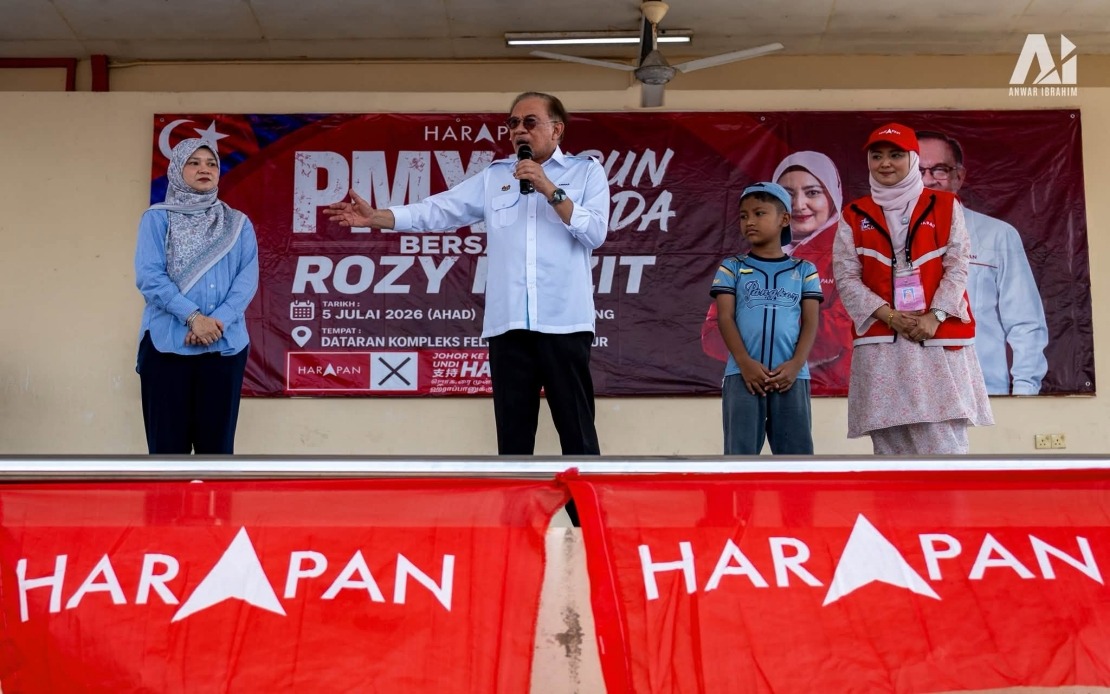
Prime Minister Datuk Seri Anwar Ibrahim has been deeply affected by an encounter with a determined young boy whose grandmother took him on a perilous journey through thick oil palm plantations, driven solely by her grandson's aspiration to see the country's leader in person. The chance meeting occurred during an official programme at Felda Palong Timur in Segamat, where the Prime Minister found himself unexpectedly moved by what unfolded—a moment that has stayed with him long after the event concluded.
Muhammad Afif Ikhwan, just nine years old, managed to push through the crowd surrounding the Prime Minister at the Felda gathering, extending his small hand for a handshake that would prove to be far more significant than a fleeting political engagement. That brief physical contact and the boy's presence among the assembled crowd made such a profound impact on Anwar that he felt compelled to ensure the moment would not be forgotten. Rather than letting the encounter fade into routine campaign memories, the Prime Minister arranged for someone from his office to seek out the young boy and present him with a bicycle—a gesture that transformed a single handshake into something more lasting.
Behind this seemingly simple moment lay a remarkable story of familial devotion and sacrifice. Rosimah Mohammad, Muhammad Afif's 58-year-old grandmother from Kampung Pudu in Segamat, had made the challenging decision to ride a motorcycle with her grandson along the dusty, difficult tracks that crisscross oil palm plantations. These routes are far from ideal for travel, particularly for an elderly woman accompanying a child, yet she undertook the journey with singular purpose: to grant her grandson the opportunity to stand before the Prime Minister and shake his hand. The plantation landscape that forms the backbone of much of Peninsular Malaysia's economy became, for this family, the path to a dream.
In reflecting on the encounter through a Facebook post, Anwar highlighted the broader significance of what might otherwise appear to be an inconsequential moment in a busy political schedule. He emphasised how what seemed like a modest ambition to the boy—meeting the nation's leader—had proven substantial enough to inspire his grandmother to overcome obstacles and ride through challenging terrain. This contrast between the smallness of the wish and the magnitude of effort required to achieve it struck the Prime Minister as worthy of public acknowledgement and celebration.
The staging of the encounter itself revealed the spontaneity and human element that characterised the interaction. When Muhammad Afif's small hand broke through the crowd to reach the Prime Minister, Anwar extended his own in response before bringing the boy onto the stage itself. This inclusion, rather than a mere perfunctory handshake, elevated the boy's experience and demonstrated an openness to genuine human connection amid the formalities of high office. For a nine-year-old from a rural community, such a moment could represent the kind of memory that shapes one's relationship with the nation and its leadership for decades to come.
Anwar's public reflections on the incident carried a deeper philosophical message about the responsibilities of those holding high office, particularly when managing the substantial demands of governing a nation confronted with myriad challenges. He articulated a conviction that regardless of how consumed leaders become with policy matters, budgetary concerns, and the complex machinery of state administration, maintaining genuine compassion and demonstrating our shared humanity cannot be sidelined. This assertion suggests that leadership encompasses not merely economic management or political strategy, but the preservation of dignity and recognition for ordinary citizens, especially the young.
The Prime Minister also voiced hope that this singular moment would crystallise into a foundational memory for Muhammad Afif—one that might serve as inspiration as the boy progressed through his schooling and navigated his future responsibilities to his family, his immediate community, and the nation at large. This perspective reveals an understanding that such encounters, while individually brief, can carry symbolic weight and potentially influence a young person's sense of connection to the broader national project.
The story resonates particularly within Malaysian society given the nation's heavy reliance on palm oil agriculture, which employs hundreds of thousands and generates substantial export revenue. For communities living within or adjacent to these plantations, the land that provides economic sustenance often remains distant from centres of power and urban development. Muhammad Afif's determination to journey across this landscape to meet his nation's leader carries implicit commentary on aspirations within peripheral communities to maintain ties with the national centre.
The bicycle gift sent subsequently by the Prime Minister's office underscores a commitment to translating emotional resonance into tangible gesture. For a child in a rural area, such an item represents not merely material comfort but enhanced mobility and independence—practical tools for development that complement the emotional value of the encounter itself. This dual gesture, combining symbolic recognition with functional support, demonstrates awareness that genuine engagement with citizens involves both acknowledgment and material concern for their wellbeing.
The incident ultimately illuminates the tension within modern governance between the necessity of managing complex institutional machinery and the equally vital capacity for personal connection and human empathy. By publicly sharing and reflecting on his encounter with Muhammad Afif and his grandmother Rosimah, Anwar has contributed to a narrative suggesting that political leadership need not be entirely divorced from the emotional and relational dimensions of public life, even as he shoulders responsibilities of tremendous scope and consequence.

