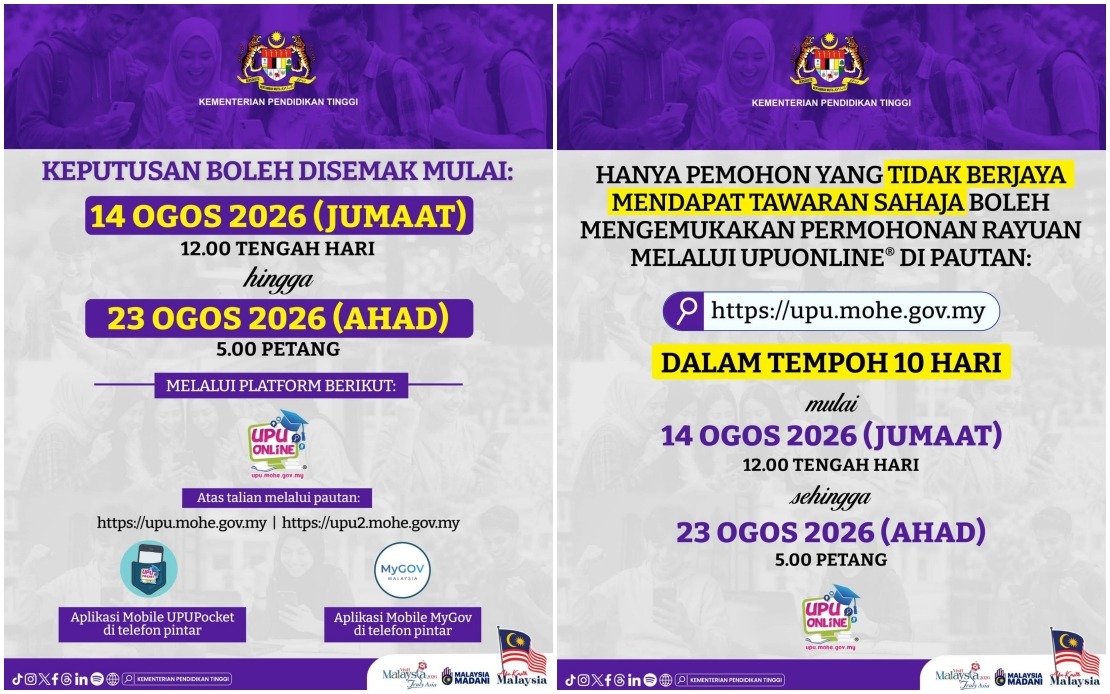
Malaysian students holding STPM or equivalent qualifications will receive their public university application decisions on August 14, marking a pivotal moment in the higher education admissions calendar for the 2026/2027 academic session. The Ministry of Higher Education has confirmed that successful applicants, along with those whose applications have been unsuccessful, will be able to access their results through multiple digital platforms beginning at noon on that date.
The period for checking outcomes extends through August 23 at 5 pm, providing candidates with a nine-day window to review their application status. The ministry has facilitated access through three primary channels: the dedicated UPUOnline portal at https://upu.mohe.gov.my, an alternative government server at https://upu2.mohe.gov.my, and mobile applications available on smartphones via UPUPocket and MyGov. This multi-channel approach reflects efforts to ensure nationwide accessibility across diverse digital literacy levels and connection speeds, particularly important for students in rural and less-connected areas.
Once results are released, the formal confirmation process begins immediately. From August 15 through August 23, candidates must actively respond to their offers through individual university websites. This staggered timeline creates urgency; applicants who wish to secure their place must navigate university portals and formally accept offers within the prescribed window. Universities will then issue official acceptance letters to those who have confirmed their willingness to enrol, commencing August 15. This sequential approach prevents situations where students hold multiple offers without committing, allowing institutions to manage enrolment planning more effectively.
The Ministry of Higher Education has established clear parameters around offer finality that merit attention from prospective undergraduates. Once an applicant receives and accepts an offer to a particular institution for a designated programme, subsequent requests to transfer between universities or change academic disciplines will not be entertained. This policy underscores the binding nature of the confirmation process and places responsibility on students to carefully evaluate their options before committing. For Malaysian education stakeholders, this reinforces the importance of thorough preparation prior to application submission, as last-minute changes will not be possible within the formal admission cycle.
Applicants who do not receive initial offers retain one recourse through the formal appeals mechanism. Between August 14 and August 23—the same window as the confirmation period—unsuccessful candidates may submit appeals via UPUOnline for consideration in subsequent rounds. However, appeals success depends entirely on programme vacancies that emerge after new student registration concludes. This creates a contingent pathway rather than a guaranteed opportunity; institutions must first confirm enrolments from initial offers before appeals can be processed. The timing is deliberately tight, requiring rejected applicants to act decisively if they wish to pursue this avenue.
For Malaysian families navigating the university admission process, understanding the appeals policy framework is crucial. The selection criteria for appeal rounds differ fundamentally from initial allocation, as spots are allocated only where genuine vacancies exist post-registration. This may result in limited positions across the public university system, particularly in programmes with high competition. Students considering appeals should develop contingency plans involving private institutions or gap-year alternatives, rather than relying solely on this secondary mechanism.
The announcement reflects ongoing evolution in Malaysia's higher education admissions infrastructure. The UPUOnline system represents a consolidation of digital admission processes, though candidates navigate multiple official channels—a feature suggesting ongoing systems integration efforts within the Ministry of Higher Education. For regional observers, Malaysia's approach demonstrates how Southeast Asian nations are leveraging digital platforms to manage large-scale admissions while maintaining institutional autonomy in final selection and confirmation stages.
The August 14 release date falls within Malaysia's traditional school holiday calendar, providing families time to process outcomes without disrupting academic schedules. However, the compressed confirmation window from August 15-23 means students receive results just before the academic calendar typically winds down and family schedules may become constrained with end-of-year activities. This timing consideration underscores the importance of advance planning and having decision frameworks in place before results arrive.
For international observers and comparative education researchers, Malaysia's structured three-phase process—initial allocation, confirmation, and appeals—offers insights into managing admissions at scale across public systems. The emphasis on digitisation aligns with regional trends toward reducing paper-based administrative burdens, though implementation across diverse institutional contexts remains an ongoing challenge. The Ministry's clear communication of timelines and procedures reflects recognition that applicant anxiety peaks during result periods, and transparency serves both institutional and student interests.

