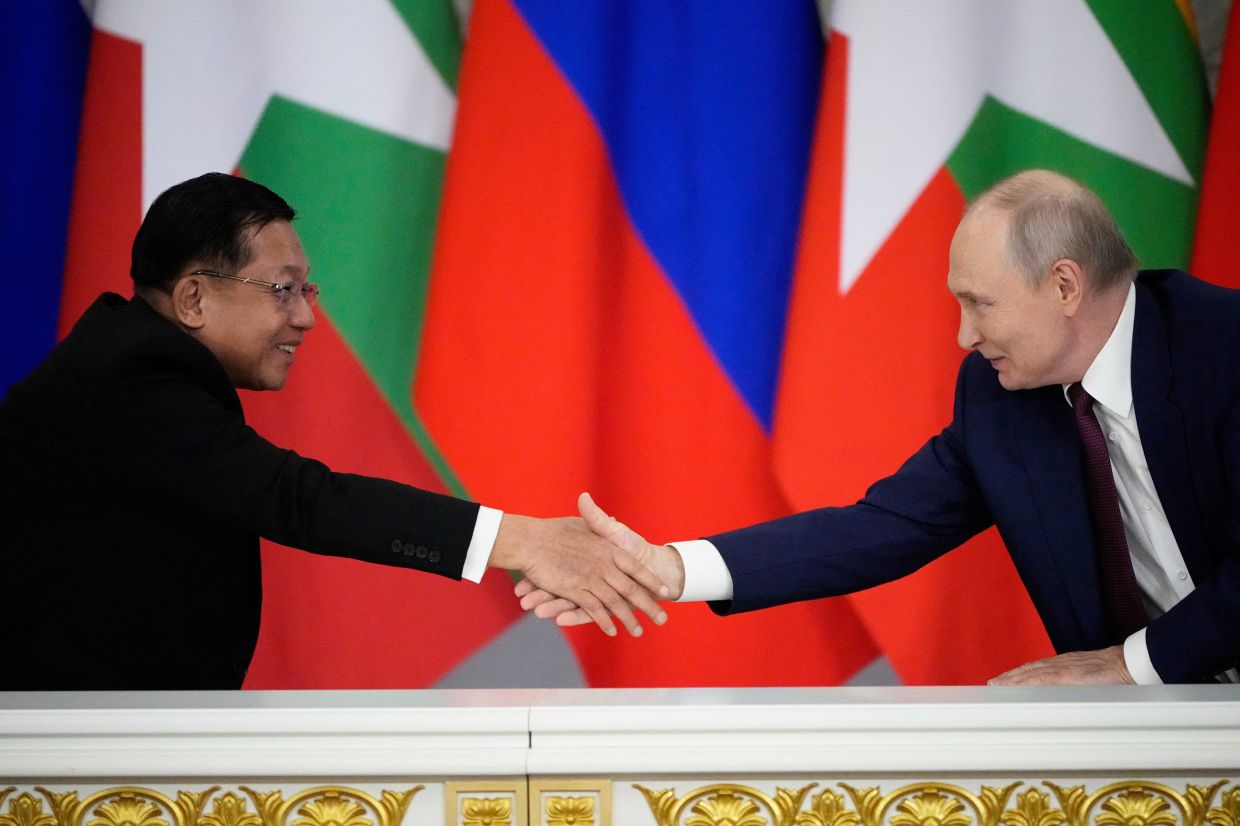
Russian President Vladimir Putin has welcomed Myanmar's leader Min Aung Hlaing to Moscow for high-level talks, reaffirming the two nations' strengthening strategic partnership at a time when the Southeast Asian country faces widespread international criticism over its military governance. The August 18 meeting at the Kremlin marked the Myanmar leader's first visit to Russia since formally assuming the presidency following disputed elections, and represented the fourth encounter between Putin and Min Aung Hlaing since Russia's invasion of Ukraine accelerated the isolation of both nations from Western powers.
Putin characterised the relationship between Russia and Myanmar as having grown "especially trusting" in recent years, a diplomatic formulation that underscores Moscow's strategic interest in maintaining influence within Southeast Asia as Western nations maintain their distance from Myanmar's military rulers. The Russian leader's comments reflected a deliberate effort to position Russia as a reliable partner for Myanmar at a moment when the junta-controlled government seeks international legitimacy following the widely criticised military-backed elections that resulted in Min Aung Hlaing's selection as president.
The scope of bilateral engagement extends well beyond symbolic gestures. Russia is actively pursuing substantial infrastructure investments in Myanmar, including plans to construct a power plant and an oil refinery in the country's southern regions. These projects signal Moscow's determination to deepen its economic footprint in Myanmar and secure long-term access to the nation's natural resources, particularly in the hydrocarbon sector. Putin explicitly stated Russia's ambitions to participate in geological exploration and hydrocarbon production activities, indicating that energy cooperation will form a cornerstone of the bilateral relationship moving forward.
The composition of the Russian delegation underscored the multifaceted nature of the partnership. High-ranking officials from Russia's foreign policy, financial, energy and defence sectors participated in the talks, demonstrating that Moscow views Myanmar as strategically significant across multiple domains. This comprehensive approach reflects Russia's broader strategy to build alternative partnerships outside the Western-dominated international system, particularly among nations willing to maintain engagement despite pressure from democratic nations and international organisations.
Military and military-technical cooperation represents perhaps the most consequential dimension of the Russia-Myanmar relationship. Putin acknowledged the establishment of "close military and military-technical cooperation" between the two countries, a partnership that has manifested in substantial weapons sales. According to a United Nations report released in May 2023, Russia has supplied more than US$400 million in advanced weaponry to Myanmar's military since the 2021 coup, making Moscow a critical supplier to the junta's armed forces. This military dimension provides Moscow with significant leverage and influence over Myanmar's strategic calculations and defence policies.
Nuclear technology cooperation adds another layer to the bilateral partnership. Myanmar is currently collaborating with Russia's Rosatom State Corporation to develop a small nuclear power plant, representing an initial foray into utilising atomic technology for applications across healthcare, agriculture and industrial sectors. This cooperation positions Russia as a technological partner in Myanmar's development aspirations and creates long-term dependencies that reinforce strategic alignment between the two nations. Such partnerships are particularly valuable to Russia as they provide avenues for technical influence and ongoing commercial engagement.
The Myanmar delegation's composition reflected the comprehensive nature of the visit. A high-level contingent including multiple government ministers and the head of the Myanmar Space Agency arrived in Moscow ahead of the formal presidential talks, signalling that Min Aung Hlaing intended to address wide-ranging aspects of bilateral cooperation. Beyond his meeting with Putin, the Myanmar leader held separate discussions with Prime Minister Mikhail Mishustin and Vyacheslav Volodin, speaker of Russia's lower house. Min Aung Hlaing was also scheduled to participate in the Myanmar-Russia Business Forum, facilitating direct engagement between commercial actors from both nations and demonstrating efforts to develop substantive economic relationships beyond government-to-government ties.
Minutes acknowledging potential for liquefied natural gas cooperation between the two countries highlight Russia's interest in expanding its energy export markets and leveraging Myanmar's geographic position and resource endowments. As Western sanctions severely restrict Russia's access to traditional energy markets, developing alternative export channels becomes increasingly critical for Moscow's economic viability. Myanmar's potential role as a transit point or partner in LNG ventures suggests Russia's strategic calculations extend beyond Myanmar itself to broader regional energy flows.
Min Aung Hlaing's Moscow visit forms part of a wider diplomatic offensive aimed at securing international acceptance of Myanmar's military government following the disputed election. The Myanmar leader has recently undertaken official trips to China, India, Laos and Thailand, systematically rebuilding bilateral relationships across Asia. These travels, coupled with stated attempts to improve relations with the United States and the Association of Southeast Asian Nations, reveal a junta leadership attempting to manage its international isolation by deepening ties with sympathetic nations while simultaneously signalling willingness to negotiate with Western powers and regional organisations. The government continues to resist international pressure regarding the detention of ousted civilian leader Aung San Suu Kyi, indicating non-negotiable positions that shape its diplomatic strategy.
Russia's early diplomatic engagement with Myanmar's post-election government has already been evident. Sergei Shoigu, Putin's top security adviser, became the first foreign official to visit Myanmar following the disputed elections in February, demonstrating Moscow's commitment to maintaining close ties when many Western nations suspended high-level engagement. This prior visit established a template for Russia-Myanmar interaction and signalled Moscow's willingness to engage Myanmar's military government without the moral reservations expressed by Western democracies and the United Nations regarding the legitimacy of the electoral process.
The strategic partnership between Russia and Myanmar reflects broader geopolitical realignments occurring across Asia. As Western influence recedes from certain regions due to policy choices by local governments, Russia and China have positioned themselves as alternative partners willing to engage without imposing conditions related to democratic governance or human rights. For Myanmar's military leadership, Russia offers valuable military technology, energy partnerships and diplomatic support that help offset the consequences of Western isolation. For Russia, Myanmar provides a strategic foothold in Southeast Asia, access to valuable resources and demonstrations that Western sanctions have not fundamentally undermined its ability to conduct great power diplomacy.
The economic dimensions of the Russia-Myanmar partnership hold particular significance for Southeast Asia's broader energy security and geopolitical balance. As regional nations grapple with energy transitions and infrastructure modernisation, the Russian model of engagement—characterised by substantial investment and minimal conditionality—presents an alternative to Western development partnerships. Myanmar's receptiveness to Russian investments in power generation and refining capacity could influence how other Southeast Asian nations approach similar infrastructure challenges, potentially expanding Russian influence across the region's critical energy sectors.
Looking ahead, the deepening Russia-Myanmar relationship appears durable despite international pressure. Both nations benefit from continued engagement: Myanmar gains military support and economic partnerships essential for regime stability, while Russia secures regional influence and resource access at a moment of strategic vulnerability. The relationship's resilience will likely depend on whether Russia can deliver on promised infrastructure projects and whether Myanmar's military government finds the economic and security benefits sufficient to justify the reputational costs of close association with a nation widely condemned for its invasion of Ukraine.

