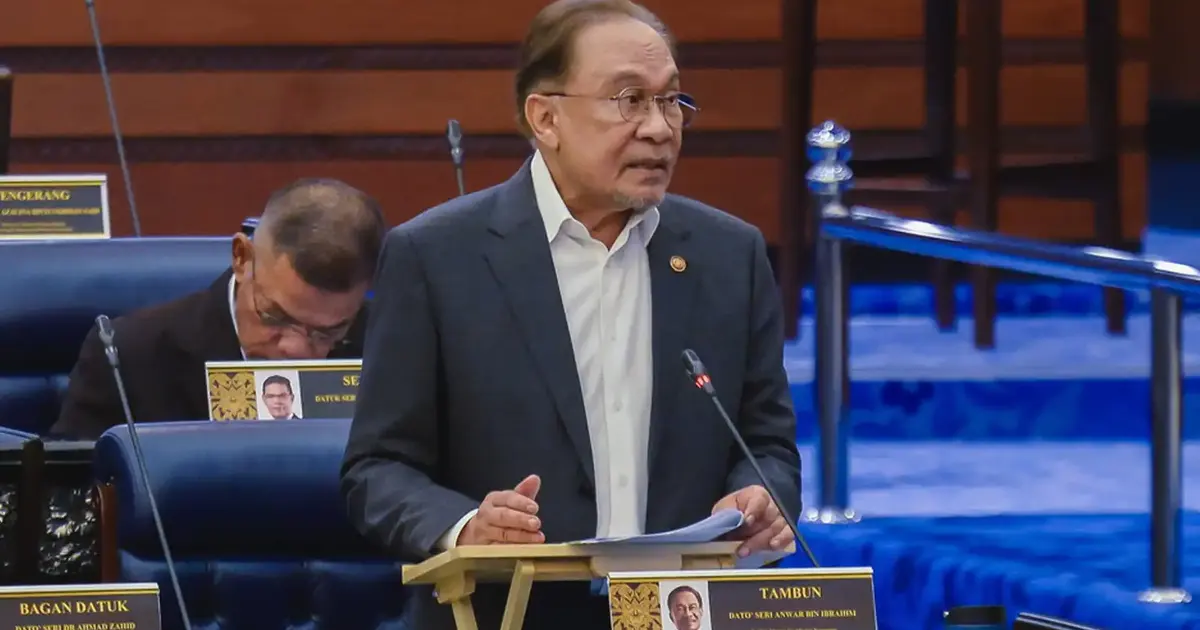
Prime Minister Anwar Ibrahim has drawn a firm line on federal financial responsibility, declaring that Putrajaya will not passively absorb unexpected expenditure burdens generated by state-level project decisions. His statement represents a significant shift in how the federal government intends to manage its relationship with state administrations on matters involving public spending, particularly when construction and development initiatives experience cost inflation.
The prime minister's position centres on the principle that states must take ownership of their financial commitments and the consequences of those decisions. When project costs exceed original budgets—whether due to material price increases, design modifications, or execution delays—states cannot simply expect the federal treasury to cover the shortfall without substantial renegotiation. This approach reflects broader governance concerns about fiscal discipline and accountability across Malaysia's federal structure.
Anwar's comments carry particular weight given Malaysia's decentralized system, where state governments operate relatively autonomously within their jurisdictions while depending substantially on federal allocations and revenue-sharing arrangements. The tension between state autonomy and federal financial involvement has historically created friction, with states occasionally viewing federal support as a given and the federal government struggling to maintain budgetary control over cascading deficits. By articulating this clear boundary, Anwar seeks to establish transparent expectations.
The implications extend beyond simple accountancy. States that had previously assumed they could present cost overruns to Putrajaya for absorption must now develop more robust contingency planning and project management systems. This encourages greater fiscal discipline at the state level and forces administrators to make tougher choices about project scope, timeline, and resource allocation. For states with weaker financial positions or ambitious development agendas, the policy creates genuine constraints that may necessitate scaling back plans or seeking alternative funding mechanisms.
Federal-state financial relationships in Malaysia have traditionally operated within informal frameworks where negotiation and political considerations often influenced outcomes. Anwar's explicit statement formalizes expectations and reduces the ambiguity that states might previously have exploited. This creates a more predictable environment for federal budgeting but potentially complicates relations with states controlled by opposition parties, which may interpret the policy as punishment or partisan discrimination.
The policy also reflects contemporary Malaysian fiscal realities. The federal government faces considerable debt servicing obligations, aging infrastructure maintenance demands, and competing claims from health, education, and defence budgets. Without firm boundaries on state-level cost absorption, federal finances could deteriorate further, limiting capacity for transformative national initiatives. By refusing automatic bail-outs, Anwar signals that federal resources must be deployed strategically rather than defensively managing state-generated crises.
States seeking additional federal funds or loan facilities must now undertake formal renegotiation processes, placing burden on state administrations to justify increased allocations and demonstrate sound project management. This requirement introduces transparency but also administrative complexity, potentially slowing project timelines while approvals are reassessed. The renegotiation framework essentially treats cost overruns as new requests rather than automatic entitlements.
The approach has particular resonance for major development projects, infrastructure initiatives, and social programmes that states frequently undertake with expectation of federal co-funding. Housing developments, transportation systems, hospital construction, and educational facilities—initiatives where state and federal interests overlap—will be subject to stricter scrutiny. States must now demonstrate project viability and proper planning from inception rather than treating cost management as a federal responsibility.
From a Malaysian economic perspective, the policy potentially strengthens overall public finance management by preventing moral hazard. If states understand that poor planning or inefficient execution will not be rescued by federal funds, they face incentives to employ rigorous project governance. This could improve capital project outcomes across the federation, reducing wastage and ensuring resources are deployed effectively. However, it could also incentivize states to abandon projects midway if unforeseen costs emerge, creating stranded assets and incomplete infrastructure.
The statement carries implications for federal-state relations during periods when different political coalitions control Putrajaya and various state governments. States governed by opposition parties might interpret stringent application of the policy as economically discriminatory, while federally-aligned states might receive more lenient treatment. Managing perceptions of fairness becomes crucial for political stability and intergovernmental cooperation.
Anwar's declaration fundamentally reframes federal responsibility from open-ended support to contingent engagement, requiring explicit justification for any additional commitments. States must absorb their own policy consequences or negotiate comprehensively rather than assuming federal safety nets. This shift towards fiscal federalism demands sophisticated state-level financial management and forces difficult prioritization decisions onto state governments.
The policy announcement suggests the federal government intends to operate under tighter budgetary discipline while encouraging similar practices throughout the federation. Whether states will comply readily or whether political tensions will emerge from strict implementation remains to be seen. The success of this approach depends ultimately on consistent application and clear communication about expectations, principles that Anwar's government has pledged to follow.

