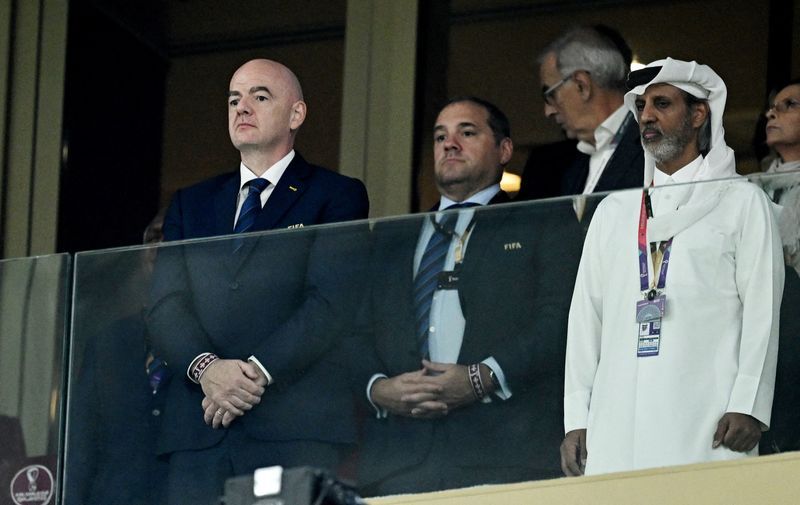
The Qatar Football Association has doubled down on its criticism of the Asian Football Confederation's leadership, claiming the continental body overstepped its authority when it joined European and North American confederations in a public rebuke of FIFA President Gianni Infantino. The escalating dispute centres on a procedural question that has exposed deep fractures within Asian football's governance structures: whether the AFC's president possessed the mandate to issue statements on behalf of member associations without their explicit consent.
The controversy stems from a joint open letter signed by the AFC alongside UEFA and CONCACAF that attacked Infantino's handling of a proposed private investment scheme for the World Cup. The initiative, known as the FIFA Forward Enterprise (FFE), had been developed and presented to member nations without meaningful consultation from continental confederations—a centralised approach that drew widespread criticism from football administrators across multiple continents. Infantino, whose reelection campaign is scheduled for next year, faced unprecedented public opposition from senior figures within his own organisation.
Qatar's President Hamad bin Khalifa Al-Thani, a long-standing Infantino supporter, has now submitted his third letter in this tense correspondence, escalating the tone of his objections. Rather than engaging substantively with the AFC's defence of its position, Al-Thani has maintained focus on what he characterises as a fundamental breach of governance protocol. His latest communication, delivered on Wednesday, argues that the AFC President's response inadvertently concedes the central point at issue: that no meaningful consultation occurred with the confederation's membership before the statement was issued in their collective name.
The distinction Al-Thani is pressing—between the merits of criticising Infantino's conduct and the procedural legitimacy of the AFC acting without consultation—reflects a sophisticated understanding of institutional authority. He contends that even if the AFC's substantive critiques of the FIFA Forward Enterprise were entirely justified, Sheikh Salman bin Ebrahim Al-Khalifa, the AFC President, lacked the constitutional standing to voice those criticisms without first obtaining approval from the confederation's executive committee and broader membership. This argument gains particular weight given that Al-Thani himself holds a seat on both the FIFA Council and the AFC executive committee, positioning him to speak with authority on these governance matters.
Sheikh Salman's response, delivered Tuesday, took a markedly different approach. Rather than defending his procedural authority in technical terms, he asserted that presidents of football confederations have both the constitutional right and the institutional responsibility to act decisively when the interests of their sport are threatened. He pointed to precedent, noting that he and other AFC leaders had previously issued public statements on matters of continental significance, including collective support for Qatar's hosting of the 2022 World Cup despite intense international pressure. By framing the issue as a matter of necessary leadership rather than procedural compliance, Sheikh Salman attempted to shift the conversation away from questions of authority toward broader questions of institutional responsibility.
The dispute between these two senior figures is remarkable for its public nature. The AFC, like most football confederations, typically conducts its business away from public scrutiny, resolving internal disagreements through private channels rather than exchanging letters that are subsequently circulated to journalists. The fact that Reuters has access to this entire correspondence and that both parties are willing to conduct this dispute in the open suggests a breakdown in the customary diplomatic protocols that usually govern elite football politics. This visibility itself carries implications for how member associations perceive AFC leadership and may embolden other voices within Asian football to challenge institutional decisions they might previously have accepted without question.
Qatar's intervention in this dispute is not disinterested. As one of six AFC members that publicly declared support for Infantino early in the controversy surrounding the FIFA Forward Enterprise, Qatar has a stake in the FIFA President's political survival. By attacking the legitimacy of the AFC's criticism, Al-Thani is effectively defending Infantino while maintaining a veneer of procedural concern. This strategic positioning allows Qatar to appear principled—focused on proper governance and institutional rules—while simultaneously advancing the political interests of an embattled FIFA President. For Malaysian readers and Southeast Asian observers, this dynamic illustrates how continental football politics intersect with broader questions of institutional authority and the informal power networks that shape decision-making in international sports governance.
The underlying tension reflects a fundamental question about how confederations should operate in an era when FIFA centralises power and decision-making. The FIFA Forward Enterprise proposal, developed without consulting confederations, embodied an approach that many administrators found objectionable. Yet when the AFC attempted to mount a collective continental response, it did so through channels that apparently did not include meaningful consultation with its own membership. This mirroring of FIFA's exclusionary approach suggests that problems of top-down decision-making may be endemic to football's governance structures across multiple levels, from FIFA down through continental confederations to individual national associations.
Al-Thani's most recent letter explicitly challenges the distinction that Sheikh Salman attempted to draw between procedural authority and substantive responsibility. The Qatari leader argues that any statements the AFC may have issued in the past, including those supporting Qatar's World Cup bid, were framed as reflecting the confederation's institutional interests rather than the collective voice of member associations. This distinction is crucial: it suggests that statements presented as acting on behalf of all members carry different weight and implications than statements issued as the AFC's own corporate position. By making this argument, Al-Thani is attempting to establish that the FIFA criticism crossed a line that previous AFC statements did not, making Sheikh Salman's invocation of precedent inapplicable.
For the broader Asian football community, this dispute raises uncomfortable questions about how decisions affecting the confederation's members are made and approved. With 47 member associations operating across diverse economic, political, and sporting contexts, the question of how to achieve meaningful consultation while maintaining organisational efficiency is not trivial. Yet Al-Thani's criticism suggests that in this instance, efficiency was prioritised over inclusivity. Whether Sheikh Salman will provide additional response to Al-Thani's latest letter remains unclear, but the AFC has yet to issue any immediate statement addressing the Qatari federation's continuing objections.
The implications of this dispute extend beyond questions of internal AFC governance. Infantino's FIFA presidency appears to face mounting opposition from multiple quarters, and divisions within continental confederations may further weaken his position heading into his reelection campaign. For Southeast Asian federations contemplating their own positions on FIFA leadership, the public nature of this dispute and the competing arguments being advanced may provide unwelcome visibility into the fractious nature of continental politics. The question of whether proper procedures were followed in expressing collective criticism of FIFA's President now threatens to overshadow the substantive concerns that prompted the criticism in the first place—a dynamic that may ultimately work to Infantino's advantage.

