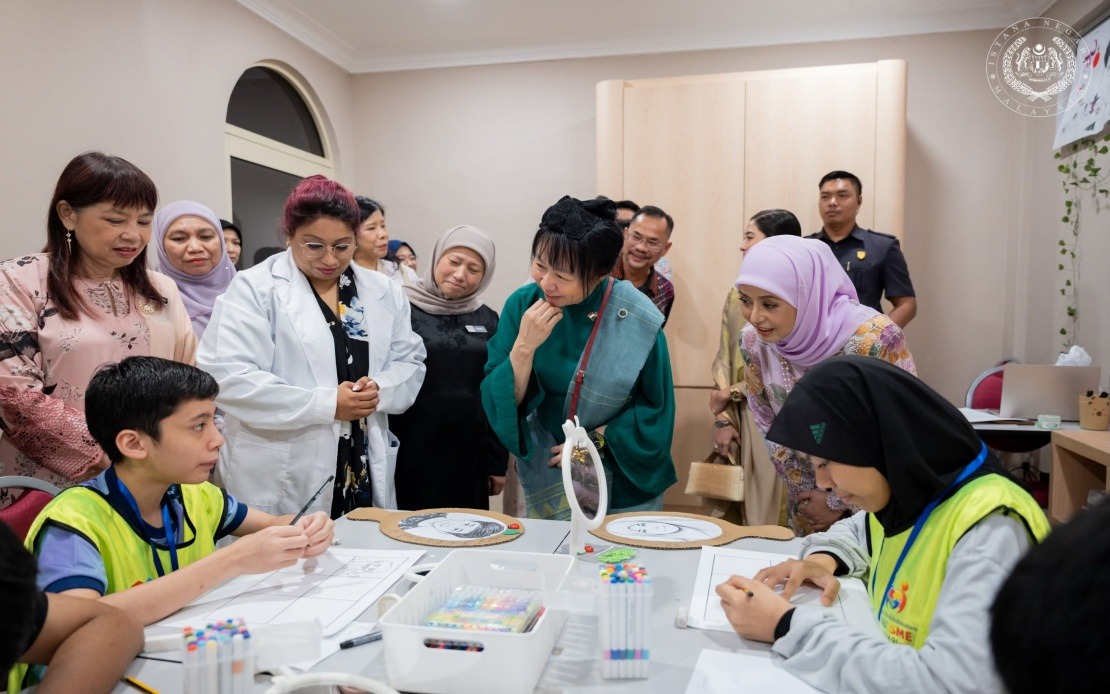
Queen Raja Zarith Sofiah of Malaysia and Singapore First Lady Jane Ittogi Shanmugaratnam toured the Bangi Autism Service Centre in the Selangor capital region on Thursday, marking a significant moment of bilateral engagement during Singapore President Tharman Shanmugaratnam's ongoing state visit to Malaysia. The excursion brought together senior officials from both nations to examine how Malaysia's autism support infrastructure operates and to explore opportunities for strengthening social welfare partnerships between the two neighbouring countries.
The visit was formally integrated into the presidential state visit programme, which commenced the previous day and reflects Singapore's strategic interest in observing Malaysian approaches to autism intervention and community-based rehabilitation. Jane Ittogi's presence alongside the Queen underscores the importance both governments place on social development initiatives, particularly those serving vulnerable populations. The itinerary demonstrated deliberate diplomatic choreography, with the First Lady received not only by Queen Raja Zarith Sofiah but also by Princess Tunku Tun Aminah Sultan Ibrahim, signalling the royal household's active engagement with civil society matters.
The Malaysian delegation assembled for the occasion included Prime Minister's spouse Datuk Seri Dr Wan Azizah Wan Ismail, whose portfolio spans advocacy for family-oriented policies. Women, Family and Community Development Minister Datuk Seri Nancy Shukri led the technical briefings, accompanied by her deputy Lim Hui Ying and senior ministry personnel including secretary-general Datuk Dr Maziah Che Yusoff. The Social Welfare Department, represented by director-general Datuk Che Murad Sayang Ramjan, provided operational expertise on how autism services are structured and delivered across Malaysia's social safety net.
During the facility tour, the visiting dignitaries observed multiple specialist zones designed to support individuals navigating autism spectrum conditions. The Activities of Daily Living room demonstrated practical training methodologies that teach essential self-care competencies, while the Occupational Therapy facilities showcased techniques for enhancing functional independence and vocational readiness. A gymnasium space exhibited how physical activity and movement-based interventions integrate into comprehensive treatment regimens. This multidisciplinary setup reflects international best-practice standards and reveals Malaysia's commitment to holistic, person-centred care models rather than purely medicalized approaches.
Minister Shukri seized the opportunity to present updated epidemiological data on autism prevalence in Malaysia. As of June of the previous year, the Social Welfare Department's official registry documented 93,199 individuals diagnosed with autism spectrum disorder. She emphasized that this figure represents only documented cases and will likely expand substantially as public consciousness grows and diagnostic infrastructure becomes more accessible across rural and underserved urban areas. Malaysia's healthcare system has progressively improved screening pathways, allowing earlier identification and intervention commencement, which correlates directly with improved long-term outcomes.
The projection of rising case numbers reflects a global pattern wherein increased awareness, refined diagnostic criteria, and reduced stigma drive higher identification rates. In Malaysia's context, this trend carries significant implications for resource allocation and service planning. State and federal agencies must anticipate growing demand for speech therapy, educational support, occupational rehabilitation, and community integration programmes. The visibility of high-level government attention to autism services, as demonstrated by ministerial participation and royal patronage, potentially catalyses resource mobilization and policy prioritization within bureaucratic hierarchies that traditionally allocate funding based on political salience.
The Bangi facility itself exemplifies innovative governance architecture within Malaysia's social sector. Rather than relying exclusively on government administration, the centre operates through collaborative frameworks binding public institutions with specialized non-governmental organizations. The National Autism Society of Malaysia brings technical expertise and community networks developed through years of grassroots advocacy and service delivery. The Damansara Damai Community-Based Rehabilitation Centre contributes localized knowledge about integrating autism support within broader community health ecosystems. This hybrid model potentially offers efficiency gains and improves service responsiveness compared to purely bureaucratic provision, whilst maintaining public accountability.
For Singapore, the inspection represented an information-gathering exercise on how a larger, more ethnically diverse nation manages autism services across federal and state jurisdictions. Singapore's own autism infrastructure, whilst highly advanced and generously resourced, serves a much smaller population within a city-state context. Learning from Malaysia's experiences in scaling services, managing heterogeneous regional capacities, and coordinating between public and civil society actors holds practical utility for Singapore's policy development, particularly regarding integration of migrants and foreign residents. The bilateral exchange thus flows bidirectionally, with each nation potentially benefiting from observing the other's institutional arrangements.
The diplomatic undertones of the visit merit careful analysis. Singapore President Tharman Shanmugaratnam's state visit to Malaysia carries significance beyond ceremonial protocol in a regional context marked by occasional bilateral tensions over maritime boundaries, water agreements, and trade matters. Scheduling the First Lady's participation in a social services inspection signals both nations' desire to emphasize shared humanitarian commitments and collaborative capacity-building. Autism support transcends geopolitics and speaks to universal human dignity, making it symbolically useful for diplomatic relationship management. By highlighting cooperation on welfare issues, both governments reinforce narratives of regional solidarity and people-to-people connectivity.
The ceremony concluded by late morning, but its implications extend well beyond the scheduled duration. The visibility accorded to autism services through royal and ministerial participation may influence resource allocation decisions within fiscal years ahead. Civil society organizations like NASOM can leverage the media attention and official endorsement to advocate for expanded funding and policy reforms. Families navigating autism diagnosis and care pathways benefit from heightened government commitment signalled through high-profile engagement. Additionally, the bilateral platform potentially opens channels for technical cooperation, training exchanges, and collaborative research between Malaysian and Singaporean autism specialists.
Looking forward, Malaysia faces substantial challenges in universalizing quality autism services across its geographically dispersed and economically heterogeneous population. Rural and lower-income urban communities remain underserved relative to affluent metropolitan areas. The social welfare department must expand diagnostic capacity, train sufficient occupational therapists and speech pathologists, and integrate autism support into mainstream educational systems. Singapore's expertise in systems integration and service standardization offers valuable reference points. Likewise, Malaysia's evolving experience managing diverse demographic cohorts navigates questions relevant to Singapore's own multicultural context.
The Bangi Autism Service Centre visit ultimately encapsulates how bilateral state relations increasingly incorporate social development as a diplomatic vehicle. Rather than limiting high-level exchanges to trade, security, and political discussions, both governments recognize mutual value in exposing counterparts to innovations and challenges within welfare provision. As Southeast Asian societies age demographically and experience rising prevalence of neurodevelopmental conditions, collaborative frameworks for knowledge exchange and institutional learning will become increasingly valuable. This visit plants seeds for deeper engagement on autism and broader disability inclusion across the region.

