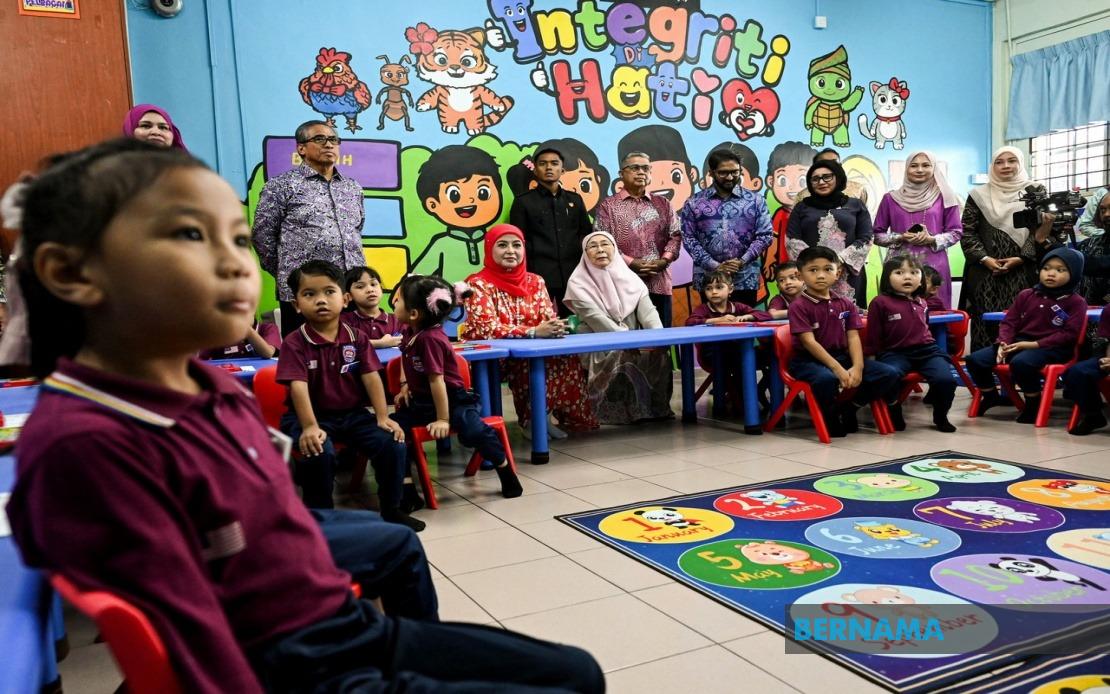
Her Majesty Raja Zarith Sofiah, Queen of Malaysia, officially launched the Children's Integrity Module (MIKa) on Tuesday at Tabika Perpaduan Taman Bukit Cheras in Kuala Lumpur, marking a significant step in the government's effort to nurture ethical values in the youngest Malaysian learners. The initiative represents a coordinated push to embed principles of honesty and responsibility into early childhood education, potentially reshaping how future generations approach governance and public life.
The Queen arrived at the kindergarten facility at 9:45 am to inaugurate the programme, which was developed by the Malaysian Institute of Integrity (IIM) in collaboration with 35 early childhood education experts. Her Majesty's presence underscored the national importance placed on the initiative, drawing attention from senior government figures including National Unity Minister Datuk Aaron Ago Dagang, Chief Secretary to the Government Tan Sri Shamsul Azri Abu Bakar, and Bandar Tun Razak Member of Parliament Datuk Seri Dr Wan Azizah Wan Ismail. Following the formal launch, the Queen visited classrooms to observe a learning simulation firsthand and engage directly with the participating pupils.
The MIKa module specifically targets children between the ages of two and six, a critical developmental window when foundational values and behavioural patterns are established. Rather than relying solely on top-down enforcement through laws and regulations, the programme's architects have recognised that integrity functions most effectively when cultivated as an ingrained habit from early childhood. This pedagogical approach aligns with contemporary child development research, which emphasises that moral reasoning and ethical behaviour are best developed through experiential learning and early socialisation rather than punitive measures implemented later in life.
Tan Sri Shamsul Azri outlined an ambitious timeline for the programme's expansion, stating that the IIM aims to extend MIKa implementation across Malaysia's entire early childhood education ecosystem by 2030. This projection encompasses over 31,000 childcare centres, kindergartens, and preschools nationwide—a massive undertaking that would reach hundreds of thousands of young Malaysians during their formative years. The scale of this ambition reflects the government's recognition that building a more integrity-focused society requires systematic change beginning at the grassroots level of education.
The development of MIKa commenced in 2024, representing a relatively recent but carefully considered initiative. The involvement of 35 early childhood education specialists indicates that the module's design draws on substantial professional expertise rather than being hastily assembled. Furthermore, the programme secured support from multiple government ministries, federal agencies, higher education institutions, and civil society organisations focused on early childhood development. This multi-stakeholder approach suggests broad consensus about the importance of integrity education and demonstrates institutional coordination across sectors that often operate in silos.
Tan Sri Shamsul Azri articulated a philosophical foundation for the initiative that extends beyond mere compliance with rules. He emphasised that integrity education must transcend bureaucratic frameworks, instead becoming a self-directed commitment to ethical behaviour. When individuals internalise integrity as a core value rather than an externally imposed obligation, trustworthiness transforms from a compliance measure into a guiding principle that shapes decision-making autonomously. This conceptual shift has profound implications for how Malaysia might address governance challenges and public accountability issues that have periodically troubled the nation's institutional credibility.
The emphasis on parental involvement signals recognition that schools and early childhood centres cannot independently cultivate integrity without reinforcement from family environments. Parents serving as ethical role models creates consistency between children's experiences at home and in educational settings, strengthening the likelihood that integrity values will take root and persist into adulthood. This family-centred approach acknowledges that sustainable behavioural change requires alignment across multiple socialisation contexts rather than relying on institutions alone.
From a regional perspective, Malaysia's investment in systematic integrity education for young children positions the country ahead of many Southeast Asian neighbours in formalising ethics instruction within early learning frameworks. As the region faces ongoing challenges related to governance transparency and public trust in institutions, establishing integrity as a childhood learning outcome could yield long-term dividends in terms of civic participation quality and institutional accountability. The programme represents a patient, foundational investment in cultural change rather than a quick-fix intervention.
The timing of this initiative also reflects broader Malaysian policy discussions about generational renewal and the values that should define the nation's development trajectory. By targeting children aged two to six, the government is deliberately shaping the ethical frameworks that will guide decision-making when today's kindergarteners become tomorrow's professionals, public servants, and community leaders. This long-term perspective suggests confidence in the potential for early-childhood interventions to produce meaningful societal shifts across decades.
Successful implementation of MIKa will require sustained political commitment and adequate resource allocation beyond the launch phase. Extending the programme to 31,000 institutions nationwide demands significant training infrastructure, curriculum development, and monitoring mechanisms to ensure quality and consistency. The involvement of the Chief Secretary to the Government and National Unity Minister in the launch event indicates high-level administrative support, but translating this backing into the operational resources needed for nationwide rollout remains a practical challenge requiring sustained attention and budget priorities.

