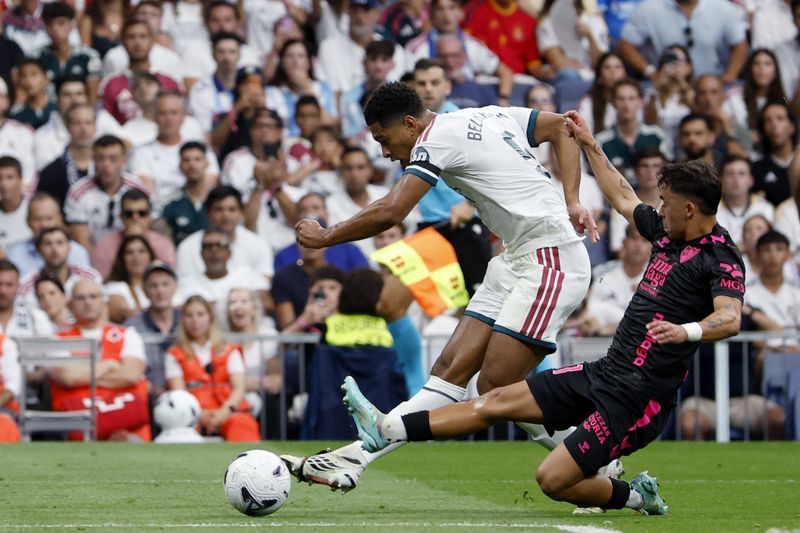
Real Madrid's unbeaten run in LaLiga gathered more momentum on Sunday as the Spanish giants dismantled promoted side Malaga 4-0 at the Santiago Bernabeu, underscoring their credentials as a formidable force this season. The clinical performance highlighted the depth of resources available to Carlo Ancelotti's squad, who produced a devastating spell either side of the halfway point to effectively put the contest beyond doubt before the interval.
The victory propelled Real to nine points from their opening three matches, establishing a commanding two-point buffer over both Atletico Madrid and Alaves in the standings. This commanding position reflects not merely the quality of their performances but also their ruthless conversion of opportunities, a hallmark of elite teams in competitive European leagues. For Malaysian football enthusiasts following La Liga's traditional heavyweight contenders, Real's early dominance signals another competitive season where maintaining consistency across multiple fronts—domestic league, cup competitions, and European football—will test their squad depth considerably.
Jude Bellingham announced his credentials with a sumptuous opening goal in the 19th minute, collecting a loose ball and executing a sublime dribbling run that carried him past three Malaga defenders before slotting past goalkeeper Alfonso Herrero with a composed finish. The English midfielder's performance encapsulated the technical superiority Real demonstrated throughout, combining intelligent movement with clinical finishing. Seven minutes later, Bellingham's influence extended to the second goal, when his header following a parried Kylian Mbappe effort led to a goalmouth scramble that resulted in an own goal, demonstrating how sustained pressure generates opportunities even from chaotic situations.
Kylian Mbappe added a third goal on the half-hour mark with a precisely executed volley from Trent Alexander-Arnold's cross, displaying the aerial awareness and finishing touch that justifies his status among Europe's elite forwards. This trio of goals inside thirty minutes effectively settled the encounter, shifting Real's approach in the second half toward controlled possession and limiting Malaga's attacking opportunities rather than pursuing further scorelines. The tactical adjustment reflected experienced management and squad confidence, hallmarks of teams accustomed to competing at the highest levels.
Real Madrid's tactical flexibility was evident in manager Carlo Ancelotti's five changes to the starting lineup, a departure from the unchanged teams deployed in the opening two fixtures against Espanyol and Real Sociedad. Marc Cucurella received his first start for the club, whilst the deployment of Alexander-Arnold ahead of Denzel Dumfries demonstrated the manager's willingness to experiment with personnel combinations. These rotations underscored the competitive depth available, with capable performers ready to integrate seamlessly into the team's system without sacrificing performance standards.
Malaga's visit to the Bernabeu represented a considerable step up in quality following their recent promotion to La Liga. The visitors demonstrated early resistance when Joaquin Munoz fashioned a shooting opportunity in the 15th minute, striking a right-footed effort from the edge of the penalty area that narrowly missed Thibaut Courtois's top corner. However, this moment of optimism proved fleeting, as Real's subsequent attacking waves overwhelmed their defensive organization. The gulf in experience and personnel between La Liga's established elite and newly promoted sides frequently manifests in such stark fashion, where initial competitiveness yields to the visitors' insufficient depth to maintain resistance against prolonged attacking pressure.
Alexander-Arnold's performance, particularly his role in constructing attacking opportunities, demonstrated how Real's full-back options contribute offensively to their overall system. His involvement in the buildup to Mbappe's third goal exemplified the modern full-back's responsibilities in European football, where defensive security must be balanced with creative contributions and attacking support. For regional observers tracking the evolution of tactical systems in elite football, Real's employment of attacking full-backs represents a strategic blueprint increasingly adopted by successful teams navigating the demands of contemporary competition.
The second-half proceedings reflected a team in command, with Bellingham striking the post in the 55th minute before Real eased their intensity. Arda Guler's introduction as a substitute yielded immediate dividend when he combined efficiently with Vinicius Jr. to add the fourth goal in added time, a performance that highlighted the calibre of attacking alternatives available from the bench. This depth of attacking options—with players like Guler capable of impacting matches meaningfully within limited timeframes—represents a significant advantage in competitions requiring squad rotation across multiple fronts.
Real's fixture schedule intensifies considerably in the coming weeks, with a LaLiga trip to face Real Betis on Friday preceding their Champions League campaign opener against Inter Milan. These encounters against elite European opposition will provide a more rigorous examination of their current form than encounters against promoted opposition. The convergence of domestic and continental fixtures represents the pinnacle of competitive football, demanding tactical acuity and squad management excellence from Ancelotti's coaching staff. For Southeast Asian followers of European football, these forthcoming matches will offer valuable indicators regarding whether Real can sustain their current trajectory across multiple competitions simultaneously, a challenge that separates elite teams from pretenders in modern football's demanding landscape.

