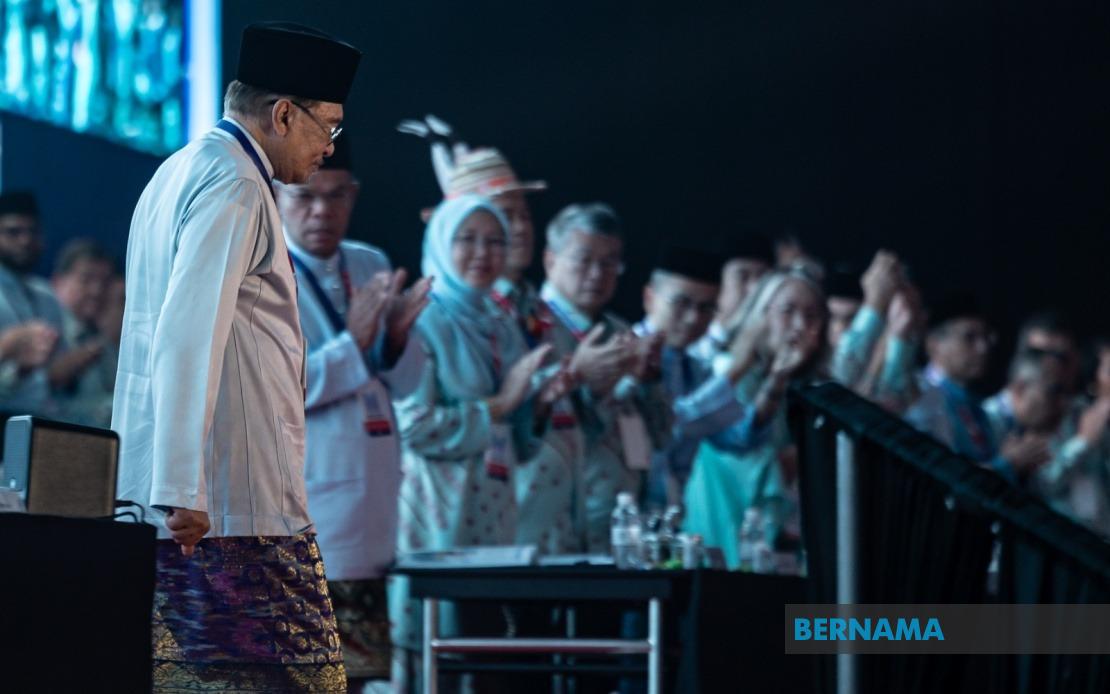
Prime Minister Datuk Seri Anwar Ibrahim has pushed back against criticism that his administration is moving too slowly on reforms, insisting that meaningful institutional changes have already taken root across government—even as he conceded that much work remains. Speaking at the PKR National Congress in Melaka, Anwar sought to strike a balance between acknowledging the impatience of reform advocates and defending the tangible achievements delivered over approximately three years of his tenure.
Anwar's comments reflect a fundamental tension within Malaysian politics: the gap between those who expect transformational change to happen swiftly and those responsible for implementing it incrementally within the constraints of coalition governance. His remarks suggest a deliberate effort to reset expectations while maintaining momentum on the reform agenda that remains central to the government's identity. The Prime Minister, who also serves as Finance Minister and heads both the PKR party and the broader Pakatan Harapan coalition, acknowledged that critics have legitimate grievances whilst arguing they should not discount progress already made.
The institutional reforms cited by Anwar span several domains critical to Malaysia's governance architecture. Amendments to the Audit Act 1957 strengthen parliamentary oversight and transparency mechanisms, while changes to the Parliamentary Service Act modernize legislative procedures. The Public Finance and Fiscal Responsibility Act 2023 represents a significant framework for budgetary discipline and accountability. The establishment of a Special Task Force on Agency Reform signals commitment to rationalizing the sprawling bureaucracy. Beyond these, the Consumer Credit Act provides stronger protections for borrowers, and new legislation addressing gig workers extends social protections to Malaysia's expanding informal workforce—a demographic challenge facing most Southeast Asian economies.
Yet Anwar's acknowledgment that governing a coalition requires constant negotiation reveals the real constraint on faster reform. The formation of the Unity Government following the 2022 General Election brought together parties with competing visions and constituencies. Pakatan Harapan, as the largest coalition partner, must accommodate the political positions and institutional interests of its allies, a reality that inevitably slows decision-making. This dynamic mirrors challenges faced by reformist governments across the region, where coalition arithmetic often determines the pace of change as much as political will does.
The Prime Minister explicitly rejected the notion that wholesale transformation could occur immediately, framing his approach as one requiring institutional consolidation and phased implementation. This perspective carries implications for Malaysian citizens and businesses waiting for deeper structural changes—from judicial independence to civil service meritocracy to electoral integrity. Anwar emphasized that sustainable reform must be carefully rooted before expansion, a principle with considerable merit but one that requires patience from constituencies eager for visible change.
Anwar's argument also contains an implicit historical claim: that many necessary reforms were left undone during the six decades preceding his administration. By positioning current reforms against this historical backdrop, he attempts to reframe the pace question. His contention is that even incremental progress now exceeds what was accomplished in entire decades previously. This framing may resonate with voters concerned about stagnation, though it may frustrate those who expect an administration explicitly elected on a reform mandate to move more decisively.
The Prime Minister's emphasis on learning and iteration suggests an administration feeling its way through complex institutional change rather than executing a meticulously planned blueprint. His frequent reminders to colleagues not to rush indicate either appropriate caution or, from a critic's perspective, insufficient urgency. The distinction matters significantly for constituencies ranging from civil society organizations to international observers assessing Malaysia's governance trajectory.
The presence of key coalition figures at the congress—including PKR deputy president Nurul Izzah Anwar, Amanah president Datuk Seri Mohamad Sabu, and Gabungan Rakyat Sabah chairman Datuk Seri Hajiji Noor—underscores the political sensitivity of the reform message. These leaders represent different constituencies and interests within the governing alliance, and their alignment around Anwar's cautious narrative reflects the coalition's need for maintained coherence on this defining policy area.
For Malaysian observers and the broader Southeast Asian region, Anwar's comments illustrate the fundamental challenge facing democracies attempting institutional reform while managing coalitional politics. The tension between reformist ambition and political feasibility remains unresolved, and likely will until either the pace accelerates visibly or expectations adjust downward. The Prime Minister's position essentially asks for patience while promising continued progress—a gamble on whether his administration can demonstrate sufficient momentum to justify the wait.
Anwar's acknowledgment that not all governmental actions have been flawless introduces an element of intellectual humility often absent from political speeches. This candor may strengthen his credibility with skeptics, particularly those concerned that the administration risks losing reform momentum altogether. Yet it also opens space for critics to question whether current implementation capacity matches the ambition of the stated agenda.
Looking ahead, the government faces pressure from multiple directions: civil society organizations pushing for more aggressive change, coalition partners protecting sectional interests, a public administration requiring substantial transformation, and an electorate measuring success against increasingly demanding benchmarks. Anwar's framing suggests the administration intends to continue its current trajectory—steady but measured progress, weighted toward consolidating existing reforms before launching more ambitious initiatives. Whether this proves sufficient to maintain the political coalition and public support for continued reform remains the critical question governing Malaysian politics.

