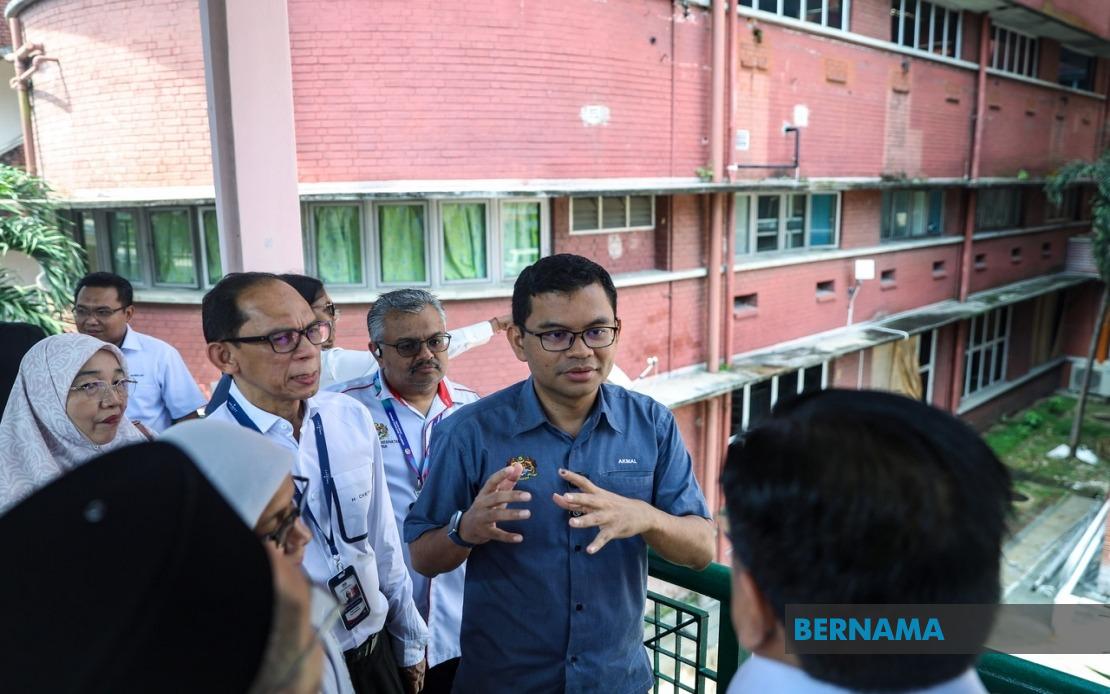
Johor's flagship government hospital is poised for a substantial service expansion through seven coordinated development initiatives totalling RM1.139 billion, signalling the state's commitment to modernising its healthcare infrastructure. Sultanah Aminah Hospital (HSA) in Johor Bahru has become the focal point of the federal government's healthcare investment drive, with Economy Minister Akmal Nasrullah Mohd Nasir confirming during an inspection visit on August 7 that work is already underway across multiple fronts to enhance both the hospital's operational capacity and patient experience.
The most advanced project involves a comprehensive overhaul of the hospital's electrical infrastructure, a critical undertaking valued at RM159 million that has already reached 76.49 per cent completion. This system upgrade addresses the foundational requirements that support modern medical operations, encompassing both primary power distribution and the mechanical systems that maintain precise environmental conditions essential for patient care and surgical procedures. The electrical and mechanical rehabilitation represents a necessary investment given the hospital's age and the increasing demands placed upon its facilities by Johor's growing population.
The largest component of the modernisation programme centres on the construction of a Day Care Centre (ACC) alongside multi-storey parking facilities and the Specialist Clinic Complex, with these interconnected projects collectively valued at RM877.54 million. This ambitious undertaking will fundamentally reshape how HSA delivers outpatient services, addressing a critical gap in many Malaysian government hospitals where specialist clinics often operate at or beyond capacity. The addition of dedicated day care infrastructure acknowledges a growing need for procedures and treatments that do not require overnight hospitalisation, reflecting evolving patient demographics and medical practice patterns across the region.
Acknowledging the practical challenges of transforming a functioning hospital while maintaining uninterrupted patient services, Akmal Nasrullah emphasised that a primary concern throughout implementation remains minimising operational disruption. The phased approach to both the Specialist Clinic Complex and the ACC reflects this delicate balance, with contractors expected to receive formal appointment letters by February of the following year. This timeline suggests careful coordination between the Ministry of Economy, relevant state authorities, and the hospital administration to sequence construction activities strategically.
Among the most visible improvements for patients will be the expansion of surgical capacity through the construction of three additional operating theatres, raising the total from twelve to fifteen. This twenty-five per cent increase in operative capacity addresses one of the chronic bottlenecks in Malaysian public hospital systems, where surgical waiting lists often extend several months even for urgent cases. For Johor's population exceeding four million residents, enhanced operating room availability represents a tangible improvement in access to essential surgical interventions.
The HSA renovation programme sits within a considerably broader development landscape across Johor state. Since 2000, a cumulative 613 development programmes and projects worth RM56.12 billion have been initiated or completed throughout the state, comprising 154 entirely new undertakings and 459 extension or upgrade projects. This substantial portfolio demonstrates sustained federal commitment to Johor's infrastructure despite the state's significant development needs and geographic challenges. The sheer scale of investment underscores how provincial development remains a key policy lever for federal administrations seeking to demonstrate tangible progress in regional economic and social improvement.
Current-year implementation figures indicate momentum, though highlighting persistent resource constraints. By late July, approximately RM2.5 billion of the allocated RM4.95 billion annual budget for 2024 had been disbursed, representing 50.51 per cent utilisation. This spending trajectory suggests acceleration may be needed in coming months to achieve full-year targets, a common pattern in Malaysian public sector project management where budget cycles and construction schedules frequently misalign. The expenditure rate reflects the practical difficulties of coordinating multiple large-scale projects across diverse implementing agencies and contractors.
The Sultanah Aminah Hospital projects carry specific significance for healthcare equity and regional development in Malaysia. Johor, as the nation's southernmost peninsular state and a crucial economic and demographic hub, has long experienced tensions between rapid urban growth and healthcare infrastructure capacity. The public hospital system bears the primary burden of serving lower-income populations and providing emergency care, roles that demand constant reinvestment to prevent service degradation. By concentrating substantial resources on HSA, the federal government signals recognition that strengthening anchor hospitals in major states remains essential to health system resilience.
The investment also reflects broader regional trends in Southeast Asian healthcare development, where governments increasingly invest in upgrading existing major hospitals rather than creating new facilities. This efficiency-focused approach recognises that newer infrastructure alone cannot substitute for proper maintenance, adequate staffing, and modern systems integration. The electrical and mechanical components of the HSA project, though less visible than new buildings, may ultimately prove as important as the added specialist clinic space in determining whether the hospital can genuinely improve service quality and patient outcomes.
For Malaysian policymakers monitoring public sector efficiency, the HSA developments offer a test case in managing large-scale healthcare infrastructure projects. The declared commitment to minimising service disruption while executing RM1.139 billion in concurrent improvements represents a significant operational challenge requiring sustained coordination between federal and state authorities. Success would establish a replicable model for similar hospitals in other states, while delays or cost overruns would underscore persistent difficulties in Malaysian infrastructure project management.
Looking ahead, the trajectory of these investments will significantly influence public healthcare accessibility across Johor over the next decade. Enhanced specialist clinic capacity could reduce waiting periods for critical outpatient services, while expanded operating theatre availability might alleviate surgical backlogs that currently force patients toward private sector alternatives. The modernised electrical and mechanical systems should improve reliability and reduce emergency downtime. Collectively, these improvements position HSA to serve Johor's population more effectively, though success ultimately depends on matching infrastructure investment with adequate recurrent funding for staffing, medications, and maintenance.

