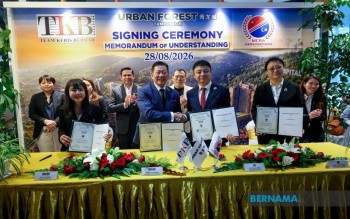
An ambitious RM1 billion urban forest development in Tambun is poised to catalyse Perak's transformation into a competitive regional tourism destination, with Team Keris Bhd partnering hospitality and culinary stakeholders to create an integrated experience spanning 84 acres. The three-year project represents a strategic shift in how the state positions itself within Southeast Asia's tourism landscape, moving beyond traditional attractions to develop a comprehensive ecosystem that weaves together accommodation, dining, and experiential offerings under one coordinated vision.
The collaboration between Team Keris Bhd, RJJ Hotels Sdn Bhd, and the Malaysian Chinese Restaurant Association (MCRA) reflects a deliberate approach to tourism development that prioritises quality over volume. Rather than simply expanding the number of rooms or dining outlets, the partners are designing a cohesive destination that leverages Perak's existing strengths—the Lost World of Tambun and other commercial properties—while introducing world-class infrastructure and service standards. Perak Tourism, Industry, Investment and Corridor Development Committee chairman Loh Sze Yee articulated this vision clearly, noting that the state must upgrade its offerings to compete in the international market rather than remain confined to domestic travellers.
The culinary strategy embedded within the urban forest reveals sophisticated thinking about how food can serve as both an economic engine and a cultural ambassador. The development will dedicate 40 per cent of food and beverage operations to MCRA-affiliated venues, predominantly showcasing Malaysian Chinese cuisine, while 60 per cent of the space will feature independent Malaysian operators. This composition ensures that visitors encounter authentic local flavours rather than diluted, sanitised versions of regional cooking, thereby distinguishing Perak from competing destinations that often homogenise their food offerings.
Muslim-friendly dining presents a particularly strategic angle within this framework. The commitment to allocate 30 per cent of F&B capacity to halal-certified and Muslim-inclusive options—including innovations such as halal dim sum—signals awareness of underserved market segments. This approach opens doors to travellers from the Middle East, parts of Asia, and diaspora communities globally, expanding the potential customer base beyond Western-centric tourism models that dominate regional marketing.
Team Keris Bhd group executive chairman Datuk Lee Seng Hee positioned the development as a fundamental reimagining of how Perak views visitor engagement. His statement that the urban forest represents "better ideas, richer experiences and standards worthy of the state" suggests recognition that the state has historically underinvested in experiential tourism infrastructure. The creation of TKB Tours & Hospitality as a dedicated division underscores commitment to orchestrating the entire visitor journey, from airport transfers through accommodation selection, meal planning, and curated activities—a level of concierge thinking that Malaysian destinations rarely provide systematically.
The hospitality anchor provided by RJJ Hotels carries particular significance given the company's affiliation with Jin Jiang Hotels, a Chinese conglomerate operating over 200 million loyalty members across more than 50 countries and commanding 40 hotel brands. This global distribution network effectively places Ipoh and Perak on international booking platforms and travel agent itineraries, addressing a longstanding challenge facing the state: visibility and accessibility among potential visitors accustomed to mainstream tourism corridors centred on Kuala Lumpur and Penang.
RJJ Hotels CEO Yap Lip Seng's discussion of package tourism and extended-stay strategies highlights pragmatic infrastructure thinking. International travellers arriving through major Malaysian airports traditionally face logistical friction reaching secondary cities; RJJ's model of bundling transport, accommodation, and meal experiences into seamless packages removes decision-making friction. Encouraging visitors to spend multiple nights rather than brief stopovers fundamentally changes spending patterns and local economic impact, translating longer stays into revenue for local suppliers, transportation providers, and retail operators.
The Malaysian Chinese Restaurant Association's role extends beyond simply providing restaurant operators. President Gao Houyun outlined a skills development agenda that positions the urban forest as a training ground for upgrading industry standards across Perak's broader hospitality sector. This spillover effect—where flagship developments raise capability and expectations throughout a region—represents a form of economic development that extends beyond the immediate project footprint, potentially creating a competitive advantage for Perak's entire tourism industry.
Supply chain localisation constitutes another underappreciated dimension of the project. Gao's mention of encouraging Chinese manufacturers of sauces, spices, and food ingredients to establish factories in Perak indicates recognition that international-standard restaurant operations require reliable, consistent ingredient sourcing. Rather than perpetuating import dependency, this approach anchors food production investment within the state, generating manufacturing jobs and value-added activity beyond the tourism sector itself.
Malaysia's halal certification ecosystem emerges as a strategic asset within this development framework. Unlike competing regional destinations, Perak can leverage halal credentials not merely for domestic positioning but as a market differentiator internationally. Halal certification enables restaurant brands and food products developed within the urban forest to expand into Southeast Asian markets with established Muslim populations and into the broader Organisation of Islamic Cooperation bloc—a potential customer base exceeding 1.8 billion people. This transforms a domestic regulatory requirement into an export advantage.
For Malaysian policymakers and investors, the urban forest model suggests a template for secondary-city tourism development that avoids the pitfalls of mass-market, undifferentiated expansion. By anchoring development around authentic culinary traditions, quality hospitality infrastructure, and deliberate supply chain integration, Perak positions itself to capture higher-value tourism spending while creating sustainable employment across multiple economic sectors. The three-year timeline establishes measurable benchmarks against which to assess whether integrated tourism ecosystems can meaningfully diversify regional economies beyond their traditional bases.
Regionally, the Tambun development signals that Southeast Asian cities increasingly compete on sophistication rather than mere capacity. As Thailand, Vietnam, and Indonesia expand their tourism infrastructure, destinations like Perak must differentiate through curated experiences and authentic cultural offerings rather than attempting to replicate the mass-market approaches of established hubs. The success or failure of this RM1 billion investment will likely influence how other Malaysian states conceptualise tourism development over the coming decade.

