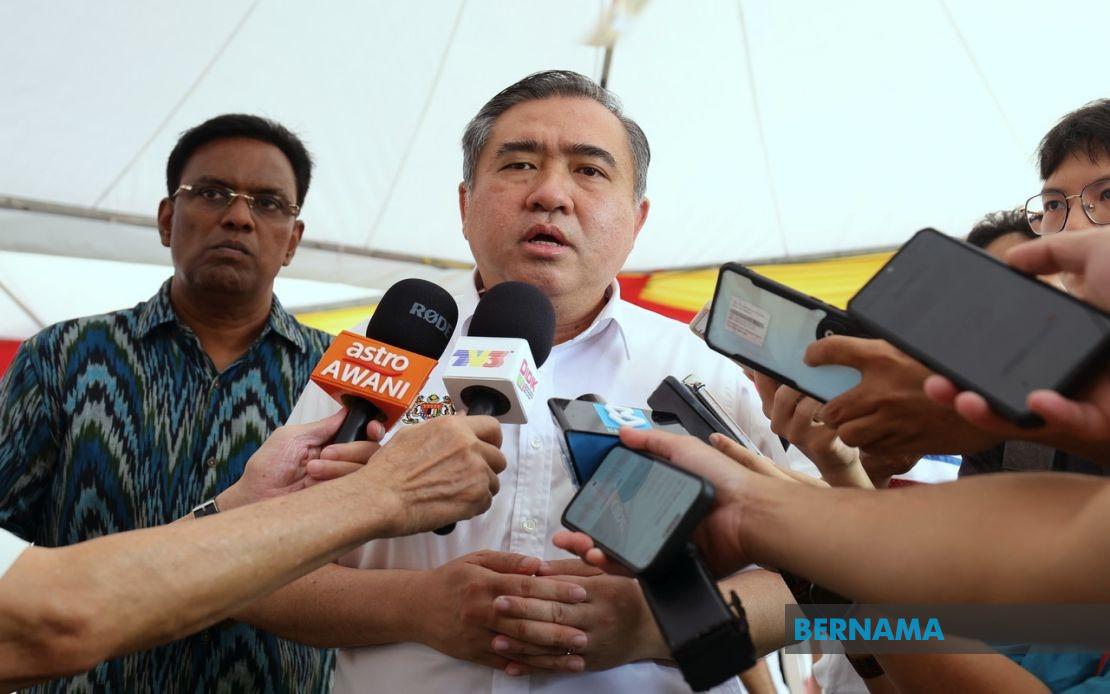
Transport Minister Anthony Loke has unveiled a RM100,000 financial commitment to Kampung Bukit Temiang as part of the government's MADANI Adopted Village Programme, a strategic initiative designed to strengthen connections between federal ministries and grassroots communities across Malaysia. The funding demonstrates the administration's emphasis on bottom-up development, where policy decisions emerge from direct engagement with residents rather than top-down planning alone.
The allocation comprises equal contributions of RM50,000 each from two sources: the Railway Assets Corporation (RAC), a Transport Ministry agency, and Loke's own resources as Member of Parliament for Seremban. This dual-funding approach reflects a hybrid model where both statutory bodies and individual lawmakers contribute to local development. The funds will flow through the Federal Village Development and Security Committee (JPKK), the administrative body responsible for implementing phased improvements across the village.
Loke emphasised that the initiative prioritises community consultation before project implementation, a departure from traditional top-down infrastructure planning. The proposed upgrades emerge directly from conversations with Kampung Bukit Temiang residents and include renovation of the community hall, structural repairs to residential roofs, enhancement of the drainage system, and other facilities identified as priorities. This consultative approach aims to ensure that development spending addresses genuine local needs rather than predetermined government agendas.
The JPKK possesses flexibility in project execution, employing various mechanisms from RAC-led works to community-organised gotong-royong activities and local contractor engagement. This multi-pronged implementation strategy encourages local participation while creating employment opportunities for village-based workers. Roof repairs, in particular, have been highlighted as a component of the programme, suggesting housing quality concerns in the settlement.
Loke characterised the MADANI initiative as emblematic of the government's commitment to direct ministerial engagement with local communities, moving beyond centralised bureaucratic structures to forge genuine connections with residents. The programme represents a philosophical shift toward understanding ground-level challenges before formulating solutions, aligning with Prime Minister Datuk Seri Anwar Ibrahim's broader governance philosophy centred on inclusive development and community-centric policymaking.
Beyond village infrastructure, Loke announced an additional RM10 million allocation for the National MADANI Taxi Renewal Programme, reflecting the government's recognition of urban transport sector challenges. On July 3, Anwar had announced this supplementary funding for the Vehicle Replacement Matching Grant Programme targeting taxi drivers, following positive uptake of the initial RM10 million provision under Budget 2026. This expansion signals growing commitment to modernising Malaysia's traditional taxi industry amid competition from digital ride-hailing platforms.
The taxi renewal initiative transcends vehicle replacement financing, instead functioning as a holistic support framework addressing multiple dimensions of driver welfare. Government briefings inform operators about accessible financing schemes designed to reduce financial barriers, income-enhancement opportunities, social protection schemes, streamlined permit procedures, and modernisation incentives. This comprehensive approach acknowledges that taxi industry sustainability depends not solely on vehicle upgrades but on improving driver economic security and operational viability.
Crucially, the government frames taxi operators and e-hailing platforms as complementary rather than competing entities, positioning both as components of an integrated public transport ecosystem. This perspective differs markedly from confrontational approaches adopted by some governments, instead promoting strategic cooperation between traditional and digital transport services. The stance recognises that Malaysian commuters benefit from service diversity while taxi drivers can increase income through strategic partnerships with platform operators rather than viewing such relationships as existential threats.
The Transport Ministry, alongside the Land Public Transport Agency (APAD) and allied government bodies, commits to sustained coordination with stakeholders including taxi associations, financial institutions, automotive manufacturers, and e-hailing operators. This multi-stakeholder approach signals recognition that transport policy effectiveness requires buy-in from diverse actors rather than government directives alone. For Malaysia's Southeast Asian positioning, integrating traditional and digital transport while supporting driver welfare could model sustainable approaches to transport modernisation elsewhere in the region.
The dual focus on village-level infrastructure through the MADANI programme and sector-specific support through taxi renewal initiatives illustrates the government's layered development strategy. Rather than concentrating resources on urban centres, the approach distributes attention across geographic scales, from individual kampungs to national industry sectors. For Malaysian readers concerned about equitable development, this distribution pattern suggests commitment to preventing rural stagnation while simultaneously modernising urban transport infrastructure.
The timing of these announcements, with village funding in mid-July and taxi programme expansion following July 3 announcements, reflects consistent messaging throughout the government calendar. This regularity suggests the MADANI framework represents sustained policy commitment rather than isolated initiatives. For communities across Malaysia evaluating government effectiveness, the combination of direct funding allocations and comprehensive sectoral support programmes provides concrete mechanisms through which development aspirations translate into material improvements.

