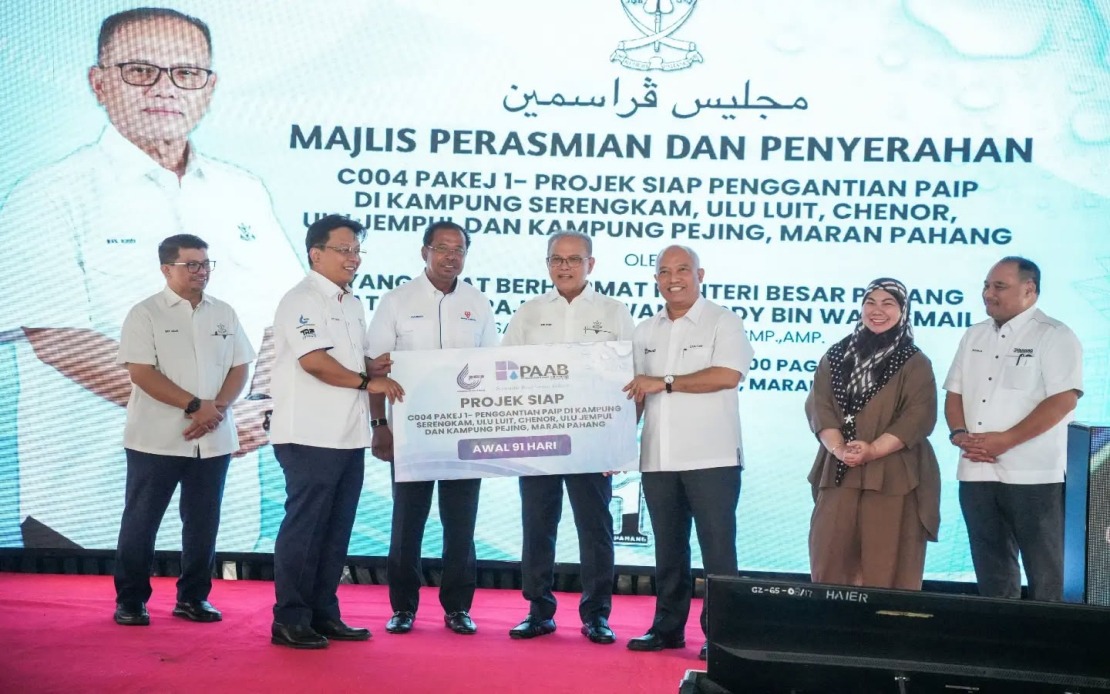
The chronic water shortages afflicting Maran residents for nearly twenty years have finally been addressed through a substantial infrastructure overhaul. Pengurusan Aset Air Berhad (PAAB) has finished a RM11.19 million initiative to replace crumbling water pipes across the district, with the project completed three months earlier than originally scheduled. The undertaking delivered tangible relief to communities that have endured frequent service interruptions, particularly in Chenor and surrounding settlements.
The scope of the replacement work was considerable, encompassing 29.6 kilometres of obsolete piping that had become increasingly unreliable. Five distinct neighbourhoods—Kampung Serengkam, Ulu Luit, Pejing, Ulu Jempul and Chenor—benefited from the systematic pipe renewal programme. These ageing conduits had deteriorated to the point where burst pipes were commonplace, forcing authorities to conduct regular repairs whilst residents endured unpredictable supply disruptions. The new infrastructure addresses structural deficiencies that had persisted across multiple administrations and government cycles.
Almost 10,000 people in Maran now have access to more dependable water services as a direct consequence of the project completion. Beyond merely preventing pipe failures, the modernised system improves water pressure consistency, which proves especially critical during high-consumption periods such as the dry season and major festivals when demand surges. The initiative also tackles non-revenue water losses—water lost through leaks before reaching consumers—a persistent challenge in Malaysian water utilities that wastes precious resources and inflates operational costs. By addressing these fundamental inefficiencies, the project contributes to both household conveniences and broader resource management objectives.
The formal handover took place at the Chenor Water Treatment Plant, where Pahang Menteri Besar Datuk Seri Wan Rosdy Wan Ismail presided over the ceremony. The event underscored the political significance of water infrastructure improvements in a state where supply reliability has historically been contested. Federal representation included Deputy Energy Transition and Water Transformation Minister Datuk Seri Abdul Rahman Mohamad and Deputy Economy Minister Datuk Mohd Shahar Abdullah, reflecting water security's importance at the national policy level. Such gatherings signal government commitment to addressing long-standing service gaps in secondary urban areas often overlooked in infrastructure planning hierarchies.
PAAB's ambitions extend well beyond Maran's borders. The organisation intends to collaborate with Pengurusan Air Pahang Berhad (PAIP) over the ensuing three years to develop comprehensive water infrastructure strategies across multiple Pahang districts. This coordinated approach represents a departure from ad-hoc project implementation towards systematic regional planning. One imminent initiative involves upgrading electrical systems at the Jengka Utama Water Treatment Plant's clean water pumping station, targeting water supply instability affecting Felda Jengka settlements. Such electrical modernisation often receives less public attention than pipe replacement, yet proves equally critical for maintaining consistent service delivery.
Two additional substantial projects underscore the scale of Pahang's water infrastructure renewal. A RM35.7 million undertaking will replace 76.2 kilometres of deteriorating pipes in Jerantut and Lipis, serving communities around Pulau Tawar and Kuala Tahan. Separately, a RM13 million scheme focuses on Felda Keratong, where 11 kilometres of pipes require replacement to enhance system efficiency in Rompin. These projects collectively represent over RM60 million in dedicated investment, indicating that the Maran project forms part of a coherent statewide modernisation strategy rather than an isolated intervention.
The broader financial context reveals PAAB's substantial long-term commitment to Pahang's water sector. As of July this year, the organisation had earmarked RM1.17 billion for water supply infrastructure across the state. Of this allocation, RM69.79 million had funded completed projects, whilst RM66.94 million supported active construction work. Notably, RM981.04 million—representing approximately 84 percent of total allocation—remains designated for projects still in planning and design phases. This distribution suggests that Pahang's water infrastructure transformation remains in its relatively early stages, with the most substantial implementation wave anticipated over coming years.
Understanding PAAB's institutional position illuminates the governance framework supporting such initiatives. Established in 2006 under the Water Services Industry Act 2006, the organisation functions as the federal government's principal instrument for executing the National Water Services Industry Restructuring Plan. PAAB operates as a wholly state-owned enterprise under Minister of Finance Incorporated, with regulatory oversight from the Ministry of Energy Transition and Water Transformation (PETRA). This centralised governance model ensures alignment between state-level water utility operations and national policy objectives concerning service universalisation and infrastructure modernisation.
PAIP's entry into structured water services governance occurred through the 2020 Pahang State Water Supply Services Restructuring Agreement, establishing formal mechanisms for coordinating infrastructure development and service delivery standards. This arrangement represents the culmination of years of sector reforms intended to professionalise utility management and introduce systematic planning disciplines. For Malaysian residents accustomed to ad-hoc infrastructure improvements driven by political campaigns, such institutionalised frameworks suggest more predictable, sustained approaches to basic service delivery. The Maran project demonstrates how such governance arrangements can translate into tangible community benefits when properly resourced and executed.
The implications for Southeast Asian water security extend beyond Maran's district boundaries. As the region confronts intensifying pressure from population growth, urbanisation and climate variability, infrastructure reliability becomes increasingly consequential. Malaysia's experience with systematic pipe renewal and pressure management offers instructive lessons for neighbouring economies managing similar transitions from colonial-era water systems towards modern, resilient networks. The Maran case illustrates that whilst such transformations require substantial financial investment and extended timeframes, the welfare improvements for previously neglected communities justify these commitments. Similar interventions across Southeast Asia could address chronic underperformance in secondary urban areas where infrastructure investment historically concentrated on major metropolitan centres.

