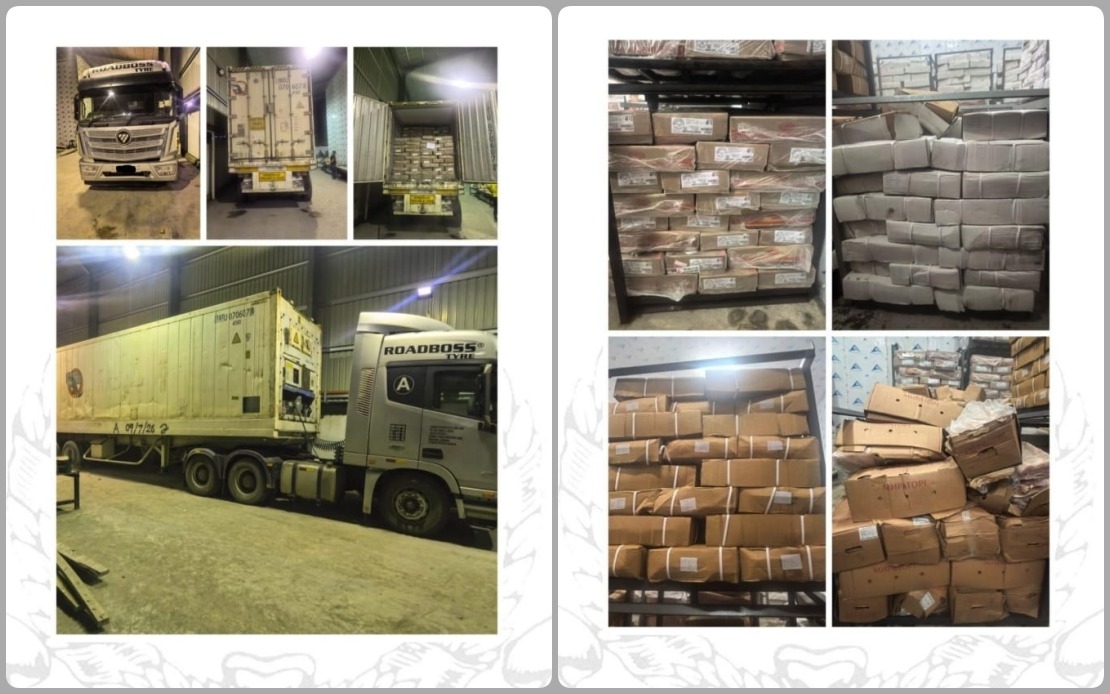
Police have dismantled a significant illegal food distribution network in Miri following the seizure of RM6.19 million in frozen pork products that lacked proper import documentation. The operation, designated Op Taring Chiller, resulted in the arrest of a 26-year-old local man at a warehouse facility on the evening of July 9. According to Datuk Seri Mohd Yusri Hassan Basri, director of the Internal Security and Public Order Department, the enforcement action underscores growing police attention to the movement of frozen foodstuffs with uncertain halal status and the broader problem of unlicensed food commerce within Malaysia.
The scale of the confiscated inventory reveals the sophisticated nature of the smuggling operation uncovered. Officers discovered approximately 30,000 kilogrammes of processed frozen pork large intestines, 18,000 kilogrammes of pork loin distributed across fifteen pallets, 750 kilogrammes of general pork inventory on a single pallet, multiple pallets of bone-in pork bellies complete with rind, and frozen pork shoulder of unspecified quantity. The variety and volume of products suggest an organised commercial enterprise rather than isolated trafficking, pointing to established supply chains and likely distribution networks extending beyond the Miri warehouse.
The enforcement operation drew resources from multiple government agencies, demonstrating a coordinated approach to illicit trade. The Wildlife Crime Bureau and Special Investigation Intelligence division of JKDNKA partnered with the Miri district police headquarters and the Sarawak Veterinary Services Department to conduct the raid. This interagency collaboration reflects official strategy to combat food smuggling by combining criminal investigation expertise with specialist knowledge in veterinary public health and commodity compliance. The involvement of wildlife crime investigators alongside food safety authorities indicates the government's classification of food smuggling within a broader organised crime context.
The legal framework invoked against the suspect encompasses specific veterinary and public health legislation. Authorities charged the individual under Sections 9(1) and 9(3) of the Veterinary Public Health Ordinance 1999, establishing clear regulatory breaches regarding importation procedures and proper documentation. Beyond criminal charges, a RM25,000 compound notice was issued under the same ordinance, representing the administrative penalty imposed for violations. This dual-track enforcement strategy—combining potential criminal prosecution with immediate financial penalties—reflects policy prioritising both deterrence and revenue recovery.
For Malaysian consumers and importers, the implications centre on food safety and legitimacy concerns. Pork products entering the country without veterinary clearance bypass mandatory health inspections designed to verify disease-free status and ensure proper handling throughout transport and storage. Without valid permits, such goods escape documented oversight regarding their origin, processing conditions, and compliance with Malaysian food safety standards. The emphasis on halal status in official statements reflects particular sensitivity around pork importation in Malaysia's Muslim-majority context, where both consumer protection and religious dietary law concerns intersect.
This operation fits within a significantly broader enforcement campaign against smuggling and organised crime. Between January 1 and July 10 of the current year, the Wildlife Crime Bureau and Special Investigation Intelligence unit executed 201 raids across Malaysia, leading to 375 arrests. These operations targeted diverse contraband categories including duty-unpaid merchandise, illegally diverted subsidised goods, frozen food products, wildlife trafficking, and electronic waste. The cumulative seizures from this period reached an estimated RM264.86 million, illustrating the substantial economic dimension of smuggling activity affecting Malaysian commerce and government revenue.
The Miri seizure exemplifies the food smuggling dimension within Malaysia's broader contraband landscape. Unlike traditional smuggling of luxury goods or electronics, frozen food trafficking directly affects public health infrastructure and consumer safety systems. The involvement of pork specifically carries additional complexity given Malaysia's regulatory framework around pork commerce, where strict documentation and halal certification requirements exist. Smuggled pork products circumvent these oversight mechanisms, potentially reaching consumers without proper verification while simultaneously depriving legitimate importers of market share and creating unfair competitive conditions.
Geographically, the Miri location reflects important patterns in Malaysian smuggling activity. Sarawak's position bordering Indonesia and its role as a significant port jurisdiction create conditions facilitating illicit cross-border movement of goods. The warehouse-based storage system uncovered suggests products staged for distribution throughout Malaysian and possibly regional markets. The concentration of enforcement attention on such facilities indicates police strategy prioritises disruption of storage and distribution nodes rather than border interception alone, targeting the full supply chain infrastructure supporting illegal commerce.
The police commitment articulated by Datuk Seri Mohd Yusri Hassan Basri emphasises intensified intelligence gathering and integrated enforcement operations. This signals increasing institutional capacity dedicated to smuggling investigations and organised crime suppression. The coordination across multiple agencies, the scale of recent operations, and the substantial seizure values demonstrate enforcement has evolved beyond reactive response to more systematic intelligence-driven campaigns. For regional observers, Malaysia's approach to food smuggling enforcement establishes a policy model increasingly relevant as cross-border commerce expands throughout Southeast Asia.
Looking forward, the broader significance of this operation extends to supply chain integrity and consumer confidence in food distribution systems. Each successful enforcement action contributes to maintaining regulatory standards and protecting legitimate food importers competing against smuggled alternatives offered at artificially reduced prices. The public health dimension remains paramount—undocumented food products may harbour pathogens or contamination risks that documented goods undergo testing to exclude. The RM6.19 million seizure represents not merely lost criminal revenue but prevented distribution of potentially unsafe products into Malaysian food systems.

