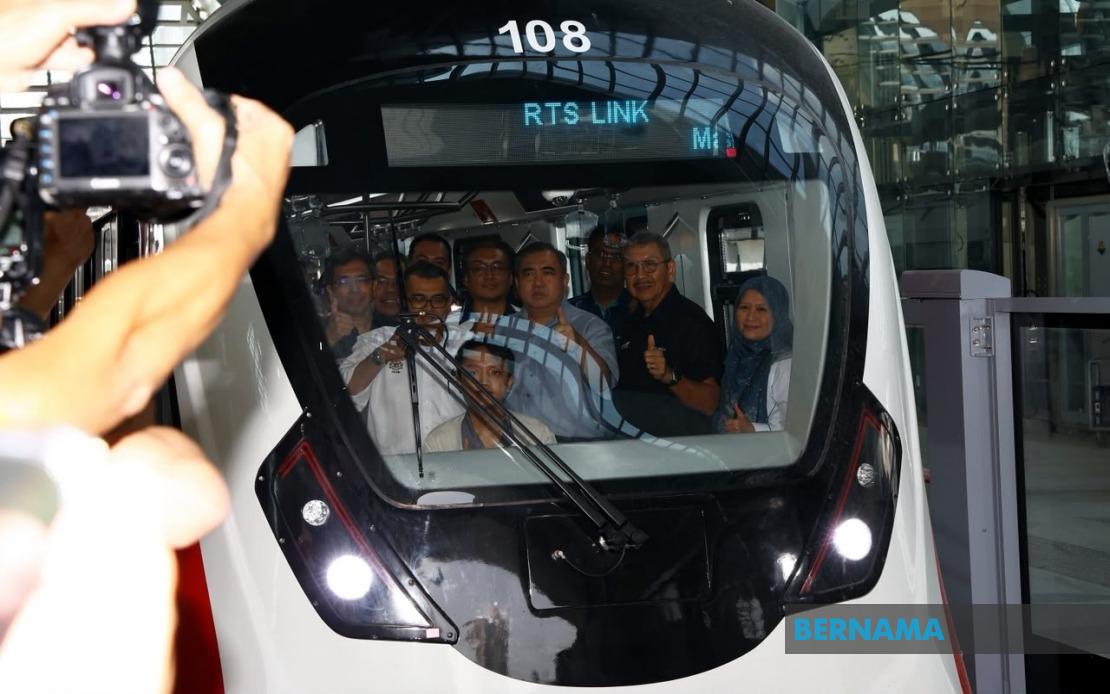
The Malaysian government is moving forward with a RM60 million infrastructure investment designed to seamlessly connect the upcoming Bukit Chagar RTS Link Station with the existing KTMB Komuter rail network. Transport Minister Anthony Loke announced the project, which has secured approval from the Ministry of Economy and will be implemented by the Ministry of Transport, during a site visit to the border crossing project in Johor Bahru on August 18.
The bridge represents a strategic enhancement to Malaysia's approach toward integrated public transport connectivity. Currently, passengers arriving at the Bukit Chagar station would need to navigate an indirect route through JB Sentral to access Komuter services. The new pedestrian infrastructure will eliminate this inefficiency, allowing direct foot traffic between the two stations and significantly reducing travel time for commuters. This design philosophy reflects growing regional recognition that modern transport hubs must prioritise seamless passenger flows across multiple transit modes to compete effectively for ridership.
The construction timeline remains modest in scope, with project completion anticipated within approximately 12 months. This relatively swift implementation schedule suggests straightforward engineering challenges and reflects the government's commitment to operational readiness ahead of the RTS Link's anticipated commencement on January 1, 2025. By synchronising the bridge completion with the corridor's full service launch, authorities aim to present passengers with a fully functional, integrated experience from day one rather than phased accessibility improvements.
Beyond the bridge infrastructure, the government is pursuing broader ecosystem enhancements to maximise the RTS Link's potential as a cross-border transit corridor. The Stage Bus Service Transformation 2.0 programme will introduce at least 200 new buses operating from residential neighbourhoods across Johor Bahru directly to Bukit Chagar. This expansion forms part of a deliberate strategy to distribute passenger volumes efficiently across the network and reduce congestion at any single nodal point. The Ministry of Finance is currently processing the final operational award, with service rollout timed to coincide precisely with the RTS Link opening.
The Bukit Chagar station will function as a genuine multimodal hub integrating Komuter rail, the RTS Link rapid transit, conventional bus services, e-hailing platforms, and remaining JB Sentral facilities into one coordinated transport ecosystem. This layering of transport modes creates redundancy and flexibility for passengers, allowing them to select optimal travel combinations based on time, cost, and route preferences. For Malaysian cities still developing mature public transport systems, such integrated planning offers a template for connecting legacy infrastructure with newer rapid transit investments.
From a bilateral perspective, the RTS Link represents a significant step toward deeper transport integration across the Malaysia-Singapore border. The corridor is engineered to accommodate passenger volumes reaching 10,000 travellers per hour in each direction, reflecting substantial forecasted demand from cross-border commuters, students, and business travellers. For Malaysian passengers, direct rail access to Woodlands North in Singapore eliminates dependence on private vehicles and buses for cross-border journeys, potentially reshaping commuting patterns in southern Johor.
The physical construction phase has concluded, with the building structure, Customs, Immigration and Quarantine complex, and station facilities now complete. Current activities concentrate on rigorous testing and commissioning procedures. System integration testing will verify that all operational components—signalling, ticketing, access control, and emergency systems—function coherently. Subsequent fault-free and trial operations will stress-test the entire network under realistic conditions before public service commencement. This methodical approach, while extending the pre-launch period, provides essential assurance that a critical piece of transport infrastructure will function reliably when it enters service.
The investment in bridge infrastructure, bus service expansion, and integrated station planning reflects a maturing policy approach toward transport development in Malaysia. Rather than viewing individual transit projects in isolation, planners now explicitly coordinate investments to create reinforcing effects across networks. The RM60 million bridge cost, while substantial, represents sound expenditure when considered against its role in unlocking the value of the larger RTS Link infrastructure and ensuring that public transport remains the competitive choice for border crossing.
For Southeast Asian transport planners, the Bukit Chagar initiative illustrates how cross-border projects require particularised attention to access infrastructure often overlooked in initial designs. The initial RTS Link concept presumably focused on the rail corridor itself, but operational success depends equally on how effectively passengers transition between modes at terminal points. The retrospective investment in the bridge demonstrates flexibility in project management and commitment to genuine integration rather than merely physical proximity of different systems.
The timeline extending into 2025 places considerable importance on delivering integrated systems simultaneously rather than in sequence. Komuter passengers accustomed to current routines will need to adapt to new pedestrian pathways and modified station signage. Incoming RTS Link users will encounter Singapore-Malaysia border procedures for the first time. Bus operators deploying 200 new vehicles must recruit and train sufficient staff. Effective communication campaigns and phased operational testing will prove essential to smoothing these transitions and ensuring that the infrastructure investment translates into sustained ridership growth.
The broader significance extends to Johor's economic positioning within the region. Efficient cross-border transport connectivity influences commercial investment decisions, talent mobility, and the viability of joint Malaysian-Singapore development initiatives. By prioritising seamless passenger movement and system integration, the government signals serious commitment to positioning Johor as a natural extension of Singapore's urban economy rather than a separate entity. This approach may generate economic benefits extending far beyond the direct transport services themselves.

