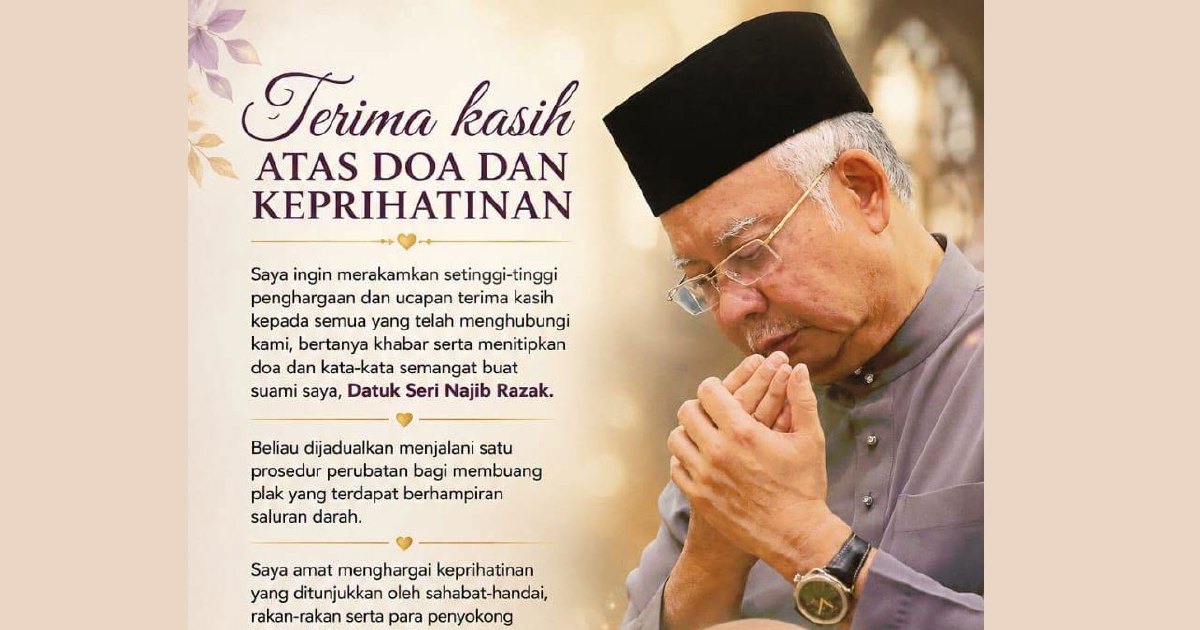
Datin Seri Rosmah Mansor has called on Malaysians to offer prayers and support as her husband, former prime minister Datuk Seri Najib Razak, undergoes a scheduled medical procedure designed to remove arterial plaque and restore healthy blood flow. The appeal underscores the family's desire for public goodwill during a significant health intervention, reflecting the continued public interest in the former leader's wellbeing.
The procedure Datuk Seri Najib is scheduled to undergo targets the removal of plaque accumulation near a blood vessel—a common vascular condition that can restrict blood flow and increase health risks if left untreated. Such interventions are increasingly routine in modern medicine, though they remain significant medical events requiring proper preparation and recovery management. Datin Seri Rosmah's public request for prayers demonstrates the family's reliance on spiritual support alongside medical expertise, a cultural practice deeply rooted in Malaysian society.
The timing of this medical disclosure comes as Datuk Seri Najib continues to navigate his post-political career amid ongoing legal scrutiny. His health condition has now become a matter of public record, making the procedure details a matter of legitimate public interest. The family's decision to communicate transparently about the scheduled treatment may serve to manage public perception and demonstrate Datuk Seri Najib's commitment to maintaining his health during a period of continued legal proceedings and personal challenges.
In Malaysian culture, public figures often seek community support through appeals for prayers and positive thoughts during health crises. Such requests carry significant weight and demonstrate humility, inviting citizens from all backgrounds to participate in collective goodwill. Datin Seri Rosmah's approach aligns with this tradition, framing her husband's medical challenge as a matter that transcends political divisions and personal circumstances, touching on universal human concerns about health and recovery.
The medical procedure itself represents a standard intervention for vascular conditions affecting millions globally. Plaque removal near blood vessels, often performed through minimally invasive techniques in contemporary medical practice, can significantly reduce the risk of serious complications such as stroke or myocardial events. For a former political leader in his late sixties, maintaining cardiovascular health is both a personal priority and a matter of public note, given his prominent historical role in Malaysian politics.
Datuk Seri Najib's health matters carry subtle political dimensions in Malaysia's complex landscape. His continued presence in public discourse, while managing both health challenges and legal obligations, remains a subject of interest for observers of Malaysian politics and governance. The transparency surrounding his medical needs contrasts with earlier periods of his career when such matters would have been handled with significantly greater discretion, reflecting changed social norms around public accountability and information sharing.
For Datin Seri Rosmah, the appeal for prayers represents a broader engagement with supporters and the public at a personal level. Beyond her roles as spouse of a former prime minister and mother, she has cultivated her own public profile over recent years. Her willingness to publicly request community support demonstrates how political figures and their families navigate the intersection of private health concerns and public prominence in the modern Malaysian context.
The scheduled procedure carries implications for the family's ongoing activities and commitments. Medical recovery timelines, while typically manageable for routine vascular interventions, may affect Datuk Seri Najib's ability to engage in public appearances, legal proceedings, or other engagements in the immediate aftermath. The family's advance communication about the procedure allows stakeholders to adjust expectations and schedules accordingly, demonstrating responsible management of a transitional period.
Community response to such appeals in Malaysia frequently extends across religious and ethnic lines, reflecting the nation's pluralistic values despite political divisions. Datin Seri Rosmah's invocation of prayers may appeal to Muslim, Christian, Buddhist, Hindu, and other communities who share common ground in wishing for successful medical outcomes. This inclusive framing of health concerns as universal human experiences offers opportunities for social cohesion amid polarised political environments.
The disclosure of Datuk Seri Najib's scheduled medical procedure also highlights the reality that former political leaders, like all citizens, remain subject to the health vulnerabilities that accompany aging. His active engagement with health maintenance through properly planned medical interventions reflects responsible personal management and demonstrates that health challenges do not define one's identity or social relevance entirely. Datin Seri Rosmah's public support serves as both personal encouragement to her husband and an invitation for broader societal recognition of his humanity beyond his political legacy.
Looking forward, the success of this procedure could influence public perception of Datuk Seri Najib's capacity to remain involved in public discourse and activities. A smooth recovery would enable his continued participation in various contexts, while complications could reshape the timeline for his various engagements. The family's proactive communication strategy—beginning with Datin Seri Rosmah's public appeal—suggests careful management of expectations and a desire to maintain dignity and normalcy throughout the medical process.

