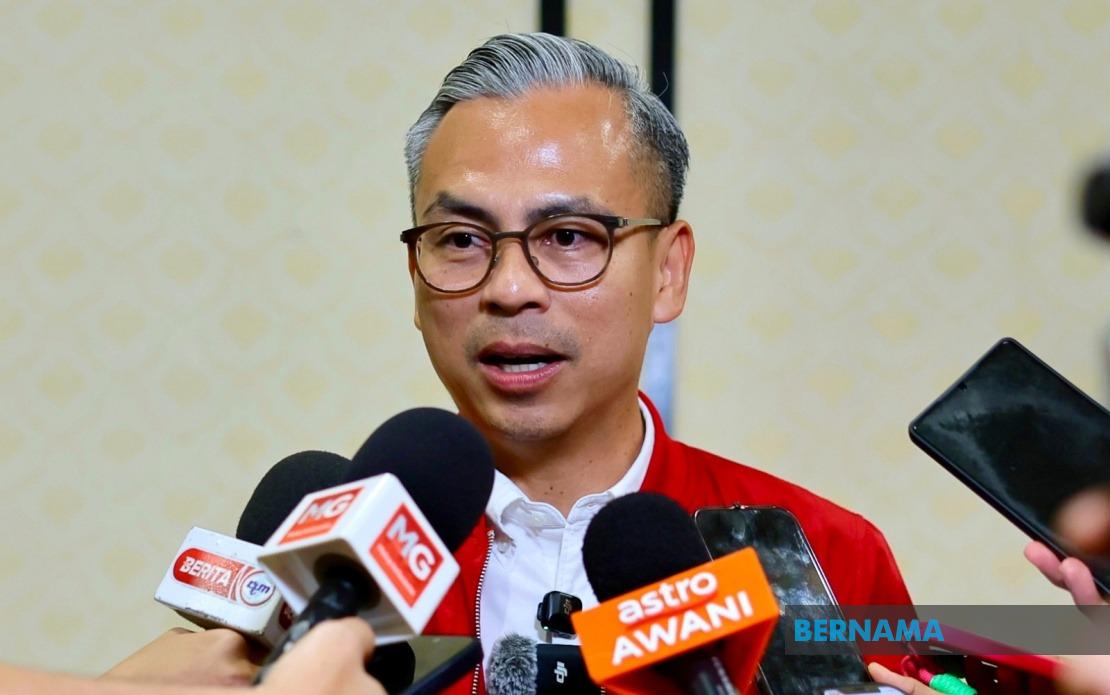
Communications Minister Datuk Fahmi Fadzil has offered a live broadcast platform on RTM for a substantive exchange between Johor Menteri Besar hopefuls, signalling the government's willingness to facilitate high-level political discourse ahead of the state election on July 11. The offer extends to Johor incumbent Datuk Onn Hafiz Ghazi of Barisan Nasional and Pakatan Harapan's Dr Maszlee Malik, candidate for the Puteri Wangsa seat, provided both parties agree to participate in what the minister characterised as a development-focused conversation rather than a partisan confrontation.
Fahmi indicated during a visit to Muar that the proposed dialogue could accommodate the schedules and preferences of both candidates, with potential venues ranging from Johor Bahru to other mutually convenient locations. His remarks came in response to recent suggestions from various quarters that Pakatan Harapan should first declare its own Menteri Besar candidate before engaging in any formal debate or dialogue with the incumbent government. The Communications Minister's position reflects an apparent willingness to move beyond such preconditions, emphasising that the platform would prioritise substantive discussion over rhetorical point-scoring.
The framing of this dialogue initiative reveals an underlying strategic calculation within the ruling coalition. By positioning the debate as a forum for discussing Johor's future development trajectory—infrastructure projects, economic diversification, social welfare programmes—rather than allowing it to devolve into mutual recriminations or partisan attacks, Fahmi sought to elevate the tone of campaigning in Malaysia's most economically significant state. This approach aligns with a broader effort to demonstrate that the government remains confident in defending its record and willing to engage opposition voices on substantive grounds, a posture increasingly important in competitive electoral environments.
Dr Maszlee has already demonstrated openness to public engagement, participating in an interactive forum with 41 young voters to discuss Johor's future aspirations and developmental priorities. Fahmi commended this initiative, suggesting that such willingness to encounter diverse viewpoints and address critical questions represents a crucial quality for future leadership. This observation carries implicit weight: leaders capable of facing rigorous scrutiny and differing perspectives, the minister implied, possess the temperament necessary to navigate complex governance challenges and shepherd state development effectively over a multi-year term.
The election itself arrives at a moment of considerable political significance for Malaysia. Johor, as the nation's industrial and commercial heartland with substantial economic output and a large, diverse voting population, has historically served as a bellwether for broader political trends. The state's electoral outcome carries implications extending well beyond Johor's borders, potentially signalling voter sentiment regarding the federal government's performance, economic management, and social policies. This contextual importance likely explains the relatively high-profile nature of the Communications Minister's intervention and his personal offer to facilitate prime-time coverage.
The Puteri Wangsa contest itself presents an intricate multi-cornered race. Beyond Dr Maszlee's representation of Pakatan Harapan and Teow Chia Ling's candidacy for Barisan Nasional, the seat will also feature Nicholas Paul Vincent of Parti Bersama Malaysia, MUDA's Rashifa Aljunied, and independent candidate Wang Wee Seong. This fragmentation reflects the increasingly crowded Malaysian electoral landscape, where established two-coalition dominance faces mounting pressure from newer entrants and independent candidates seeking to capture disaffected or issue-focused voters.
Meanwhile, in the Machap constituency, the political battleground appears more straightforward. Incumbent Onn Hafiz of Barisan Nasional faces Pakatan Harapan's Nor Hafiz Roslan in a direct contest, presenting voters with a clearer binary choice between the ruling coalition and the main opposition alliance. The contrasting electoral dynamics between these two key races—one fragmented, one bipolar—reflect broader variations in voter preferences across different Johor constituencies and suggest that campaign strategy and messaging will necessarily differ significantly by locality.
Fahmi's appeal to younger voters, specifically urging them to overcome any logistical inconveniences associated with the mid-month polling date and fulfil their civic responsibility, touches on a persistent challenge in Malaysian electoral politics. Youth turnout has historically lagged behind older demographic cohorts, and polling dates that fall during the academic calendar or in the middle of working weeks can suppress participation among younger citizens. By framing voting participation as essential to determining Johor's development direction over the subsequent five-year period, the minister attempted to motivate this crucial electoral segment through appeals to long-term state interest rather than partisan loyalty.
The establishment of July 11 as polling day, with early voting scheduled for July 7, provides candidates with a compressed campaign window to build momentum and mobilise supporters. For Pakatan Harapan, which has not yet formally announced its preferred Menteri Besar candidate, this timeline adds urgency to strategic decisions about candidate positioning and campaign messaging. The absence of a declared MB candidate becomes increasingly conspicuous as polling day approaches, and Fahmi's casual confidence that such a candidate will eventually materialise and participate in dialogue suggests internal PH discussions remain ongoing regarding this crucial decision.
The RTM platform itself carries particular significance in Malaysia's media landscape. As the nation's public broadcaster, RTM commands substantial reach across both urban and rural constituencies and traditionally maintains editorial standards emphasising balanced coverage. A live dialogue broadcast on RTM TV1 would reach audiences considerably broader than partisan campaign events or social media campaigns, potentially exposing significant voter segments to detailed policy positions and substantive discussion of state governance issues. For voters still undecided or seeking detailed information about candidates' visions for Johor, such a platform could prove influential in shaping final electoral preferences.
Fahmi's characterisation of the proposed dialogue as focused on developmental and policy matters rather than personal attacks or partisan scoring reflects an apparent recognition that Malaysian voters, particularly in economically dynamic states like Johor, increasingly demand substantive engagement with governance and development questions. Whether this aspirational framing translates into actual dialogue remains contingent on both the Menteri Besar incumbent and Pakatan Harapan's principal candidate accepting the invitation. Should such a dialogue materialise, it could establish a template for more policy-focused campaigning in future Malaysian elections, elevating discourse standards across the electoral landscape.

