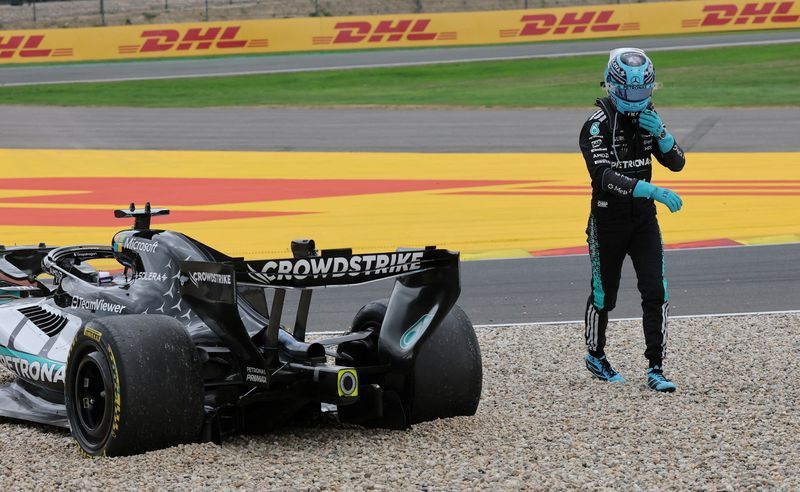
George Russell's championship hopes suffered another significant setback at the Belgian Grand Prix when the Mercedes driver crashed out of Sunday's race at Spa-Francorchamps, colliding with his former teammate Lewis Hamilton on the opening lap. The incident marks a crushing moment for a driver who started the weekend in third on the grid but found himself facing a mounting catalogue of technical failures that left him vulnerable and ultimately unable to recover. Russell's emotional response—describing himself as "numb to the disappointment"—reflects the accumulated frustration of a season slipping through Mercedes' fingers as Kimi Antonelli's lead in the championship continues to expand.
The collision unfolded after Russell lost crucial ground exiting the first corner due to what he later identified as a critical battery management malfunction. Having executed a strong initial maneuver that placed him directly behind Max Verstappen, Russell's car unexpectedly failed to recharge its hybrid system at Turn One, leaving him with just 35 percent battery capacity heading into the subsequent corners. This mechanical failure cascaded into further problems—the turbo boost system refused to engage properly, and by the time Russell reached Eau Rouge, the battery was completely depleted. Stripped of the hybrid system's power assistance at a critical moment in the race, Russell found himself overwhelmed by three cars in quick succession, a situation he correctly identified as a direct consequence of mechanical failure rather than driver error.
When Russell attempted to challenge Hamilton into the next sequence of corners, the pair made contact with sufficient force to send the Mercedes driver spinning off into the gravel. Hamilton continued racing despite the incident, which prompted the race stewards to investigate. They determined that Hamilton bore greater responsibility for the collision, issuing the Ferrari driver a five-second penalty. However, Russell himself insisted that Hamilton's actions, while contributing to the crash, did not constitute reckless driving—a characteristically measured assessment from a driver accustomed to navigating the delicate politics of team dynamics and media scrutiny.
What distinguishes this particular failure from previous mechanical issues is its timing and the broader context of Mercedes' championship campaign. Russell has now failed to score points in three races this season, a statistic that underscores a troubling pattern of unreliability and performance degradation. The team's current championship leader, Antonelli, occupies pole position in the standings with a commanding 25-point advantage over Russell, his Mercedes teammate and closest challenger. With nine races completed from a 22-race season, the gap is already substantial enough to suggest that Mercedes faces an uphill battle to claw back lost ground, particularly if technical gremlins continue to plague Russell's vehicle.
The battery management issue Russell encountered is particularly concerning because it highlights potential design flaws or calibration problems within Mercedes' hybrid power unit. The car's failure to recharge during the first corner, a sequence where hybrid energy recovery is typically at its peak due to braking deceleration, suggests either a software glitch or a fundamental issue with the energy harvesting system. That subsequent symptoms manifested in the turbo boost system only compounds the problem, indicating possible electrical distribution issues across multiple power unit components. For a manufacturer of Mercedes' pedigree and resources, such failures raise questions about the adequacy of pre-race testing protocols and the effectiveness of the team's engineering diagnostics.
Russell had flagged concerns about his car's straight-line performance during Saturday's qualifying session, suggesting that the issues were evident to the driver well before Sunday's race. This advance warning should have prompted intensive overnight analysis and remedial work. That technical problems persisted into the race, and ultimately contributed to a collision and retirement, represents a failure at multiple organizational levels. The engineering team's inability to diagnose and resolve the issue overnight, combined with the car's propensity to malfunction at critical moments, reflects systemic challenges within Mercedes' current technical program.
The championship implications of Russell's retirement extend beyond simple points arithmetic. Antonelli's lead is now sufficiently commanding that Mercedes would need to engineer a dramatic turnaround in competitiveness or rely on misfortune befalling the current leader. With nine races remaining, there is technically sufficient time for such a reversal, but the pattern of reliability issues affecting Russell's vehicle suggests that the problem is not merely transient. If Mercedes cannot stabilize its technical performance and eliminate the hybrid system failures plaguing Russell's car, the championship outcome may effectively be decided by attrition rather than competitive superiority.
Russell's measured response to the incident, while professionally composed, masks the deeper frustration of a title contender watching his campaign derail through circumstances beyond his control. His explicit statement that he felt "numb" to the disappointment reflects a psychological coping mechanism—the repeated experience of mechanical failure has created an emotional numbness that, paradoxically, makes it harder to mobilize the psychological energy necessary for a championship recovery. This mental toll, combined with the technical unreliability, creates a compounding disadvantage for Russell as the season progresses.
The contrast between Russell's technical narrative and Antonelli's continued dominance serves as a reminder that Formula One success remains heavily dependent on the quality of the mechanical platform. While driver talent and racecraft remain essential, a fundamentally unreliable chassis with hybrid system failures cannot be overcome through skill alone. Mercedes faces a critical juncture where urgent technical remediation is required to prevent this season from becoming defined by mechanical attrition rather than competitive racing. For Russell personally, the immediate focus must shift to working intensively with his engineering team to identify and eliminate the root causes of these failures, lest the championship opportunity slip entirely beyond recovery.

