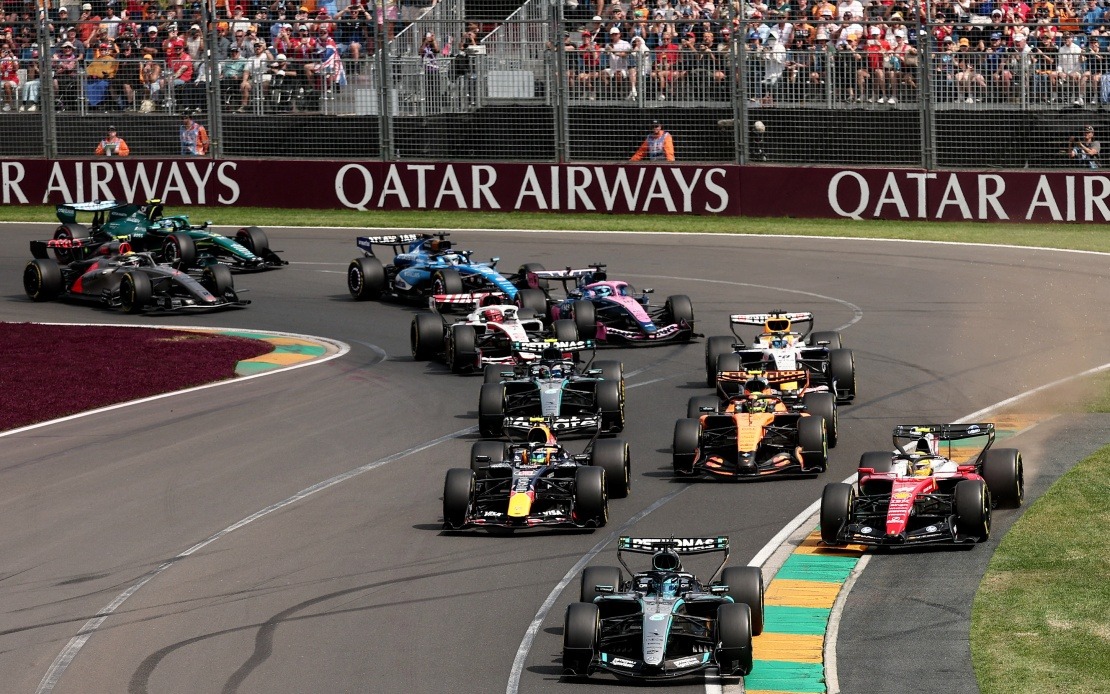
George Russell's world championship campaign received a devastating blow at Spa-Francorchamps, where a technical malfunction and subsequent collision with Lewis Hamilton forced his retirement from Sunday's Belgian Grand Prix. The incident marks another chapter in a frustrating season for the Mercedes driver, who now trails Italian teenage sensation Kimi Antonelli by 50 points after the youngster claimed his sixth victory in ten races contested thus far.
Russell's evident frustration boiled over in a radio exchange that captured the depth of his disappointment. During the transmission—held back from broadcast during the race itself—the British driver expressed exasperation over a battery deployment issue that compromised his straight-line performance. His explosive commentary reflected not merely the frustration of a single race gone wrong, but the accumulated toll of recurring mechanical gremlins that have plagued his season. Russell declared the situation "unacceptable," a rare moment of unguarded emotion that underscored the mounting pressure on his shoulders as his championship dreams slipped away.
The origins of Russell's troubles lay in a complex technical failure within Mercedes' energy management system. Throughout the weekend at the Belgian circuit, an unexplained deployment malfunction hampered his performance, first during qualifying where he ended up half a second adrift of Antonelli, and then again during the race itself. The problem's roots proved elusive initially; the Mercedes engineering team first attributed the issue to Russell's driving style before ultimately discarding that theory as the situation continued to baffle their specialists.
The impact of this technical setback cascaded through the race weekend. When his power unit failed to harvest and deploy electrical energy correctly on the straights, Russell lost crucial performance margin to his rival. This deficit exposed him to pressure from the chasing field, creating the vulnerability that ultimately led to his retirement. The collision with teammate Hamilton, occurring after Russell had been pushed back into the pack by the earlier engine glitch, represented the final blow to his afternoon. For a driver already contending with an increasingly difficult championship position, the convergence of these failures painted a bleak picture of his competitive standing.
Russell's reaction to the Belgian disappointment extended beyond immediate frustration. Discussing his prospects for the Hungarian Grand Prix—the final race before the summer break—he expressed hope that Mercedes could identify and rectify the problem in time. However, his underlying tone suggested a driver increasingly weary of repeated setbacks. He described himself as "numb to disappointment," a telling phrase that captures how a litany of mechanical issues throughout the season has eroded his usual optimism and resilience.
Mercedes team principal Toto Wolff offered a measured response to Russell's outburst, demonstrating the delicate balance required in managing a frustrated championship contender. Wolff acknowledged the emotional intensity that accompanies on-track disasters, contextualizing Russell's reaction within the broader framework of elite motorsport. He emphasised that all top drivers experience difficult spells and that the team remained fully committed to supporting Russell through this challenging period. Wolff's remarks suggested an attempt to rebuild morale while maintaining perspective about the team's competitive position.
Regarding the technical failure itself, Wolff provided insight into the extraordinary complexity of modern Formula 1 power units. The sophisticated interaction between energy harvesting, energy deployment, and driver input creates a labyrinthine system where problems can manifest in subtle but significant ways. Wolff confirmed that Mercedes engineers had indeed identified the specific engine issue affecting Russell's performance, noting that the power unit was not delivering sufficient electrical energy to deploy into the corner sequences where overtaking opportunities exist.
Wolff's technical explanation revealed a silver lining amid the disappointment. The technical problem proved easier to diagnose at Spa-Francorchamps, a circuit that places extreme demands on energy management systems, than it might have at Hungary—a venue less dependent on electrical power deployment. This suggests that Mercedes may indeed be in a position to understand and correct the malfunction before the Hungarian Grand Prix. Nevertheless, Wolff acknowledged that even identifying the problem does not retroactively repair the damage done to Russell's championship position or his psychological state as the season progresses.
The performance gap between Russell and Antonelli has become increasingly stark, with the teenager demonstrating remarkable consistency and pace that has seemingly outstripped his more experienced teammate. The fifty-point deficit represents a mountain to climb in the remaining races, made considerably steeper by the mechanical unreliability that has haunted Russell's campaign. Where Antonelli has benefited from a relatively smooth run, Russell has contended with a succession of technical gremlins that have undermined his competitive efforts.
For Malaysian and Southeast Asian motorsport enthusiasts, Russell's predicament illustrates the unforgiving nature of Formula 1 competition, where mechanical reliability remains as crucial as driver skill. The sport's increasingly complex power unit regulations, while designed to promote sustainable technology development, have created an intricate technical landscape where failures can prove decisive. Russell's season serves as a cautionary tale about the fragility of championship campaigns when technical support falters.
The broader implications for Mercedes are significant. The team, once synonymous with reliability and technical excellence, is grappling with power unit issues that suggest deeper problems within their new regulatory framework compliance. With Russell's championship hopes fading and internal team dynamics complicated by Hamilton's unexpected competitive resurgence, Mercedes faces mounting pressure to stabilize their technical platform before further opportunities slip away.
As Russell heads toward Hungary seeking redemption and hoping for the mechanical stability that has eluded him, his upcoming performances will be closely scrutinized. Whether Mercedes can deliver the reliability and technical fixes promised will determine not only his championship chances but also the trajectory of the team's season and their ability to mount a credible challenge against the dominant Antonelli and his formidable Ferrari machinery.

