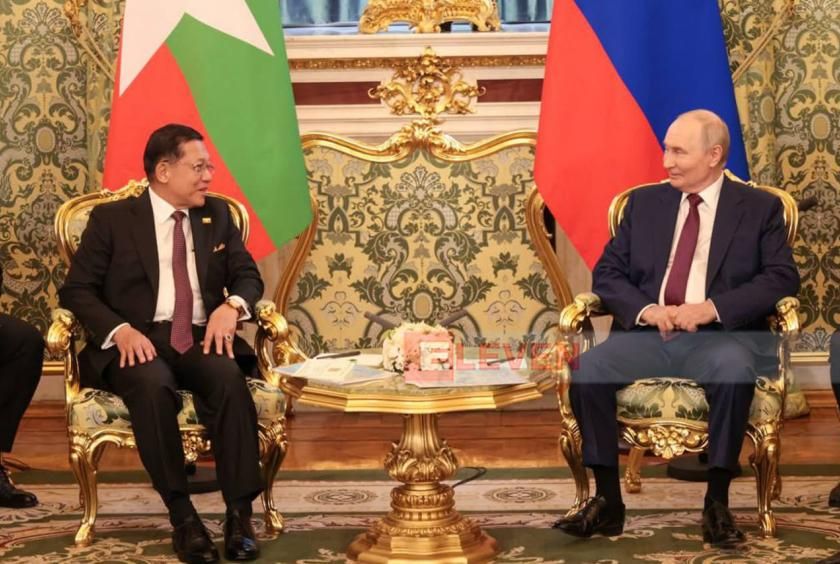
Russia and Myanmar are moving to substantially expand their strategic partnership, with President Vladimir Putin announcing during an August 18 media appearance alongside Myanmar's leader that Moscow stands prepared to collaborate on offshore oil and gas ventures and broader natural resource exploitation. The statement underscores Russia's intensifying engagement in Southeast Asia at a time of shifting geopolitical alignments, and signals particular interest in Myanmar's energy sector as a platform for deeper bilateral integration across multiple sectors of mutual interest.
The cooperative framework being developed reflects what Putin characterised as a relationship rooted in historical continuity stretching back decades. He emphasised that the Soviet Union had played a formative role in Myanmar's post-independence development, constructing hospitals, universities and other institutional infrastructure during the 1950s and 1960s that continue functioning today. This historical narrative serves a dual purpose: it legitimises present-day Russian involvement by framing it as an extension of established goodwill, while simultaneously positioning contemporary cooperation as building upon proven foundations of mutual benefit rather than emerging from opportunistic calculation.
Energy cooperation represents the most concrete dimension of the expanded partnership. Beyond exploration and extraction of conventional oil and gas reserves, including those in offshore waters, Russia has identified liquefied natural gas (LNG) as a significant opportunity. Putin indicated that Russian LNG exports to Myanmar could serve dual purposes—meeting Myanmar's growing domestic energy requirements while simultaneously positioning the country as a potential hub for energy redistribution throughout Southeast Asia. This approach reflects broader Russian strategy to leverage energy as both an economic and geopolitical instrument in regions where its influence faces competition from Western and Asian powers.
The nuclear sector constitutes another pillar of deepening engagement. Russia and Myanmar signed an agreement during the previous year for construction of a nuclear power plant, which Putin identified as a flagship project carrying strategic weight for both nations. This commitment represents a particularly sensitive area of cooperation given international scrutiny of nuclear development programmes in Southeast Asia and Myanmar's complex political transition. The project's advancement will likely attract regional attention and may influence broader perceptions of Myanmar's energy security strategy.
Infrastructial development extends well beyond energy infrastructure. Russia is supporting multiple industrial projects simultaneously, including coal-fired power generation facilities, an oil refinery, a steel manufacturing plant, and a fertiliser production facility already under construction in Myanmar. Most significantly, discussions are underway concerning a deep-sea port in southern Myanmar, which carries profound implications for regional trade patterns and maritime connectivity. Port infrastructure in Myanmar could reshape Southeast Asian logistics networks and influence broader patterns of regional economic integration.
The breadth of proposed cooperation underscores Russia's ambitions to position itself as a comprehensive development partner rather than a single-sector investor. High-technology sectors—including digital infrastructure, cybersecurity and related fields—feature prominently in Russian proposals. This diversification strategy suggests Moscow views Myanmar not merely as an energy resource to be tapped, but as a strategic location offering multiple vectors for engagement and influence consolidation throughout the region.
People-to-people and educational dimensions complement infrastructure investments. A visa-free arrangement enables circulation of scientists, students, athletes and cultural actors between the two nations. Russian universities currently host approximately 400 Myanmar students, while 17,000 Myanmar graduates have completed studies in Russia over preceding years. The planned establishment of a Myanmar consulate in Vladivostok and Russian cultural centres in Altai, Kaluga and Moscow represent institutional infrastructure supporting sustained human exchange. Notably, approval has been granted to construct a Russian Orthodox Christian church in Yangon, a visible symbol of Russia's permanent presence within Myanmar's social landscape.
The expansion of Russian language instruction across Myanmar's university system and military academy indicates intentional effort to deepen cultural and intellectual alignment. When combined with military-technical cooperation—involving frequent exercises in Myanmar's waters and regular visits by Russian naval vessels—these civilian-sector initiatives create multi-layered engagement structures resistant to sudden disruption or reversal.
Military cooperation warrants particular attention within the broader partnership architecture. Frequent naval exercises and port visits by Russian warships establish an enduring security dimension to bilateral relations, providing Russia with sustained maritime access to strategic waters and enabling operational familiarity with Myanmar's coastline. This military dimension complements the civilian infrastructure and economic projects, creating an integrated approach to influence consolidation.
The twelve memorandums of understanding signed during this visit represent concrete codification of announced intentions across multiple sectors. These agreements establish frameworks for implementation, resource allocation, and institutional coordination necessary to translate announcements into functioning partnerships. The sheer number of simultaneous agreements suggests a comprehensive strategy rather than incremental opportunism, indicating Moscow has allocated significant diplomatic and economic resources toward Myanmar engagement.
For the broader Southeast Asian region, expanding Russia-Myanmar cooperation carries consequential implications. Myanmar's strategic location on the Bay of Bengal, bordering Bangladesh, Thailand and China, makes it geopolitically significant. Russian energy investments, infrastructure projects and military presence expand Moscow's footprint in a region increasingly contested by major powers. This development occurs alongside China's substantial investments in Myanmar infrastructure and Belt and Road Initiative projects, creating a complex landscape where Russian and Chinese interests intersect and potentially compete.
Malaysian observers should recognise these developments within the context of shifting regional power dynamics. Russia's systematic engagement across energy, infrastructure, technology and security dimensions mirrors strategies employed by other external powers seeking influence in Southeast Asia. The Ukraine conflict's economic impact on energy prices and supply chains creates both opportunities and risks for regional stability. Myanmar's development trajectory, shaped increasingly by Russian and Chinese investment alongside internal political complexities, will influence broader Southeast Asian geopolitical configurations and economic integration patterns that directly affect Malaysia's regional position and strategic options.
The partnership's sustainability will ultimately depend on both nations' capacity to implement announced projects amid Myanmar's ongoing political transition and international scrutiny. However, the comprehensive nature of cooperation frameworks being established suggests Russia has committed substantial resources to building resilient relationships that transcend potential short-term disruptions or political fluctuations.

