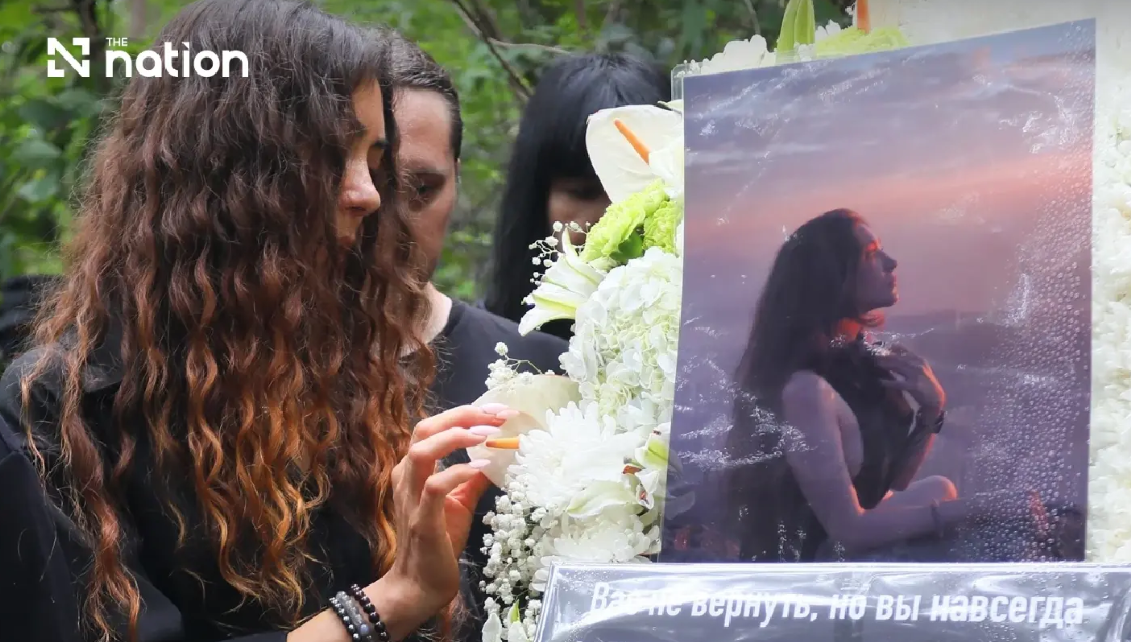
A solemn Buddhist memorial ceremony took place in Chon Buri province on Thursday as the mother of Russian siblings Diana and Roman gathered with mourners to honour her children and three members of a Thai family who perished in what authorities believe were coordinated killings by the same perpetrators. Sharina Nazimova presided over the service at the Huai Yai subdistrict location where Diana and Roman were discovered, drawing Thai and international visitors alongside local government representatives, police personnel and administrative officials to pay final respects to all five victims.
The graveside ritual combined Thai Buddhist traditions with personal remembrances that reflected the family's deep spiritual connection to the faith. Ordained monks chanted sacred verses and performed merit-making rites believed to guide the deceased's spiritual journey, while attendees maintained respectful silence with hands pressed together in prayer. The ceremony underscored how, despite the violent circumstances surrounding their deaths, the family chose to honour their loved ones through a framework of spiritual compassion rather than retribution.
Touching details emerged throughout the service that humanised the victims beyond the tragic headlines dominating news coverage. Mourners placed white flowers—carnations, lilies and roses—at the memorial site, each bloom selected for its symbolic meaning of purity, honour and peaceful transition. Most poignantly, relatives positioned Diana's favoured beverage, a cup of coffee, among the floral tributes. This intimate gesture, seemingly small in scale, visibly moved those assembled and served as a powerful reminder that behind the criminal investigation lay real people with ordinary preferences and everyday joys now forever lost.
Nazimova's emotional composure wavered during the proceedings, and she accepted comfort from family members, friends and other mourners gathered around her. Her remarks centred on profound gratitude toward the Thai nation, its government apparatus, law enforcement agencies and civilian volunteers who mobilised resources following the family's catastrophe. She emphasised how the outpouring of compassion from Thai society had sustained her family through an incomprehensibly difficult chapter, acknowledging that institutional and grassroots support had provided essential strength when the family confronted unimaginable loss.
The memorial service held particular significance as the family's formal farewell to Diana, Roman and the other victims whose cases had attracted considerable public attention. The gathering reflected how a tragedy involving foreign nationals in Thailand can transcend nationality boundaries, with local residents and international observers united in shared grief and collective demand for accountability. Those attending openly expressed expectations that the Thai justice system would pursue the responsible parties with rigour and ensure the five victims and their grieving families would receive meaningful justice.
Investigative authorities had previously arrested Thana "Pong" Kerdthong, aged 43, and Thongchai "Thong" Srinil, aged 39, on July 31 following an intensive manhunt spanning Wang Sombun district in Sa Kaeo province. These men emerged as primary suspects in the siblings' deaths after police traced their movements and connections to the crime scenes. The investigation's trajectory revealed a pattern of apparently coordinated violence suggesting systematic rather than random criminal activity.
According to police reconstructions, the two suspects encountered Diana and Roman near a roadside location, exploited their deception by falsely identifying themselves as law enforcement officers, physically restrained the siblings, and transported them to a remote forested area where the homicides occurred. Police attributed the initial criminal motivation to theft—specifically the siblings' motorcycle—though the severity of the violence suggested factors potentially exceeding simple robbery. The accused individuals subsequently offered conflicting narratives regarding the sequence of events, with investigators declining to accept their full accounts pending comprehensive cross-examination against forensic evidence and physical findings.
Following their custody, the suspects cooperated in directing police to the burial site containing Diana and Roman's remains. This cooperation precipitated an expanded excavation effort in the surrounding region, ultimately uncovering another grave containing the corpses of three Thai family members. This discovery transformed what initially appeared as an isolated incident into evidence of a broader pattern of homicidal violence, dramatically expanding the investigation's scope and raising urgent questions about potential additional victims or associated criminal activities.
For Malaysian readers and Southeast Asian observers, the case underscores persistent security challenges affecting both tourists and residents across Thailand's provincial regions. The incident highlights vulnerabilities that can expose foreign nationals to opportunistic criminal predation, particularly in rural or less-monitored areas where law enforcement presence remains inconsistent. It simultaneously demonstrates the capacity of Thai authorities to mobilise investigative resources and achieve arrests when high-profile cases attract national and international scrutiny, though questions persist regarding preventative measures and community safety infrastructure in remote zones.
The family's decision to observe Buddhist memorial traditions rather than pursue recriminations reflected a cultural reconciliation with Thai spirituality. Nazimova had independently raised both Diana and Roman as practicing Buddhists, embedding them within the religious framework of their adopted home despite their Russian heritage. This spiritual orientation shaped how the family chose to process grief—through merit-making ceremonies promoting compassion rather than cycles of revenge—offering a model of cross-cultural resilience relevant to diaspora communities throughout Southeast Asia.
The investigation continues as authorities develop their case against the detained suspects, with prosecutors preparing formal charges pending completion of forensic analysis and witness testimony compilation. The memorial service marked an interim closure for the family's public grieving process while the justice system pursues its own timeline toward resolution. For those who attended or followed the tragedy's evolution, the ceremony represented collective acknowledgment that the victims deserved remembrance as individuals whose lives held meaning beyond their violent endings.

