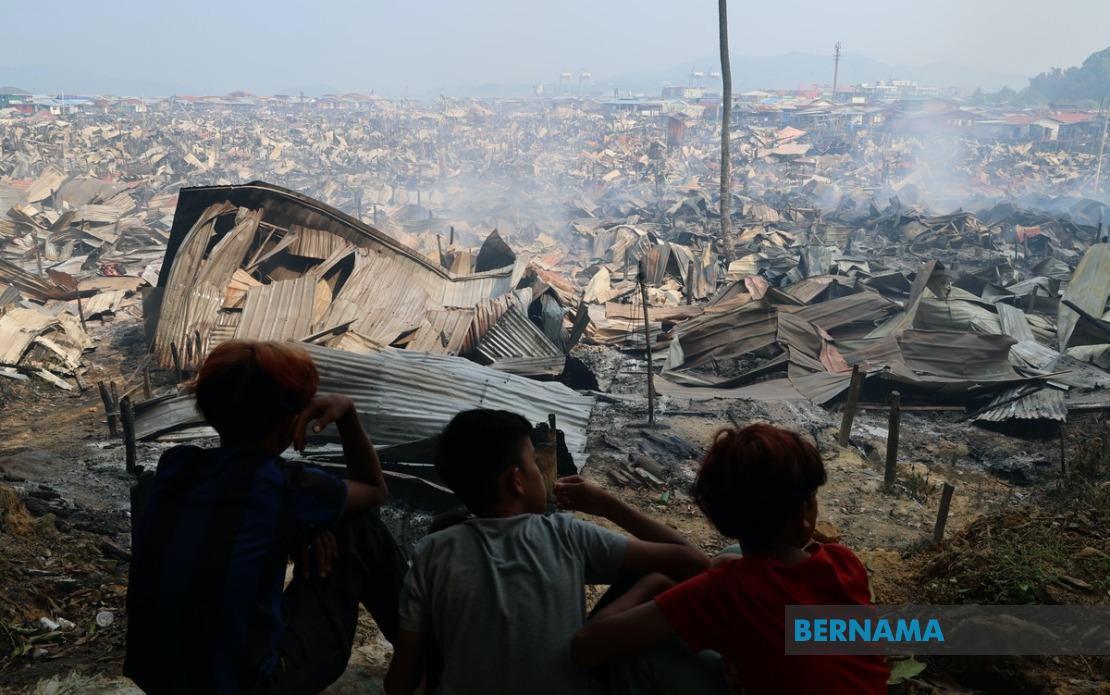
The Sabah government has unveiled a comprehensive relief package totalling RM3,000 for every Malaysian head of household impacted by the fire that ravaged Kampung Lok Buta in Numbak, Kota Kinabalu, destroying more than 200 residences in the early hours of August 30. Chief Minister Datuk Seri Hajiji Noor made the announcement during a visit to victims sheltering at the Likas Multipurpose Hall, where temporary relief operations are being coordinated, pledging immediate financial support to alleviate the hardship faced by those who lost their homes and possessions.
The relief allocation has been structured as a collaborative effort across three institutional bodies, with each contributing RM1,000 towards the total package. The Sabah state government, the federal government, and the Yayasan Kebajikan Sabah have jointly committed their resources to ensure affected families receive meaningful assistance during this critical period of displacement and recovery. This tripartite approach demonstrates coordination between state and federal authorities in responding to domestic disasters, a mechanism that has become increasingly important as the region faces more frequent natural and man-made emergencies.
Beyond the direct cash assistance, the Sabah government has committed to facilitating home reconstruction through a structured partnership involving the State Secretary's Office and Majlis Amanah Rakyat (MARA), the state's development and cooperative agency. This partnership signals recognition that financial aid alone is insufficient; affected families will require comprehensive support including technical planning, material sourcing, and administrative guidance to rebuild their homes. The authorities have indicated that decisions regarding whether residents will reconstruct at the original site or be relocated to alternative locations will be made judiciously, taking into account factors such as land stability, infrastructure accessibility, and community cohesion.
In a gesture of inclusive compassion, Chief Minister Hajiji also directed that non-Malaysian residents whose heads of household were affected by the fire would receive RM1,000 from the state government. This provision reflects recognition that undocumented or foreign nationals, who often form part of Sabah's economically vulnerable population, are particularly exposed to disaster impacts without the safety nets available to citizens. The decision extends humanitarian principles beyond citizenship categories, acknowledging that anyone experiencing such catastrophic loss deserves basic dignified support.
The immediate material needs of displaced families are being addressed through distribution of essential supplies encompassing food items and household goods. These provisions represent the frontline of disaster response, ensuring that families displaced from their homes have access to basic sustenance and daily necessities while longer-term reconstruction unfolds. The establishment of the Likas Multipurpose Hall as a relief centre provides a coordinated distribution point, allowing authorities to efficiently catalogue victims, assess individual needs, and prevent duplication of aid.
The tragedy carried a particularly devastating human dimension. The fire, which erupted at approximately 1.40 am, claimed the lives of three children: four-year-old Nana Abdullah, her six-year-old brother Mohd Asrul, and their eight-year-old cousin Nurfarahdilah Mohd Tajihah. These fatalities underscore the severe risks posed by fire in densely populated informal settlements where residential structures often lack modern safety features including adequate fire exits, alarm systems, and suppression equipment. The deaths have prompted questions about building code enforcement and fire safety standards in Sabah's vulnerable communities.
The scale of destruction—more than 200 homes—indicates the fire's rapid propagation through the settlement, likely facilitated by wooden construction and minimal spacing between dwellings characteristic of informal urban areas. Such conflagrations are relatively common across Southeast Asia, where rapid urbanisation has created sprawling settlements with inadequate infrastructure and safety provisions. The Kampung Lok Buta incident echoes similar disasters across Malaysia, from the Port Klang fire of 2022 to previous incidents in Kuala Lumpur, establishing a troubling pattern of preventable mass destruction affecting the most economically marginalised populations.
The financial response, while substantial in per-household terms, requires contextual understanding. A RM3,000 injection provides critical immediate relief but realistically covers perhaps one-third to one-half of typical home reconstruction costs for modest structures. This reality necessitates that long-term recovery depend significantly on the promised reconstruction facilitation through government agencies and private construction assistance. Without coordinated follow-through on rebuilding support, the initial cash assistance risks becoming insufficient for genuine recovery.
The disaster illuminates persistent vulnerabilities in how Malaysia's regional economies accommodate lower-income populations. Kampung Lok Buta, like many settlements providing housing for working-poor families and migrants, exists in a regulatory grey zone where building codes are poorly enforced and fire safety infrastructure remains rudimentary. The government response, while commendable in its speed and generosity, tacitly acknowledges a structural failure: inadequate prevention and preparedness systems allowed a single fire to devastate an entire community. Sustainable solutions require not only better post-disaster response but investment in preventive infrastructure including fire stations, water supply networks, improved building standards, and emergency early warning systems in high-density informal areas.

