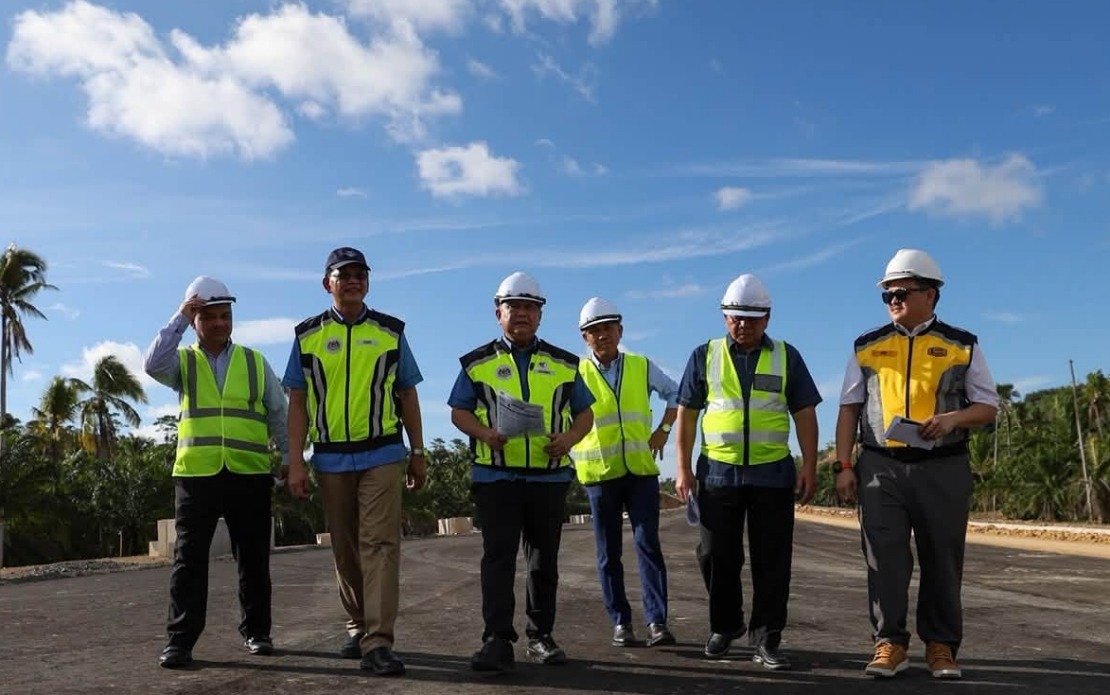
The contractor responsible for constructing the Sabah Pan Borneo Highway Work Package 11 has formally submitted a recovery plan aimed at addressing delays that have accumulated on this strategically important infrastructure project. Works Minister Datuk Seri Alexander Nanta Linggi disclosed the submission in a statement on July 20, confirming that the measure is designed to bring the RM167.48 million project back on track for its contractual completion date of September 29, 2026.
The 7.3-kilometre alignment, spanning from Rampayan Laut to Sarang, forms part of the larger Pan Borneo Highway initiative that has been gradually reshaping connectivity across Sabah. As of late June, the project had reached 61.76 per cent physical progress, yet this figure masks an underlying scheduling problem: the work remained 4.35 per cent behind the original timeline, translating to a 32-day shortfall that threatens the ambitious completion target.
The recovery plan represents a collaborative effort among multiple stakeholders working to salvage the project's schedule. The Works Ministry, alongside Sabah's Public Works Department, the project consultant, and the contractor have committed to close monitoring of implementation efforts. Nanta outlined an intermediate objective to reduce the accumulated delay to just 14 days by August 2026, effectively requiring a significant acceleration of remaining construction activities over the coming months.
The delays plaguing Work Package 11 reveal the complex coordination challenges inherent in large-scale highway projects across Sabah. Utility relocation has emerged as a critical bottleneck, involving three major service providers: Sabah Electricity Sdn Bhd, the Sabah State Water Department, and Celcom Timur Sabah Sdn Bhd. Beyond infrastructure utilities, land acquisition issues have also contributed to the scheduling difficulties, creating multiple friction points that have disrupted the sequential flow of construction work.
These obstacles underscore a broader lesson for infrastructure development in Malaysian Borneo: projects of this scale require exceptional coordination between government agencies, private utilities, and state authorities. When these stakeholders operate with insufficient communication or conflicting priorities, even well-funded and properly contracted projects suffer delays. The Works Minister's emphasis on improving coordination and resolving issues "in an integrated manner" suggests that siloed decision-making has hindered progress and that more systematic collaboration protocols may be needed.
Once completed, the Rampayan Laut-Sarang alignment will deliver substantial benefits to northern Sabah's connectivity landscape. The new route will provide travellers with a significantly safer and more efficient alternative to existing paths, reducing journey distances to locations such as Simpang Mengayau or Kudat by up to 30 kilometres. This translates into travel time savings of between 30 and 60 minutes, figures that compound substantially when multiplied across daily traffic volumes.
The infrastructure improvements extend beyond mere convenience to commercial and economic dimensions. The alignment will enhance access to what Nanta termed the Tourism Belt and the Northern Sabah Coastal Tourism Master Plan, initiatives designed to position the region as a premium destination. Improved road connectivity typically catalyses tourism development by making previously remote attractions more accessible to domestic and international visitors, while simultaneously reducing logistics costs for goods transported to and from northern districts.
Economic diversification represents a key strategic advantage of this project for Sabah. Enhanced infrastructure connectivity traditionally triggers secondary effects including increased business investment, expanded employment opportunities, and improved market access for local producers and service providers. The northern coastal regions have long been disadvantaged by distance and poor road conditions; the new alignment directly addresses these structural constraints that have historically limited economic participation in these areas.
The Works Minister's statement reflects governmental commitment to maintaining quality standards alongside schedule recovery. Rather than treating the project as purely a scheduling exercise, the ministry has explicitly prioritised "the highest standards of quality, safety and integrity," signalling that acceleration efforts will not come at the expense of construction standards or worker safety compliance. This balanced approach is particularly important given that highway safety depends fundamentally on construction quality and proper implementation of engineering specifications.
The recovery plan's submission marks a critical juncture for the project. Achieving the intermediate target of reducing delays to 14 days by August 2026 will require sustained effort and unwavering commitment from all parties. The success of this recovery effort will also serve as a valuable case study for future Pan Borneo Highway phases and comparable infrastructure projects across Malaysian Borneo, demonstrating either the effectiveness or limitations of recovery planning in addressing complex coordination challenges.
From a regional perspective, the Pan Borneo Highway represents one of Southeast Asia's most ambitious connectivity initiatives, designed to bind Sarawak and Sabah more closely to Malaysia's broader economic framework while reducing their geographical isolation. Work Package 11's timeline thus carries implications beyond Sabah's borders, affecting the overall pace at which the entire Pan Borneo system can deliver its promised regional integration benefits. The contractor's recovery plan, though focused on a single segment, therefore deserves attention from stakeholders monitoring infrastructure development across Borneo more broadly.

