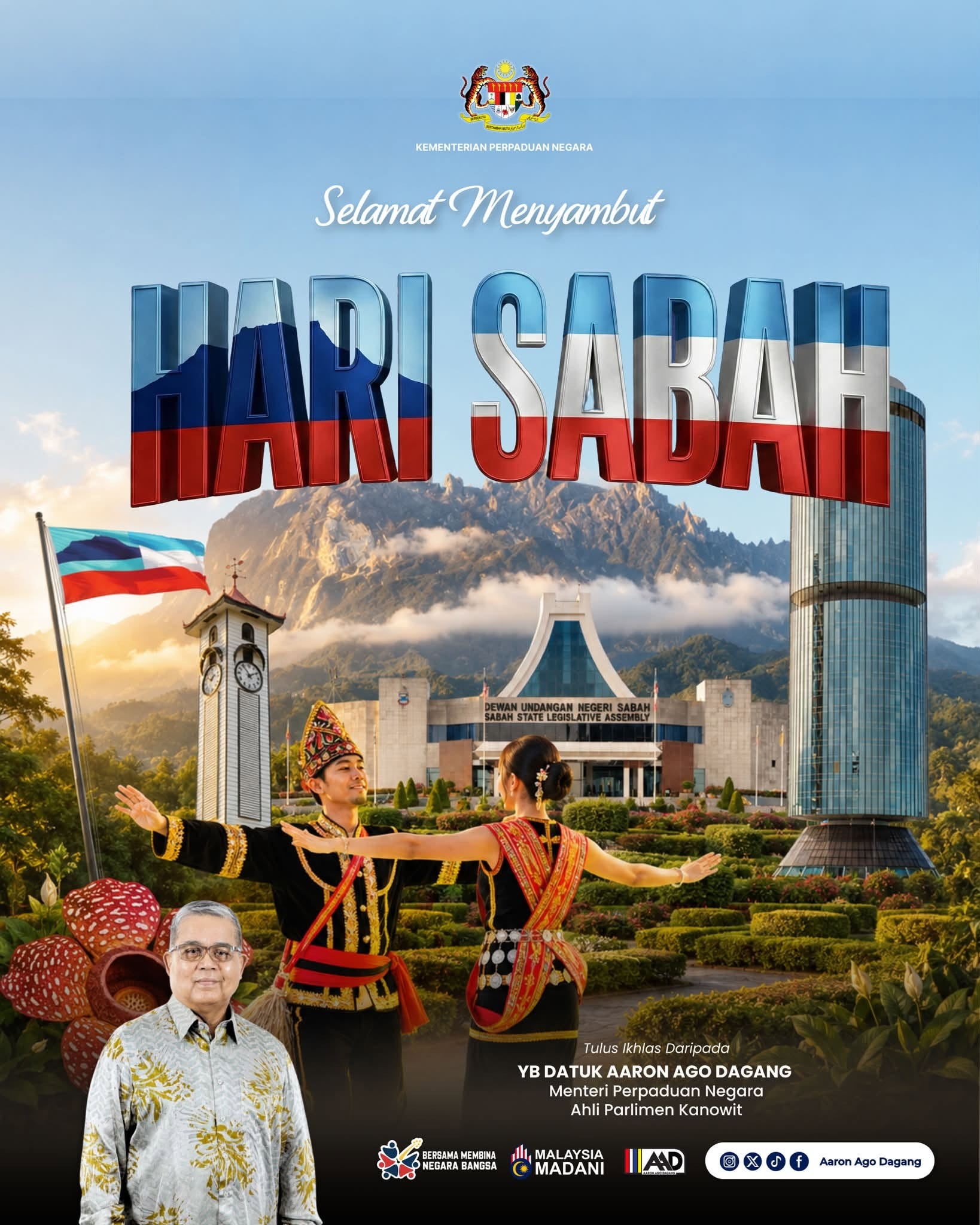
The National Unity Minister, Datuk Aaron Ago Dagang, has underscored the profound importance of Sabah's multicultural composition, positioning the state's ethnic richness as a foundational element of Malaysia's national character. Speaking on the occasion of Sabah Day on August 31, he characterised the coexistence of dozens of distinct communities within the state not merely as a demographic fact but as a strategic advantage that distinguishes Sabah within the federation.
The scale of Sabah's cultural plurality is substantial and intricate. The state is home to 35 recognised ethnic groups, which subdivide further into 217 distinct sub-groups, each maintaining its own linguistic traditions, ceremonial practices, distinctive clothing, musical expressions and inherited customs. This architectural complexity of identity reflects centuries of settlement patterns, trade movements and interethnic exchanges across the island of Borneo. The communities explicitly mentioned by the minister—the Kadazan, Dusun, Bajau, Murut, Rungus, Bisaya, Lotud and Lundayeh peoples—represent only a portion of this broader tapestry, yet their collective presence has indelibly shaped the contemporary character of Sabah society.
The minister's framing of diversity as a unifying force rather than a divisive one carries particular weight in the Malaysian context, where questions of cultural coexistence remain politically sensitive. Dagang argued that harmony emerges not from the erasure or subordination of cultural differences but from mutual comprehension and deliberate acceptance. This perspective suggests that Sabah's historical experience of managing plural communities offers a tangible model for national unity—one grounded not in enforced uniformity but in respectful acknowledgement of legitimate difference. For a region increasingly concerned with social cohesion, this proposition has practical implications for policymaking and intercommunal relations.
Sabah's historical trajectory provides important context for understanding contemporary unity efforts. The territory transitioned through multiple administrative regimes before achieving self-governance in 1963—moving from the British North Borneo Company's commercial administration through Japanese military occupation and returning to British sovereignty, before finally attaining autonomous governance. This complex colonial heritage meant that Sabah's constituent communities developed distinct relationships with external authority while simultaneously building internal networks of coexistence. The subsequent formation of the Federation of Malaysia on September 16, 1963, represented a pivotal moment in which Sabah voluntarily integrated into a larger political structure while retaining particular constitutional protections and cultural prerogatives.
The designation of August 31 as Sabah Day, formalised by the state government in 2024, represents an effort to embed commemoration of this foundational period into the annual civic calendar. Such observances serve multiple functions: they anchor contemporary identity in historical memory, they provide designated moments for reflection on shared values and challenges, and they create platforms for official messaging regarding national priorities. By selecting this date for his remarks on cultural unity, Minister Dagang connected historical continuity with present-day imperatives, suggesting that the conditions allowing Sabah's diverse communities to flourish in the mid-twentieth century remain relevant to contemporary development.
The minister's emphasis on intergenerational responsibility extends the discussion beyond nostalgic commemoration toward future-oriented action. He articulated an explicit charge to the current generation of Sabahans—particularly younger citizens—to advance the state's trajectory in measurable domains: educational excellence, economic competitiveness, technological capability and infrastructural development. This framework positions cultural heritage not as an obstacle to modernisation but as a distinct asset that contemporary Sabahans should leverage while progressing. The combination of preserving identity while pursuing development constitutes a deliberate rejection of false dichotomies between tradition and advancement.
For Malaysian readers and policymakers, Sabah's model of managed diversity carries instructive value. The state's demonstrated capacity to maintain social stability across dozens of ethnic and linguistic communities, while sustaining distinct political institutions and constitutional arrangements, offers practical evidence that diversity need not undermine governance or economic function. Indeed, Dagang's positioning suggests the inverse: that cultural richness, when properly respected, enhances rather than diminishes a region's capacity to address collective challenges and pursue shared prosperity.
The invocation of previous generations' contributions—described as sacrifice, labour and intellectual investment—serves a rhetorical function of establishing moral obligation. By acknowledging historical actors who devoted themselves to building the Sabah of today, the minister implicitly argues that contemporary citizens inherit not merely territorial and institutional inheritance but moral debts that should motivate continued commitment to the state's welfare. This framing transforms national unity from an abstract ideal into a concrete practice rooted in recognition of ancestral effort.
The broader significance of such ministerial statements within Malaysian discourse centres on their role in articulating official positions on sensitive matters of identity and belonging. Public affirmations from senior government figures that diversity constitutes strength rather than weakness help establish normative parameters for public discourse and policy formation. Given Malaysia's occasional experience of communal tensions and competing narratives regarding the proper relationship between different ethnic and religious communities, explicit governmental endorsement of pluralism and intercommunal respect carries weight beyond the particular context of Sabah.
The substance of Dagang's remarks also reflects international dimensions of diversity politics. Southeast Asia increasingly recognises that societies managing multiple ethnic, linguistic and religious communities—such as Indonesia, Philippines, Malaysia and others—face comparable challenges and can benefit from sharing institutional innovations and best practices. Sabah's experience of sustained multiethnic cooperation positions it as a potential case study within regional discussions about conflict prevention and social cohesion.
Looking forward, the challenge for Sabah—and by extension for Malaysia—involves translating rhetorical affirmations of diversity's value into sustained institutional practices and resource allocation. Government policies governing education, cultural patronage, economic opportunity distribution and political representation ultimately determine whether diversity remains a celebrated abstraction or becomes embedded in lived experience. The minister's call for the current generation to advance Sabah while protecting its heritage implicitly acknowledges this gap between aspiration and practice, suggesting that such integration requires active, deliberate effort rather than mere passive coexistence.

