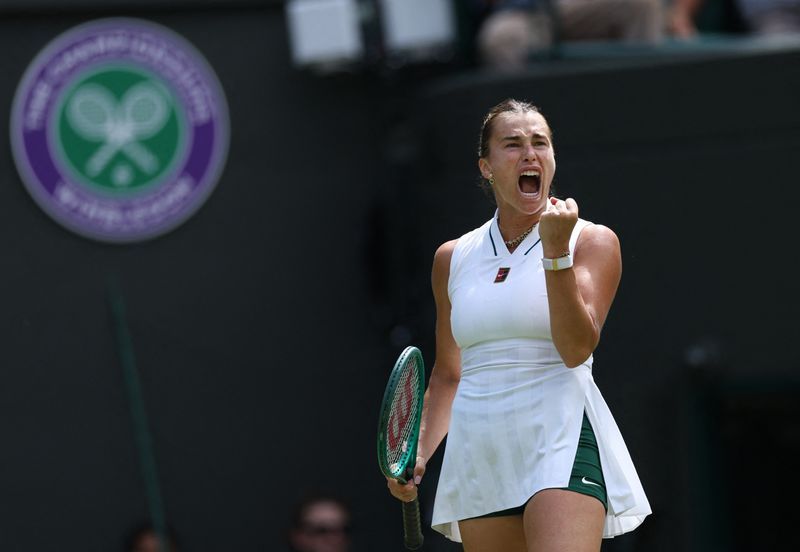
Aryna Sabalenka's uneasy relationship with Wimbledon's notoriously slippery turf surfaced once again on Wednesday as the Belarusian world number one narrowly escaped a major upset at the hands of American challenger McCartney Kessler, eventually prevailing 6-1 7-6(9) in the second round at the All England Club. The match provided a masterclass in both Sabalenka's destructive baseline power and her capacity to dig deep when facing elimination, as she ultimately converted her third match point after one hour and 39 minutes of compelling tennis to remain firmly on course for her first Grand Slam triumph on a surface other than hard courts.
Sabalenka appeared entirely in control through the opening set, dominating play with the kind of aggressive power that has made her a formidable force on the professional tour. The 26-year-old's comfort level during the first 24 minutes of the encounter, however, evaporated almost entirely once the second set commenced, revealing the vulnerability that has periodically haunted her grass-court campaigns. Her frustration became physically evident as she repeatedly slapped her thigh in exasperation following unforced errors, a visible manifestation of her mounting irritation at struggling to impose her usual rhythm on the unpredictable bounce of the Wimbledon grass.
Kessler, the only player to reach the second round without surrendering a single game in the opening round, capitalised ruthlessly on Sabalenka's apparent loss of rhythm. The American surged to a commanding 5-2 advantage in the second set, suddenly appearing as though she might force the match into a decisive third set and potentially engineer one of the tournament's most stunning results. Kessler's aggressive baseline game and willingness to take risks made her a genuinely troublesome opponent, and she subsequently held four separate opportunities to close out the set, reaching set point at 5-3 before twice more coming within a point in the subsequent tiebreak.
Yet each time Kessler approached the precipice of victory, Sabalenka's superior shot-making and accumulated experience proved decisive. The world number one's greater ability to generate pace and depth from the baseline gradually reasserted itself during the critical moments, allowing her to claw back into the tiebreak and ultimately claim victory at 9-7. This capacity to summon her best tennis when the stakes are highest represents one of Sabalenka's greatest strengths, though it also underscores a concerning pattern whereby she permits opponents back into matches rather than simply overwhelming them from start to finish.
For Malaysian and Southeast Asian tennis enthusiasts following the tournament, Sabalenka's narrow escape carries particular significance given her status as one of the tour's most dominant figures. Her struggles on grass have long been documented, particularly in comparison to her overwhelming dominance on hard courts where she has claimed multiple major titles. This match demonstrated that even world-ranked players face genuine peril at Wimbledon, where the unique surface conditions level the playing field and permit lesser-known competitors to engineer upsets against established stars.
Sabalenka's path forward presents an intriguing challenge as she prepares to face Latvia's Jelena Ostapenko in the third round. The veteran Ostapenko, a former French Open champion, brings her own brand of aggressive tennis and knows well how to navigate grass-court conditions. The prospect of another competitive encounter looms large, particularly if Sabalenka cannot resolve her consistency issues on this surface.
In her post-match comments, Sabalenka acknowledged both the quality of Kessler's performance and her own relief at advancing. "She really tested me today and I am super happy to pass the test," the relieved champion stated. "She played incredible and played super aggressive and it was really tough to handle the second set and I am glad to have powered through." Her words reflected genuine respect for Kessler's capabilities while simultaneously confirming her understanding that survival, rather than supremacy, had characterised her performance.
The match outcome raises broader questions about Sabalenka's grass-court prospects at major championships. While her hard-court credentials remain unassailable, her pattern of inconsistent performances on grass suggests she may never become the kind of complete player who dominates across all surfaces. However, tournaments like Wimbledon ultimately reward those with the resilience to overcome adversity, and Sabalenka's ability to find a way through when threatened demonstrates why she remains the bookmakers' choice to contend seriously for the title.
Kessler's performance, meanwhile, should not be overlooked despite the defeat. The American's ability to push the world number one to such brink, combined with her unbeaten record through the opening round, indicates she possesses the tools to become a significant force in women's tennis. For emerging players on the tour, particularly those from smaller tennis nations, Kessler's showing at Wimbledon provides an encouraging blueprint for how to compete effectively against established stars through aggressive tennis and unwavering determination.
As Sabalenka prepares for her encounter with Ostapenko, consolidating her grass-court technique will become increasingly important. The road to winning Wimbledon, as her match against Kessler graphically illustrated, will not be straightforward. With each round bringing sterner challenges and opponents who understand how to exploit conditions that level traditional hierarchies, Sabalenka's survival instincts will likely be tested repeatedly before she can claim her first grass-court major championship.

