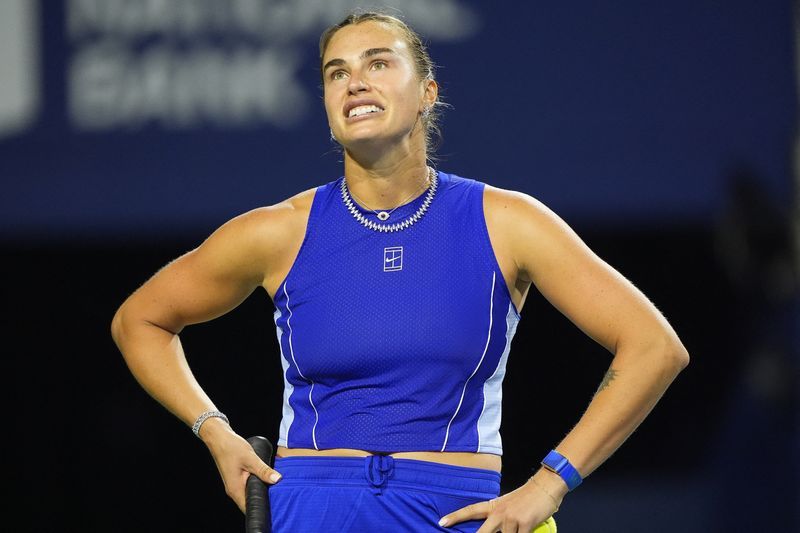
Aryna Sabalenka's carefully planned preparation for the U.S. Open has hit an unexpected obstacle after the world number one crashed out of the Canadian Open in Toronto on Saturday, succumbing to a determined performance from Russia's Ekaterina Alexandrova. The 16th-seeded Alexandrova prevailed 7-6(3) 4-6 6-4 in a gruelling encounter that stretched beyond two hours and forty minutes, denying the reigning U.S. Open champion a smooth passage towards Grand Slam success later this month.
For Sabalenka, the loss represents a significant interruption to her pre-tournament momentum. The Belarusian, who has captured four Grand Slam titles and most recently claimed the U.S. Open crown, came to Canada as a strong favourite but found herself unable to contain Alexandrova's relentless aggression across the course of the match. Having recovered from a set deficit to force the contest into a decisive third frame, Sabalenka appeared positioned to extend her dominance, yet the final set proved her undoing as unforced errors accumulated and the Russian's attacking tennis refused to relent.
The match itself unfolded as a compelling battle of contrasting approaches. Sabalenka established an early break in the opening set, showcasing the authoritative power that has become her hallmark on the professional circuit. However, Alexandrova proved resilient, clawing back into the set to force a tiebreak situation. The Russian seized this opportunity with conviction, winning the breaker 7-3 to claim the first set and signal her capacity to trouble the world's top-ranked player.
Sabalenka responded with characteristic assertiveness in the second set, taking control through a crucial break at 3-2 and subsequently holding serve to level the match. This recovery suggested the world number one was finding her rhythm and would likely impose her physical dominance in the decider. Yet Alexandrova's mental resilience prevented any such trajectory from materialising. The Russian remained composed despite the pressure of facing the sport's pre-eminent player, maintaining her aggressive approach and forcing Sabalenka into increasingly costly mistakes.
The decisive moment came when Sabalenka, serving to remain in the match at 4-5 down, managed to save two match points through sheer determination. However, the pressure proved too great when she committed a double fault on the third match point, handing Alexandrova the victory and a berth in the quarter-finals. For Sabalenka, this unforced error in a critical juncture encapsulated the mounting errors that characterised her display in the final set, a concerning sign as she prepares for Flushing Meadows.
Alexandrova's post-match commentary revealed the mental approach that carried her through this demanding contest. The Russian emphasised her point-by-point mentality, consciously avoiding fixation on the scoreline whilst focusing purely on executing aggressive tennis. She acknowledged her own surprise at securing victory, particularly given her impressions after the second set when she believed her chances had dissipated. Her willingness to maintain offensive intent despite being a set down, combined with her refusal to become paralysed by the magnitude of facing the world number one, proved decisive.
This victory positions Alexandrova for a quarter-final clash against Ukraine's Elina Svitolina, who dispatched American eighth seed Amanda Anisimova with a straightforward 6-2 6-4 victory. Svitolina's emphatic performance against Anisimova suggests she carries momentum into her matchup with Alexandrova, though the Russian will draw confidence from her demonstrated capacity to play at the highest level under pressure.
For Malaysian tennis enthusiasts and regional observers, Sabalenka's stumble carries broader implications for the U.S. Open's narrative arc. Her departure from Toronto eliminates the consensus favourite from that tournament's narrative, opening possibilities for alternative storylines and challenging the assumptions surrounding her Grand Slam invincibility. In an era where tennis has become increasingly unpredictable at the highest levels, Sabalenka's loss demonstrates that even supreme talents face vulnerability when opponents execute their game plans with precision and refuse to be intimidated.
The timing of Sabalenka's defeat is particularly significant given the proximity to the season's final Grand Slam. Typically, players use the hardcourt season leading into the U.S. Open to fine-tune their performance, build confidence, and identify technical adjustments required for success on Flushing Meadows' notorious fast courts. Sabalenka's early exit means she has less than a fortnight to address the defensive lapses and unforced errors that plagued her against Alexandrova. Whether this setback proves a mere blip or a harbinger of struggles to come will substantially influence the U.S. Open's competitive landscape.
Looking ahead, Alexandrova's triumph underscores the tournament's capacity to produce surprise results and reminds observers that seeding and world rankings, whilst important indicators of quality, do not determine outcomes on any given day. Her relentless court coverage, aggressive baseline play, and mental fortitude proved sufficient to overcome a superior-ranked opponent on grass-like hard courts. For Southeast Asian fans following the WTA circuit, this match exemplifies the tournament tennis that makes professional women's sport compelling—where preparation, execution, and psychological resilience converge to determine victory.

