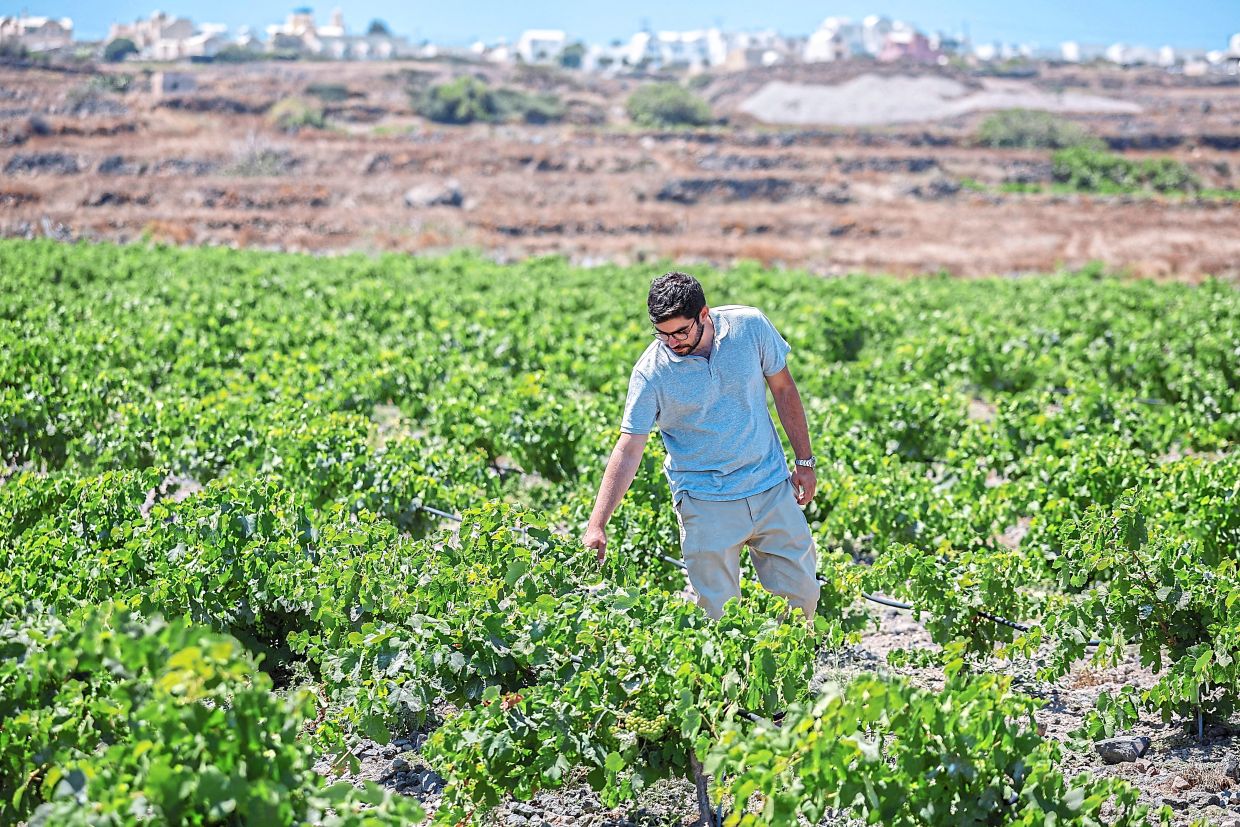
The Greek island of Santorini faces an existential threat to its famed wine industry as successive years of scorching temperatures and minimal rainfall have pushed the region's viticulture to a breaking point. The crisis became starkly visible in vineyards across the island, where ancient grapevines trained into the traditional basket-shaped "kouloura" configuration—designed to shield fruit from the punishing summer sun—have begun dying at alarming rates. One such vine, which had survived for nine decades through countless Mediterranean summers, finally succumbed to the combined pressure of heat and drought, symbolising a broader crisis affecting producers who have tended these islands' terroirs for generations. The environmental pressures have also triggered secondary economic shocks: grape prices have climbed significantly, overall wine production has contracted, and persistent concerns about water availability now loom over both agricultural and tourism sectors that depend on reliable supplies.
Yiannis Boutaris, a sixth-generation winemaker operating Domaine Sigalas—now part of the larger Kir-Yianni family of wineries—embodies the industry's determination to survive without sacrificing heritage. Rather than abandoning the viticultural practices his ancestors refined, Boutaris has begun testing a series of adaptive strategies in partnership with local authorities and university researchers. Most prominently, his team is piloting a wastewater recycling scheme that diverts treated effluent from residential buildings and hotels back into vineyard irrigation systems. This approach, already proven viable in California's drought-plagued wine regions, offers a fundamentally more sustainable and cost-effective alternative to relying on expensive desalination plants to supplement island water supplies. By repurposing water that would otherwise be discharged, Santorini's producers could maintain agricultural output while reducing the strain on the island's freshwater reserves—an increasingly critical consideration as climate patterns continue to shift.
Beyond wastewater management, Boutaris is testing structural changes to how vines are planted and arranged. Moving away from the scattered, traditional configuration toward ordered rows allows for more precise and efficient irrigation delivery, reducing both water consumption and the labour required to maintain individual plants. Simultaneously, his team is experimenting with atmospheric water harvesting technology, a technique that captures ambient moisture using hydrogels and then releases it as usable water through heating powered by solar panels. This approach taps into renewable energy sources while extracting water from an often-overlooked environmental reservoir, representing the kind of integrated thinking now essential for Mediterranean agriculture in an era of climatic instability.
Water scarcity on Santorini is not merely an agricultural matter but a symptom of intense competition for finite resources during the tourism season. When millions of visitors arrive on the island during warm months, hotels, swimming pools, restaurants, and farms simultaneously demand water supplies that the island's infrastructure struggles to provide. This competition grows more acute each year as temperature-driven evaporation accelerates and rainfall becomes more unpredictable. The contrast with mainland Greece underscores the island's particular vulnerability: while northern regions benefit from cooler climates and more reliable precipitation, allowing grape producers there to maintain competitive pricing at approximately €0.80 per kilogram, Santorini's growers face exponentially higher input costs and lower yields.
The severity of recent climatic shifts has not gone unnoticed by the scientific community studying Greek viticulture. Stefanos Koundouras, a viticulture professor at Aristotle University in Thessaloniki, has documented that temperatures in 2023 and 2024 reached their highest levels in six decades, fundamentally disrupting the delicate environmental conditions that have defined Santorini's wine character for centuries. Beyond mere quantity losses, quality degradation now threatens the island's reputation for premium wines. Koundouras warns that if current warming and drying trends persist across southern Europe and the Mediterranean basin, the economic viability of wine production throughout the region could deteriorate significantly, potentially reshaping European viticulture as producers either relocate to cooler zones or abandon cultivation entirely.
Other local producers are adopting similarly innovative approaches. Winemaker Yiannis Papaeconomou, who operates younger vineyards now in their sixth year of production, is participating in the wastewater recycling initiative while simultaneously implementing subsurface irrigation systems that deliver water directly beneath the soil rather than to the plant's upper surfaces. This technique dramatically reduces evaporation losses—a critical advantage in an environment where summer heat can cause half the water applied to traditional overhead systems to evaporate before reaching root zones. Papaeconomou has also modified his trellising systems to optimise water efficiency, allowing more targeted and economical hydration schedules that maintain vine health while consuming less of the island's stressed water supplies.
The broader crisis facing Santorini's wine industry reflects larger patterns emerging across Mediterranean agriculture as climate change accelerates. Islands and regions dependent on stable rainfall patterns and moderate summer temperatures face unprecedented challenges to their traditional agricultural identities and economic models. The solutions being tested—wastewater recycling, precision irrigation, renewable-powered water capture, and restructured cultivation methods—represent not a abandonment of viticultural heritage but rather its reimagining in response to radically altered environmental conditions. These adaptations require substantial capital investment, technical expertise, and collaboration between private operators and public institutions, making them accessible primarily to established producers with sufficient resources.
For Malaysia and Southeast Asia, Santorini's struggle offers instructive parallels and warnings. The region's agricultural sectors similarly depend on predictable monsoon patterns and established water management systems that climate change is destabilising. Palm oil, rubber, rice, and cocoa producers across the region will increasingly confront the types of challenges now forcing Santorini's winemakers to innovate rapidly. The Greek experience demonstrates both the necessity of adaptation and the complexity of maintaining agricultural sustainability as environmental baselines shift. Water-use efficiency, alternative supply sources, and technology integration may become as essential to tropical agriculture as they have become to Mediterranean viticulture.
The philosophical stance adopted by Boutaris and Papaeconomou—that tradition and adaptation need not be mutually exclusive—carries weight beyond wine production. Both men emphasise that modernising practices to address contemporary environmental realities need not mean abandoning the cultural and technical knowledge accumulated over generations. Instead, ancestral understanding of viticulture can be combined with contemporary technology and scientific insight to create hybrid systems capable of functioning under new conditions. This integration of tradition and innovation may offer a template for how other agricultural communities facing climate pressures might approach their own crises—not through wholesale replacement of established practices, but through thoughtful evolution that preserves cultural identity while embracing necessary change.

