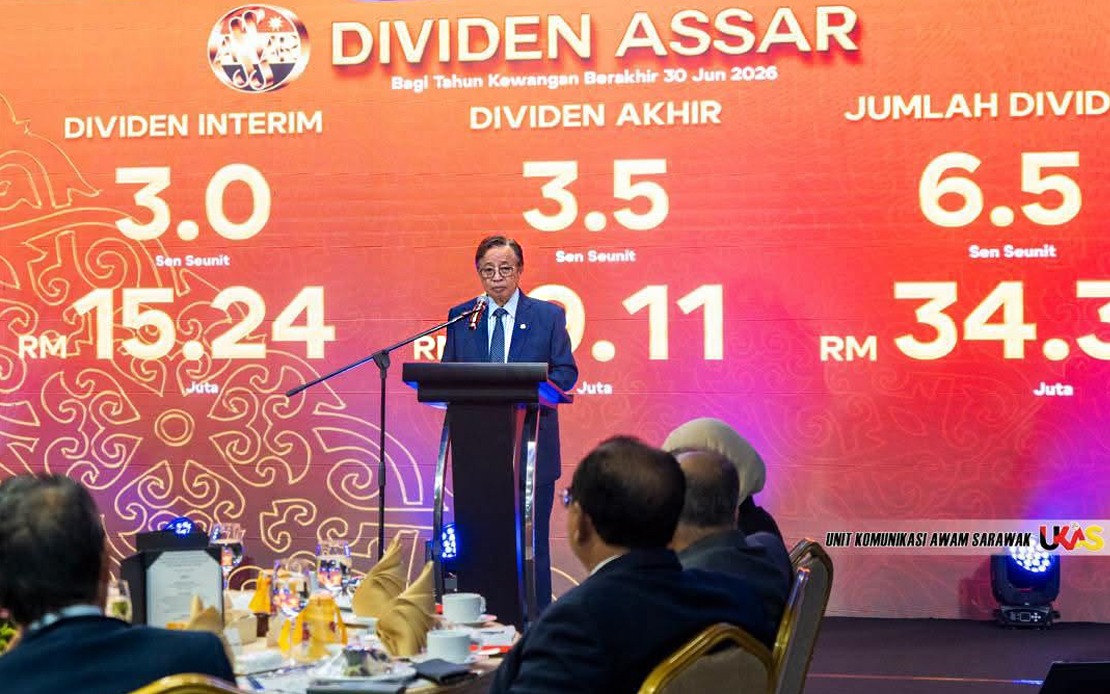
The Sarawak state government is examining the possibility of broadening access to its Amanah Saham Sarawak (ASSAR) investment scheme beyond the Bumiputera community through the creation of a parallel fund structure, marking a potential shift towards more inclusive economic participation in the state. Premier Tan Sri Abang Johari Tun Openg announced the proposal following the ASSAR Dividend Announcement ceremony for the financial year ending June 30, 2026, signalling the government's intention to evaluate how investment opportunities can be extended more widely across Sarawak's diverse population.
Under the current ASSAR framework, participation has been restricted to members of the Bumiputera community, maintaining the state's longstanding policy of targeted investment vehicles for indigenous Malays and bumiputera groups. However, the proposed ASSAR 2 initiative would create a separate investment channel designed specifically to accommodate non-Bumiputera Sarawakians, effectively doubling the reach of the state's savings and investment programme. The structural separation would allow each fund to operate under parameters suited to its respective community while maintaining the core philosophy behind the original ASSAR scheme.
Abang Johari emphasised that the expansion strategy reflects a deliberate policy direction towards inclusive economic development, a positioning that carries significant implications for how Sarawak approaches capital accumulation and wealth-building across all citizen groups. By establishing two distinct investment avenues rather than merging communities into a single fund, the government aims to preserve the integrity of existing Bumiputera provisions while simultaneously creating fresh pathways for non-Bumiputera participation in the state's investment landscape. This dual-track approach mirrors similar models employed elsewhere in Malaysia's corporate landscape, providing a tested framework for balancing communal interests with broader economic inclusion.
The proposal will require thorough scrutiny from ASSAR's board of directors and management teams, with feasibility assessments drawing comparative analysis from Permodalan Nasional Berhad (PNB), Malaysia's largest state-owned investment company. PNB's experience managing multiple fund categories serving different demographic segments provides a relevant precedent for how such expansion might function operationally and comply with regulatory requirements. The examination process is expected to address governance structures, investment allocation strategies, fund management costs, and dividend distribution mechanisms to ensure ASSAR 2 operates efficiently while maintaining the rigorous standards established by the original scheme.
From an economic perspective, the expansion carries substantial potential benefits for Sarawak's capital-raising objectives and investment ecosystem development. By tapping into the savings pools of non-Bumiputera communities—a segment with considerable purchasing power and accumulated capital—the state government could significantly increase the volume of domestically-sourced investment funds available for channeling into priority sectors. This expanded funding base would strengthen Sarawak's ability to finance infrastructure projects, support business development, and accelerate economic diversification initiatives currently underway across the state.
The timing of this proposal reflects Sarawak's broader economic momentum, with Abang Johari specifically highlighting the state's strong economic performance as a foundation for expanded investment participation. Creating additional channels for wealth accumulation among non-Bumiputera communities would theoretically enhance overall economic resilience by broadening the base of citizens with direct financial stakes in the state's prosperity. Such stakeholder expansion often correlates with increased political and social cohesion, as investment participation tends to align individual financial interests with broader state development objectives.
For Malaysian investors and business observers, the Sarawak proposal signals a potentially significant evolution in how the country's state-level governments conceptualise investment inclusion and community economic participation. While Bumiputera protections remain constitutionally enshrined and politically significant, the willingness to create parallel structures rather than consolidate communities suggests growing recognition that expansion of investment opportunities need not necessitate dismantling existing protections. This nuanced approach to balancing equity and inclusion may influence how other Malaysian states contemplate their own investment schemes and community engagement strategies.
The regulatory environment for ASSAR 2 will require careful navigation, particularly regarding Securities Commission oversight and compliance with the Capital Markets and Services Act. The fund structure must satisfy requirements for investor protection, transparent operation, and prudent asset management regardless of which community it serves. Early coordination between Sarawak's financial authorities and federal regulators will likely prove essential to ensuring seamless establishment and operation of the new fund category, particularly if ASSAR 2 eventually seeks to diversify its investment portfolio across markets beyond Sarawak itself.
The proposal also addresses demographic and social considerations specific to Sarawak's composition, where non-Bumiputera communities represent a substantial and economically engaged population segment. Creating dedicated investment vehicles for this group acknowledges both their economic contribution to the state and their desire for structured, professionally-managed investment opportunities with governance standards comparable to mainstream schemes. Such recognition can enhance social cohesion by ensuring that investment inclusion does not create perceptions of unequal treatment or marginalisation within the broader economic framework.
While the announcement indicates serious governmental intent, several implementation questions remain unresolved pending board review and feasibility assessment. Key considerations include minimum investment thresholds, expected dividend distribution patterns, fund management fee structures, and any special provisions for dividend reinvestment or withdrawal policies. The government will need to clarify whether ASSAR 2 will maintain investment allocations primarily within Sarawak or permit geographic diversification, as this decision carries implications for the fund's risk profile and return potential.
The investment landscape across Southeast Asia increasingly reflects tension between preserving community-specific protections and expanding participation opportunities, making Sarawak's approach particularly relevant for regional observers. If successfully implemented, ASSAR 2 could demonstrate how post-colonial constitutional provisions can coexist with progressive inclusion policies, potentially offering a model worthy of consideration in other Malaysian states confronting similar policy balancing exercises.
Longer-term success of ASSAR 2 will ultimately depend on competitive returns relative to alternative investment options, professional fund management that instils investor confidence, and clear communication regarding how proceeds support Sarawak's development priorities. The government's decision to ground this proposal in demonstrated economic growth suggests confidence in delivering attractive investment opportunities, an assertion that will require validation through transparent performance metrics and regular stakeholder reporting once implementation commences.

