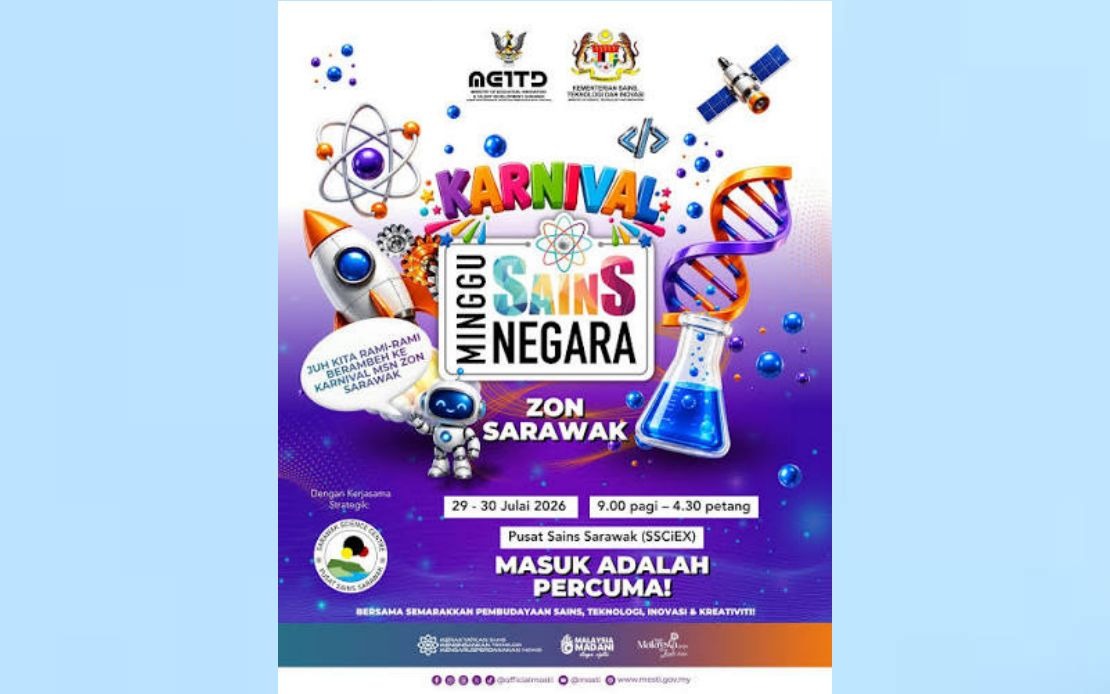
The Ministry of Science, Technology and Innovation formally inaugurated the National Science Week Carnival 2026 for the Sarawak Zone in Kuching on July 30, marking an ambitious effort to democratise access to science and technology learning across the state's diverse geography. The event, hosted at the Sarawak Science Centre and officially opened by Sarawak's Minister of Education, Innovation and Talent Development Datuk Seri Roland Sagah Wee Inn, represents a strategic pivot towards ensuring that scientific curiosity and technological advancement are not confined to urban centres but actively cultivated in Malaysia's interior and remote regions.
The centrepiece of this year's initiative is its explicit commitment to overcoming geographical barriers that have historically limited STEM education access in rural Malaysia. Rather than concentrating programming in major towns, the carnival framework deliberately targets underserved districts including Meradong, Bintulu and Belaga, where schools often lack exposure to cutting-edge scientific demonstrations and hands-on technology activities. This geographical approach aligns with Malaysia's broader developmental aspirations, recognising that technological literacy among youth in all regions strengthens national competitiveness and creates more equitable pathways for future careers in high-value sectors.
Central to the carnival's mechanics is the STEM Catalysts Programme, which deploys trained educators and interactive exhibits directly to rural schools throughout Sarawak. The programme functions as a mobile ecosystem designed to demystify science and engineering concepts through practical, observable demonstrations rather than textbook abstractions. By bringing interactive learning experiences to students where they live, the initiative sidesteps the logistical and financial barriers that prevent many rural families from attending centralised science fairs, thereby reaching cohorts who might otherwise remain disconnected from STEM pathways during formative educational years.
Ministry secretary-general Datuk Dr Nagulendran Kangayatkarasu articulated the governmental philosophy underpinning the carnival, framing it as a cornerstone policy initiative aimed at embedding innovation into Malaysian culture at foundational levels. His remarks emphasised that fostering a technology-literate generation requires sustained, systemic intervention beginning in primary and secondary schools, particularly in communities where science infrastructure and qualified mentors are scarce. This framing acknowledges that cultural shifts toward innovation demand more than infrastructure investment; they require deliberate cultivation of mindsets and capabilities among young people across all demographic strata.
Among the carnival's notable features is its nuclear technology advocacy component, which introduces an underexplored frontier in Malaysia's public science discourse. By featuring nuclear applications at a carnival aimed at school-age participants and broader communities, MOSTI is attempting to reshape perceptions of nuclear energy from an abstract or potentially controversial technology into a practical, demonstrable solution with real-world applications. This educational framing is particularly significant given Malaysia's ongoing energy transition debates and the strategic importance of diverse, low-carbon energy sources in regional development planning. Normalising nuclear technology knowledge among younger demographics may gradually shift societal attitudes toward options that policymakers increasingly view as essential for sustainable growth.
Complementing the physical carnival experience is the sainsrakyat.my citizen science portal, a digital platform that extends participation beyond the two-day event into an ongoing mechanism for public engagement with scientific research. The platform's architecture invites community members—from schoolchildren to farmers to Indigenous knowledge holders—to contribute real-world observational data that informs research projects addressing tangible local challenges. This approach recognises that rural and interior communities possess valuable environmental, agricultural, and social data that, when systematised and analysed, can drive evidence-based solutions tailored to regional contexts rather than generic national prescriptions.
The citizen science model holds particular resonance for Sarawak and Southeast Asian nations more broadly, where biodiversity, agricultural systems, and climate patterns exhibit significant regional variation. By positioning rural communities as active participants in knowledge generation rather than passive recipients of externally designed solutions, the platform cultivates both scientific engagement and institutional trust. Residents who contribute meaningful data experience direct stakes in research outcomes, potentially strengthening community investment in implementing findings that improve livelihoods or environmental stewardship.
From a developmental perspective, the carnival's emphasis on technology literacy in rural areas directly addresses skills gaps that constrain economic mobility in interior communities. As Malaysia and the region transition toward higher-value, technology-dependent sectors, residents of remote areas without foundational STEM exposure face escalating disadvantages in labour market competition. Early and sustained science engagement beginning in primary school creates pipelines that can eventually feed qualified candidates from underrepresented regions into technical vocations, professional training, and innovation-driven industries.
The Sarawak launch also signals a broader federal commitment to regional inclusivity in national innovation frameworks. Sarawak's size, population distribution, and developmental challenges make it a crucial testing ground for scalable models that can subsequently be adapted across Peninsular Malaysia and other East Malaysian states. Lessons learned regarding programme delivery, community reception, and measurable learning outcomes in Sarawak provide templates and evidence for replicating similar initiatives elsewhere, potentially creating network effects across the federation.
Looking forward, the success of the National Science Week Carnival hinges on sustained resource allocation, teacher training, and institutional coordination among MOSTI, state education ministries, and local authorities. One-off carnivals, however well-designed, produce lasting impact only when embedded within continuous school curricula and supported by qualified educators capable of sustaining momentum between carnival visits. The inclusion of the digital citizen science platform suggests an intent to maintain engagement beyond the event itself, though translating participation into meaningful learning outcomes requires complementary investments in digital literacy and technical support infrastructure.
For Malaysian policymakers and regional observers, the Sarawak initiative exemplifies how science diplomacy and educational outreach can simultaneously advance national development objectives and democratise access to opportunity. The carnival's rural focus implicitly acknowledges that innovation cultures flourish only when nurtured across entire populations, not merely elite segments concentrated in major urban zones. In an era where technological capability increasingly determines economic trajectories and regional competitiveness, ensuring that young people in Meradong, Bintulu, Belaga and similar communities possess foundational STEM knowledge and confidence represents a strategic investment in inclusive, sustainable national advancement.

